
!['Collections of travels through Turky into Persia, and the East Indies. Giving an account of the present state of those countries, as also a full relation of the five years wars, between Aureng-Zebe and his brothers in their father's life time, about the succession. And a voyage made by the Great Mogul (Aureng-Zebe) with his Army from Dehli to Lahor, from Lahor to Bember, and from thence to the Kingdom of Kachemire, by the Mogols, call'd, the Paradise of the Indies. Together with a relation of the Kingdom of Japan and Tunkin, and of their particular manners and trade. To which is added a new description of the Grand Seignior's Seraglio, and also of all the Kingdoms that encompass the Euxine and Caspian Seas, being the travels of Monsieur TavernierBernier, and other great men.' [‎173] (214/1024)](https://iiif.qdl.qa/iiif/images/81055/vdc_100023560208.0x000001/567.i.19._0214.jp2/full/!1200,1200/0/default.jpg "'Collections of travels through Turky into Persia, and the East Indies. Giving an account of the present state of those countries, as also a full relation of the five years wars, between Aureng-Zebe and his brothers in their father's life time, about the succession. And a voyage made by the Great Mogul (Aureng-Zebe) with his Army from Dehli to Lahor, from Lahor to Bember, and from thence to the Kingdom of Kachemire, by the Mogols, call'd, the Paradise of the Indies. Together with a relation of the Kingdom of Japan and Tunkin, and of their particular manners and trade. To which is added a new description of the Grand Seignior's Seraglio, and also of all the Kingdoms that encompass the Euxine and Caspian Seas, being the travels of Monsieur TavernierBernier, and other great men.' [‎173] (214/1024)")
'Collections of travels through Turky into Persia, and the East Indies. Giving an account of the present state of those countries, as also a full relation of the five years wars, between Aureng-Zebe and his brothers in their father's life time, about the succession. And a voyage made by the Great Mogul (Aureng-Zebe) with his Army from Dehli to Lahor, from Lahor to Bember, and from thence to the Kingdom of Kachemire, by the Mogols, call'd, the Paradise of the Indies. Together with a relation of the Kingdom of Japan and Tunkin, and of their particular manners and trade. To which is added a new description of the Grand Seignior's Seraglio, and also of all the Kingdoms that encompass the Euxine and Caspian Seas, being the travels of Monsieur TavernierBernier, and other great men.' [173] (214/1024)
The record is made up of 1 volume (898 pages). It was created in 1684. It was written in English. The original is part of the British Library: Printed Collections.
Transcription
This transcription is created automatically. It may contain errors.
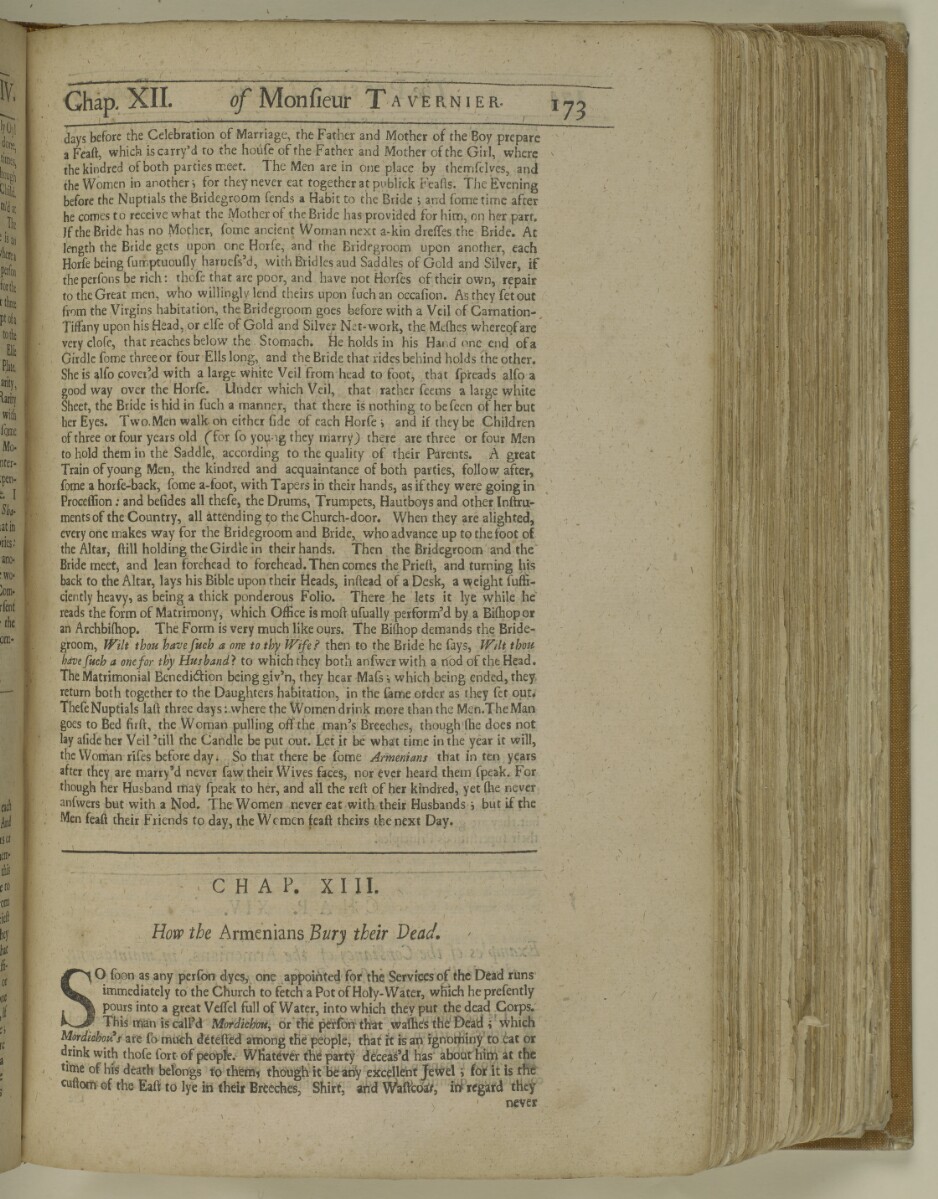
Chap. XII. of Monfieur T A VERNIER.
days before the Celebration of Marriage, the Father and Mother of the Boy prepare
a Feaft, which iscarry’d to the houfe of the Father and Mother of the Girl, where
the kindred of both parties meet. The Men are in one place by themfelves, and
the Women in another) for they never eat together at publrck Ftafts. The Evening
before the Nuptials the Bridegroom fends a Habit to the Bride > and fotne time after
he comes to receive what the Mother of the Bride has provided for him, on her part.
If the Bride has no Mother, fome ancient Woman next a*kin dreffes the Bride. At
length the Bride gets upon one Horfe, and the Bridegroom upon another, each
Horfe being fumptuoufly harnefs’d, with Bridles aud Saddles of Gold and Silver, if
the perfons be rich: thofe that are poor, and have not Tories of their own, repair
to the Great men, who willingly lend theirs upon fuchan occafion. As they fetout
from the Virgins habitation, the Bridegroom goes before with a Veil of Carnation-
Tiffany upon his Head, or elfe of Gold and Silver Net-work, the Mcfhes whereof are
veryclofe, that reaches below the Stomach. ^Ie holds in his Hand one end of a
Girdle fome three or four Ells long, and the Bride that rides behind holds the other.
She is alfo cover’d with a large white Veil from head to foot, that fpreads alfo a
good way over the Horfe. Under which Veil, that rather feems a large white
Sheet, the Bride is hid in fuch a manner, that there is nothing to befeen of her but
her Eyes. Two.Men walk on either fide of each Horfe > and if they be Children
of three or four years old ("for fo yotmg they marry) there are three or four Men
to hold them in the Saddle, according to the quality of their Parents. A great
Train ofyoung Men, the kindred and acquaintance of both parties, follow after,
fome a horfe-back, fome a-foot, with Tapers in their hands, as if they were going in
Proceffion; and befides all thefe, the Drums, Trumpets, Hautboys and other Inftm-
mentsof the Country, all Attending to the Church-door. When they are alighted,
everyone makes way for the Bridegroom and Bride, who advance up to the foot of
the Altar, (fill holding the Girdle in their hands. Then the Bridegroom and the
Bride meet, and lean forehead to forehead. Then comes the Pried, and turning his
back to the Altar, lays his Bible upon their Heads, infiead of a Desk, a weight fuffi-
ciently heavy, as being a thick ponderous Folio. There he lets it lye while he
reads the form of Matrimony, which Office is mod ufually perform’d by a Bidiopor
an Archbiffiop. The Form is very much like ours. The Bidiop demands the Bride
groom, IFilt thou have fuch a one to thy Wife? then to the Bride he fays, Wilt thou
hive fuch a one for thy Husband} to which they both anfwcr with a rlod of the Head.
The Matrimonial Benediction being giv’n, they hear Mafs, which being ended, they
return both together to the Daughters habitation, in the fame order as they fet out*
Thefe Nuptials lad three days: where the Women drink more than the Men.TheMan
goes to Bed fird, the Woman pulling off the man’s Breeches, though die does not
lay afide her Veil ’till the Candle be put out. Let it be what time in the year it will,
the Woman rifes before day. So that there be fome Armenians that in ten years
after they are marry’d never faw their Wives faces, nor ever heard them fpeak. For
though her Husband may fpeak to her, and all the red of her kindred, yet die never
anfwers but with a Nod. The Women never eat with their Husbands , but if the
Men fead their Friends to day, the Women fead theirs the next Day.
; C H A P. XIII.
How the Armenians Bury their Dead.
S O (bon as any perfon dyes, one appointed for the Services of the Dead runs
immediately to the Church to fetch a Pot of Holy-Water, which he prefently
pours into a great Veffel full of Water, into which they put the dead Corps.
This man is call’d Mordichou^ or the perfon that wadies the Dead i which
Mordichoits are fo much deteded among the people, that it is an rgnotiiiny to eat or
drink with thofe fort of people. Whatever the party deceas’d has about him at the
fime of his death belongs to therm though it be any excellent Jewel v for it is the
euftom of the Ead to lye in their Breeches, Shirt, and WadcoaV, regard they
- never
About this item
- Content
Collections of travels through Turky into Persia, and the East Indies. Giving an account of the present state of those countries, as also a full relation of the five years wars, between Aureng-Zebe and his brothers in their father's life time, about the succession. And a voyage made by the Great Mogul (Aureng-Zebe) with his Army from Dehli to Lahor, from Lahor to Bember, and from thence to the Kingdom of Kachemire, by the Mogols, call'd, the Paradise of the Indies. Together with a relation of the Kingdom of Japan and Tunkin, and of their particular manners and trade. To which is added a new description of the Grand Seignior's Seraglio, and also of all the Kingdoms that encompass the Euxine and Caspian Seas, being the travels of Monsieur TavernierBernier, and other great men.
Author: John-Baptist Tavernier
Publication details: Printed for Moses Pitt at the Angel in St Paul's Churchyard, MDCLXXXIV [1864].
Physical description: Pagination. Vol. 1: [18], 184, 195-264, [2]; [2], 214; [6], 94, [6], 101-113, [1] p., [23] leaves of plates (1 folded). Vol. 2: [8], 154; [12], 14, [2], 15-46, 47-87, [3]; 66 p., [10] leaves of plates (2 folded).
Misprinted page numbers. Vol. 1, part I: 176 instead of 169; 169 instead of 176; 201 instead of 209; 202 instead of 210. Vol. 1, part II: 56 instead of 58; 61 instead of 63; 178 instead of 187. Vol. 1, part III: 13 instead of 30; 49 instead of 48. Vol. 2, part II: 93 instead of 39.
- Extent and format
- 1 volume (898 pages)
- Arrangement
The volume contains a table of contents giving chapter headings and page references which covers all four books within the volume. There is also a list of illustrations giving titles anf page references. There is an alphabetic index at the end of Books I and II and a separate alphabetic index of place names which accompanies the map at the beginning of book IV.
- Physical characteristics
Dimensions: 306 x 200mm
- Written in
- English in Latin script View the complete information for this record
Use and share this item
- Share this item
'Collections of travels through Turky into Persia, and the East Indies. Giving an account of the present state of those countries, as also a full relation of the five years wars, between Aureng-Zebe and his brothers in their father's life time, about the succession. And a voyage made by the Great Mogul (Aureng-Zebe) with his Army from Dehli to Lahor, from Lahor to Bember, and from thence to the Kingdom of Kachemire, by the Mogols, call'd, the Paradise of the Indies. Together with a relation of the Kingdom of Japan and Tunkin, and of their particular manners and trade. To which is added a new description of the Grand Seignior's Seraglio, and also of all the Kingdoms that encompass the Euxine and Caspian Seas, being the travels of Monsieur TavernierBernier, and other great men.' [173] (214/1024), British Library: Printed Collections, 567.i.19., in Qatar Digital Library <https://www.qdl.qa/archive/81055/vdc_100026187078.0x00000f> [accessed 22 June 2026]
https://www.qdl.qa/en/archive/81055/vdc_100026187078.0x00000f
Copy and paste the code below into your web page where you would like to embed the image.
<meta charset="utf-8"><a href="https://www.qdl.qa/en/archive/81055/vdc_100026187078.0x00000f">'Collections of travels through Turky into Persia, and the East Indies. Giving an account of the present state of those countries, as also a full relation of the five years wars, between Aureng-Zebe and his brothers in their father's life time, about the succession. And a voyage made by the Great Mogul (Aureng-Zebe) with his Army from Dehli to Lahor, from Lahor to Bember, and from thence to the Kingdom of Kachemire, by the Mogols, call'd, the Paradise of the Indies. Together with a relation of the Kingdom of Japan and Tunkin, and of their particular manners and trade. To which is added a new description of the Grand Seignior's Seraglio, and also of all the Kingdoms that encompass the Euxine and Caspian Seas, being the travels of Monsieur TavernierBernier, and other great men.' [‎173] (214/1024)</a> <a href="https://www.qdl.qa/en/archive/81055/vdc_100026187078.0x00000f"> <img src="https://iiif.qdl.qa/iiif/images/81055/vdc_100023560208.0x000001/567.i.19._0214.jp2/full/!280,240/0/default.jpg" alt="" /> </a>
This record has a IIIF manifest available as follows. If you have a compatible viewer you can drag the icon to load it.https://www.qdl.qa/en/iiif/81055/vdc_100023560208.0x000001/manifestOpen in Universal viewerOpen in Mirador viewerMore options for embedding images
Copyright: How to use this content
- Reference
- 567.i.19.
- Title
- 'Collections of travels through Turky into Persia, and the East Indies. Giving an account of the present state of those countries, as also a full relation of the five years wars, between Aureng-Zebe and his brothers in their father's life time, about the succession. And a voyage made by the Great Mogul (Aureng-Zebe) with his Army from Dehli to Lahor, from Lahor to Bember, and from thence to the Kingdom of Kachemire, by the Mogols, call'd, the Paradise of the Indies. Together with a relation of the Kingdom of Japan and Tunkin, and of their particular manners and trade. To which is added a new description of the Grand Seignior's Seraglio, and also of all the Kingdoms that encompass the Euxine and Caspian Seas, being the travels of Monsieur TavernierBernier, and other great men.'
- Pages
- front, back, spine, edge, head, tail, front-i, i-r:ii-v, 1:18, 1:12, 12a:12b, 13:14, 14a:14b, 15:50, 50a:50b, 51:56, 56a:56b, 57:86, 86a:86b, 87:128, 128a:128b, 129:178, 178a:178b, 179:184, 195:256, 256a:256b, 257:258, 258a:258b, 259:264, iii-r:iv-v, 1:2, 2a:2b, 3:4, 4a:4b, 5:6, 6a:6b, 7:8, 8a:8b, 9:10, 10a:10b, 11:12, 12a:12b, 13:14, 14a:14b, 15:148, 148a:148d, 149:150, 150a:150b, 151:152, 152a:152b, 153:166, 166a:166b, 167:214, 1:6, 1:114, 1:8, 1:154, 1:18, 1:14, 14a:14f, 15:16, 16a:16b, 17:22, 22a:22b, 23:46, 46a:46h, 47:52, 52a:52b, 53:92, 1:66, v-r:v-v, back-i
- Author
- Tavernier, Jean-Baptiste, 1605-1689--Travel
- Usage terms
- Public Domain
- Reference
- 567.i.19.
- Title
- 'Collections of travels through Turky into Persia, and the East Indies. Giving an account of the present state of those countries, as also a full relation of the five years wars, between Aureng-Zebe and his brothers in their father's life time, about the succession. And a voyage made by the Great Mogul (Aureng-Zebe) with his Army from Dehli to Lahor, from Lahor to Bember, and from thence to the Kingdom of Kachemire, by the Mogols, call'd, the Paradise of the Indies. Together with a relation of the Kingdom of Japan and Tunkin, and of their particular manners and trade. To which is added a new description of the Grand Seignior's Seraglio, and also of all the Kingdoms that encompass the Euxine and Caspian Seas, being the travels of Monsieur TavernierBernier, and other great men.'
- Pages
- front, back, spine, edge, head, tail, front-i, i-r:ii-v, 1:18, 1:12, 12a:12b, 13:14, 14a:14b, 15:50, 50a:50b, 51:56, 56a:56b, 57:86, 86a:86b, 87:128, 128a:128b, 129:178, 178a:178b, 179:184, 195:256, 256a:256b, 257:258, 258a:258b, 259:264, iii-r:iv-v, 1:2, 2a:2b, 3:4, 4a:4b, 5:6, 6a:6b, 7:8, 8a:8b, 9:10, 10a:10b, 11:12, 12a:12b, 13:14, 14a:14b, 15:148, 148a:148d, 149:150, 150a:150b, 151:152, 152a:152b, 153:166, 166a:166b, 167:214, 1:6, 1:114, 1:8, 1:154, 1:18, 1:14, 14a:14f, 15:16, 16a:16b, 17:22, 22a:22b, 23:46, 46a:46h, 47:52, 52a:52b, 53:92, 1:66, v-r:v-v, back-i
- Author
- Tavernier, Jean-Baptiste, 1605-1689--Travel
- Usage terms
- Public Domain