
![Scrapbook of newspaper cuttings about Afghanistan [‎110r] (225/312)](https://iiif.qdl.qa/iiif/images/81055/vdc_100000001524.0x0003a3/Mss Eur F126_24_0281.jp2/full/!1200,1200/0/default.jpg "Scrapbook of newspaper cuttings about Afghanistan [‎110r] (225/312)")
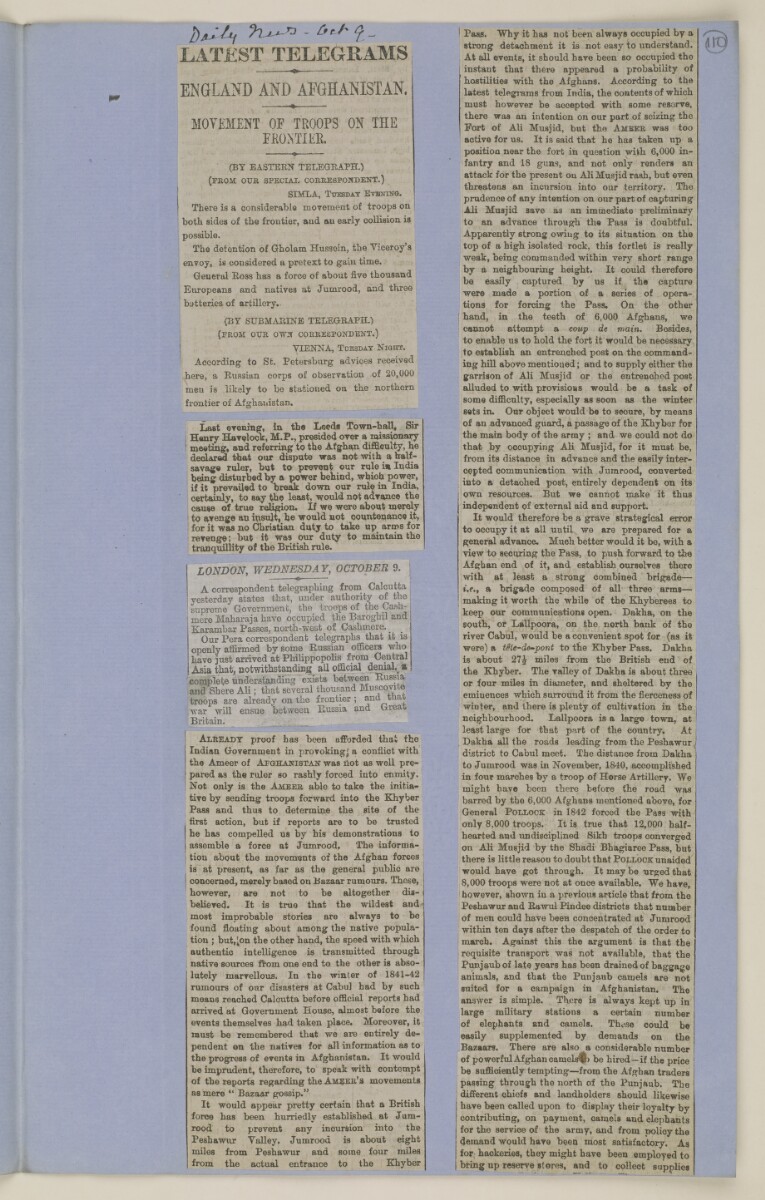
Scrapbook of newspaper cuttings about Afghanistan [110r] (225/312)
The record is made up of 1 volume (150 folios). It was created in 07 Sep 1878-19 Oct 1878. It was written in English. The original is part of the British Library: India Office The department of the British Government to which the Government of India reported between 1858 and 1947. The successor to the Court of Directors. Records and Private Papers Documents collected in a private capacity. .
Transcription
This transcription is created automatically. It may contain errors.
/V/A - 6^9-
LATEST TELEGRAMS
ENGLAND AND AFGHANISTAN.
MOTKMENT OF TROOPS ON THE
FRONTIEE.
(BY EASTERN TELEGRAPH.)
(from: our special correspondent.)
SIMLA, T TTKSDAT E TBOTNG.
There is a considerable moTement of troops ou i
both sides of the frontier, aud an early collision is
possible.
The detention of Gholam Hussein, the Yiceroy's
envoy, is considered a pretext to gain time.
General lioss has a force of about five thousand
Europeans and natives at Jumrood, and three
batteries of artillery..
(BY SUBMARINE TELEGRAPH.)
(from otjr own correspondent.)
VIENNA, Tuesday. Night.
According to St. Petersburg advices received
here, a Russian corps of observation of 20,000
men is likely to bo stationed on the northern
frontier of Afghanistan.
Last evening, In the Leeds Town-hall, Sir
Henry Havelock, M.P., presided over a missionary
! meeting, and referring to the Afghan difficulty, he
declared that our dispute was not with a half-
savage ruler, but to prevent our rule i« India
being disturbed by a power benind, which power,
if it prevailed to break down our rule in India,
certainly, to say the least, would not advance the
cause of true religion. If we were about merely
to avenge an insult, he would not countenance it,
for it was no Christian duty to take up arins for
revenge; but it was our duty to maintain the
tranquillity of the British rule.
LONDON, WED NESDAY , OCTOBER 9. :
A correspondent telegraphing from Calcutta
yesterday states that, under authority of the;
supreme Government, the^ troops of the Cash-
I mere Maharaja have occupied the Baroghil and
Kaxambar Passes, north-west of Cashmere. _ _
Our Pera correspondent telegraphs that it is
openly affirmed by some Russian officers who
have just arrived at Philippopolis from Central
Asia that ; notwithstanding all official deniah «
complete understanding exists between Russia
and Shere Ali; that several thousand Muscovite
troops are already on the frontier ; and that
war will ensue between Russia and Great
Britain.
A lready proof has been afforded that the
Indian Government in provoking^ a conflict with
the Ameer of A fghanistan was not as well pre
pared as the ruler so rashly forced into enmity.
Not only is the A meer able to take the initia
tive by sending troops forward into the Khyber
Pass and thus to determine the site of the
: first action, but if reports are to be trusted
he has compelled us by his demonstrations to
assemble a force at Jumrood, The informa-
I tion about the movements of the Afghan forces
is at present, as far as the general public are
| concerned, merely based on Bazaar rumours. These,
however, are not to be altogether dis-
believecj. It is true that the wildest and
most improbable stories are always to be
found floating about among the native popula
tion ; button the other hand, the speed with which
authentic intelligence is transmitted through
native sources ftom one end to the other is abso
lutely marvellous. In the -winter of 1841-42
rumours of our disasters at Cabul had by such
means reached Calcutta before official reports had
arrived at Government House, almost before the
events themselves had taken place. Moreover, it
must be remembered that we are eutirely de
pendent on the natives for all information as to
the progress of events in Afghanistan. It would
be imprudent, therefore, to speak with contempt
of the reports regarding the A meer's movements
as mere " Bazaar gossip."
It would appear pretty certain that a British
force has been hurriedly established at Jum
rood to prevent any incursion into the
Peshawur Valley. Jumrood is about eight
miles from Peshawur and some four miles
from the actual entrance to the Khyber
' Pass. Why it has not been always occupied by a
strong detachment it is not easy to understand.
At all events, it should have been so occupied the
instant that there appeared a probability of
hostilities with the Afghans. According to the
latest telegi-ams from India, the contents of which
must however be accepted with some resorve,
there was an intention on our part of seizing the
Fort of Ali Musjid, but the A mber was too
active for us. It is said that he has taken up a
position near the fort in question with 6,000 in
fantry and 18 guns, and not only renders an
attack for the present ou Ali Musjid rash, but even
threatens an incursion into our territory. The
prudence of any intention on our part of capturing
Ali Musjid save as an immediate preliminary
to an advance through the Pass is doubtful.
Apparently strong owing to its situation on the
top of a high isolated rock, this fortlet is really
weak, being commanded within very short range
by a neighbouring height. It could therefore
be easily captured by us if the capture
were made a portion of a series of opera
tions for forcing the Pass, On the other
hand, in the teeth of 6,000 Afghans, we
cannot attempt a coup de main. Besides,
to enable us to hold the fort it would be necessary
to establish an entrenched post on the command
ing hill above mentioned; and to supply either the
garrison of Ali Musjid or the entrenched post
alluded to with provisioas would be a task of
some difficulty, especially as soon as the winter
sets in. Our object would be to secure, by means
of an advanced guard, a passage of the Khyber for
the main body of the army ; and we could not do
that by occupying Ali Musjid, for it must be,
from its distance in advance and the easily inter
cepted communication with Jumrood, converted
into a detached post, entirely dependent on its
own resources. But we cannot make it thus
independent of external aid and support.
It would therefore be a grave strategical error
to occupy it at all until we are prepared for a
general advance. Much better would it bo, with a
view to securing the Pass, to push forward to the
Afghan end of it, and establish ourselves there
with at least a strong combined brigade—
»>*, a brigade composed of all three arms—
making it worth the while of the Khyberees to
keep our communications open. Dakha, on the
south, or Lallpoora, on the north bank of the
river Cabul, would be a convenient spot for (as it
were) a tSie-de -pont to the Khyber Pass. Dakha
is about 27^ miles from the British end of
the Khyber. The valley of Dakha is about three
or four miles in diameter, and sheltered by the
eminences which surround it from the fierceness of
winter, and there is plenty of cultivation in the
neighbourhood. Lallpoora is a large town, at
least large for that part of the country. At
Dakha all the roads leading from the Peshawur I
district to Cabul meet. The distance from Dakha ]
to Jumrood was in November, 1840, accomplished I
in four marches by a troop of Horse Artillery. We |
might have been there before the road was
barred by the 6,000 Afghans mentioned above, for
General P ollock in 1842 forced the Pass with
only 8,000 troops. It is true that 12,000 half
hearted and undisciplined Sikh troops converged
on Ali Musjid by the Shadi Bhagiaree Pass, but
there is little reason to doubt that P ollock unaided
would have got through. It may be urged that
8,000 troops were not at once available. We have,
however, shown in a previous article that from the
Peshawur and Rawul Pindee districts that number
of men could have been concentrated at Jumrood
within ten days after the despatch of the order to
march. Against this the argument is that the
requisite transport was not available, that the
Punjaubof late years has been drained of baggage
animals, and that the Punjaub camels are not
suited for a campaign in Afghanistan, The
answer is simple. There is always kept up in
large military stations a certain number
of elephants and camels. Th t >se could be
easily supplemented by demands on the
Bazaars. There are also a considerable number
of powerful Afghan camels^) be hired—if the price 1
be sufficiently tempting—from the Afghan traders
passing through the north of the Punjaub. The
different chiefs and landholders should likewise
[ have been called upon to display their loyalty by
j contributing, on payment, camels and elephants
j for the service of the army, and from policy the
i demand would have been most satisfactory. As
| for hackeries, they might have been employed to
| bring up reserve stores, and to collect supplies
About this item
- Content
Press cuttings from British and Indian Newspapers regarding the Afghan War (today known as the 2nd Afghan-Anglo War), negotiations in Cabul [Kabul], the British Government's policy with regards to the Indian Frontier, and the movements of the Russians during the war.
The cuttings have been taken from a number of newspapers including the Pall Mall Budget , The Pall Mall Gazette , The Globe , The Times , The Pioneer Mail , The Standard , The Daily News , The Daily Telegraph , The Evening Standard , The Saturday Review , The Spectator , The Morning Post and The World .
- Extent and format
- 1 volume (150 folios)
- Arrangement
The cuttings have been arranged in the scrapbook in chronological order and the pages of the book have been tied into three bundles ff 1-46, ff 47-96 and ff 97-142
- Physical characteristics
Foliation: This file has been foliated in the top right hand front corner of the recto The front of a sheet of paper or leaf, often abbreviated to 'r'. of each folio with a pencil number enclosed in a circle.
- Written in
- English in Latin script View the complete information for this record
Use and share this item
- Share this item
Scrapbook of newspaper cuttings about Afghanistan [110r] (225/312), British Library: India Office Records and Private Papers, Mss Eur F126/24, in Qatar Digital Library <https://www.qdl.qa/archive/81055/vdc_100024093681.0x00001a> [accessed 21 June 2026]
https://www.qdl.qa/en/archive/81055/vdc_100024093681.0x00001a
Copy and paste the code below into your web page where you would like to embed the image.
<meta charset="utf-8"><a href="https://www.qdl.qa/en/archive/81055/vdc_100024093681.0x00001a">Scrapbook of newspaper cuttings about Afghanistan [‎110r] (225/312)</a> <a href="https://www.qdl.qa/en/archive/81055/vdc_100024093681.0x00001a"> <img src="https://iiif.qdl.qa/iiif/images/81055/vdc_100000001524.0x0003a3/Mss Eur F126_24_0281.jp2/full/!280,240/0/default.jpg" alt="" /> </a>
This record has a IIIF manifest available as follows. If you have a compatible viewer you can drag the icon to load it.https://www.qdl.qa/en/iiif/81055/vdc_100000001524.0x0003a3/manifestOpen in Universal viewerOpen in Mirador viewerMore options for embedding images
Copyright: How to use this content
- Reference
- Mss Eur F126/24
- Title
- Scrapbook of newspaper cuttings about Afghanistan
- Pages
- 7v:8r, 12v:13r, 17r:18r, 23v:24r, 29r:29v, 39r:39v, 43r:44v, 59r, 60r:60v, 72r:73r, 82v:83r:89r:89v, 100r:102r, 110r:111r, 116v:118r, 126v:127r, 133r:134r, 139r:139v
- Author
- Daily News
- Usage terms
- Public Domain