
![Scrapbook of newspaper cuttings about Afghanistan [‎35v] (71/312)](https://iiif.qdl.qa/iiif/images/81055/vdc_100000001524.0x0003a3/Mss Eur F126_24_0089.jp2/full/!1200,1200/0/default.jpg "Scrapbook of newspaper cuttings about Afghanistan [‎35v] (71/312)")
Scrapbook of newspaper cuttings about Afghanistan [35v] (71/312)
The record is made up of 1 volume (150 folios). It was created in 07 Sep 1878-19 Oct 1878. It was written in English. The original is part of the British Library: India Office The department of the British Government to which the Government of India reported between 1858 and 1947. The successor to the Court of Directors. Records and Private Papers Documents collected in a private capacity. .
Transcription
This transcription is created automatically. It may contain errors.
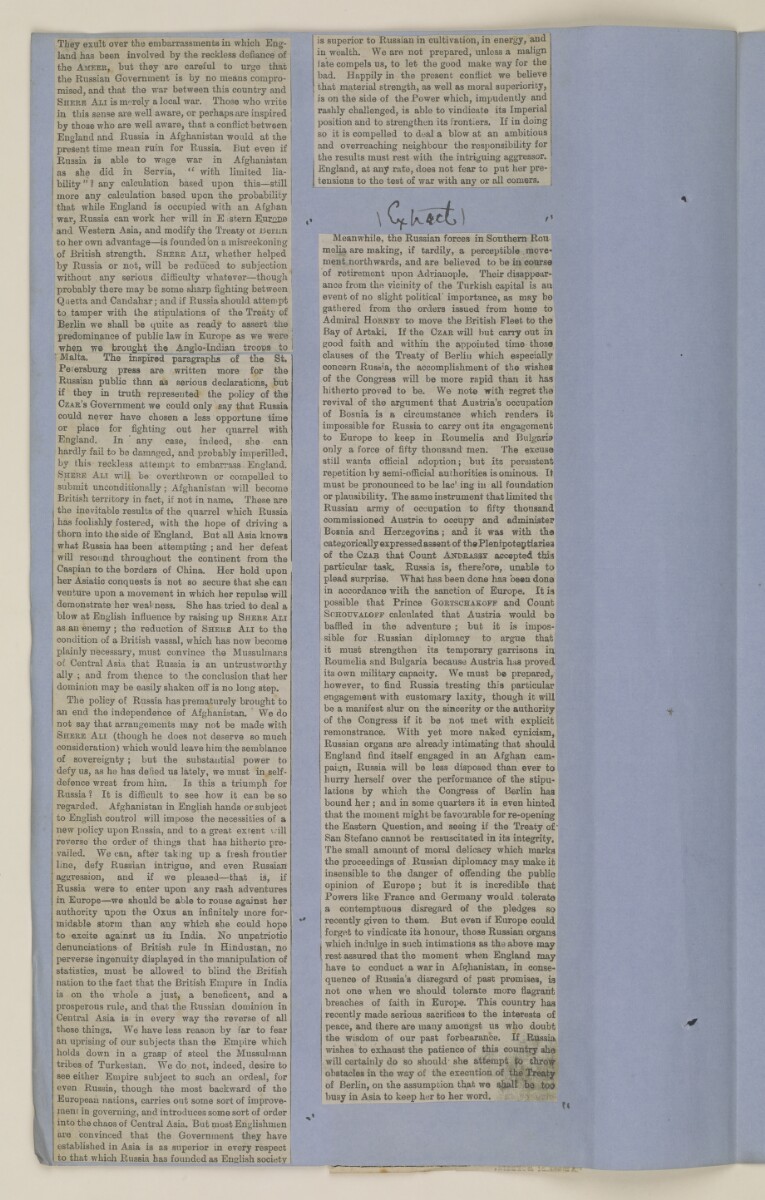
They exult over the embarrassments in which Eng
land has been involved by the reckless defiance of
the Amkek , but they are careful to urge that
the Russian Government is by no means compro
mised, and that the war between this country and
Sheee Am is merely a local war. Those who write
in this sense are well aware, or perhaps are inspired
by those who are well aware, that a conflict between
England and Russia in Afghanistan would at the
present time mean ruin for Russia. But even if
Russia is able to wage war in Afghanistan
as she did in Servia, lC with limited lia
bility " ? any calculation based upon this—still
more any calculation based upon the probability
that while England is occupied with an Afghan
war, Russia can work her will in E stern Eumiifi
and Western Asia, and modify the Treaty 01 Jberun
to her own advantage—is founded 'on a misreckoning
of British strength. Sheee Ali , whether helped
by Russia or not, will be reduced to subjection
without any serious difficulty whatever—though
probably there may be some sharp fighting between
Quetta and Candahar j and if Russia should attempt
to tamper with the stipulations of the Treaty of
Berlin we shall be quite as ready to assert the
predominance of public law in Europe as we were
when we brought th e Anglo -Indian troops to
Malta. The inspired paragraphs of the St.
Pe'eraburg press are written more for the
Russian public than as serious declarations, but
if they in truth represented the policy of the
Czar's Government we could only say that Russia
could never have chosen a less opportune time
or place for fighting out her quarrel with
England. In any case, indeed, she can
hardly fail to be damaged, and probably imperilled,
by this reckless attempt to embarrass England.
Sheee Ali will be overthrown or compelled to
submit unconditionally; Afghanistan will become
British territory in fact, if not in name. These are
the inevitable results of the quarrel which Russia
has foolishly fostered, with the hope of driving a
thorn into the side of England. But all Asia knows
what Russia has been attempting ; and her defeat
will resound throughout the continent from the
Caspian to the borders of China. Her hold upon
her Asiatic conquests is not so secure that she can
venture upon a movement in which her repulse will
i demonstrate her weal- ness. She has tried to deal a
blow at English influence by raising up Shere Ali
as an enemy ; the reduction of Shere Ali to the
condition of a British vassal, which has now become
plainly necessary, must convince the Mussulmans
of Central Asia that Russia is an untrustworthy
ally ; and from thence to the conclusion that her
dominion may be easily shaken off is no long step.
The policy of Russia has prematurely brought to
an end the independence of Afghanistan. We do
not say that arrangements may not be made with
Shere Ali (though he does not deserve so much
consideration) which would leave him the semblance
of sovereignty ; but the substantial power to
defy us, as he has defied us lately, we must in self-
defence wrest from him. Is this a triumph for
Russia? It is difficult to see how it can be so
regarded. Afghanistan in English hands or subject
to English control will impose the necessities of a
new policy upon Russia, and to a great extent will
reverse the order of things that has hitherto pre
vailed. We can, after taking up a fresh frontier
line, defy Russian intrigue, and even Russian
aggression, and if we pleased—that is, if
Russia were to enter upon any rash adventures
in Europe—we should be able to rouse against her
authority upon the Oxus an infinitely more for
midable storm than any which she could hope
to excite against us in India. No unpatriotic
denunciations of British rule in Hindustan, no
perverse ingenuity displayed in the manipulation of
statistics, must be allowed to blind the British
nation to the fact that the British Empire in India
is on the whole a just, a beneficent, and a
prosperous rule, and that the Russian dominion in
Central Asia is in every way the reverse of all
these things. We have less reason by far to fear
an uprising of our subjects than the Empire which
holds down in a grasp of steel the Mussulman
tribes of Turkestan. We do not, indeed, desire to
see either Empire subject to such an ordeal, for
even Russia, though the most backward of the
European nations, carries out some sort of improve
ment in governing, and introduces some sort of order
into the chaos of Central Asia. But most Englishmen
are convinced that the Government they have
established in Asia is as superior in every respect
to that which Russia has founded as English society
is superior to Russian in cultivation, in energy, and
in wealth. We are not prepared, unless a malign
fate compels us, to let the good make way for the
bad. Happily in the present conflict we believe
that material strength, as well as moral superiority,
is on the side of the Power which, impudently and
rashly challenged, is able to vindicate its Imperial
position and to strengthen its frontiers. If in doing
so it is compelled to deal a blow at an ambitious
and overreaching neighbour the responsibility for
the results must rest with the intriguing aggressor.
England, at any rate, does not fear to put her pre
tensions to the test of war with anv or all comers.
Meanwhile, the Russian forces in Southern Rou
melia are making, if tardily, a perceptible move
ment. northwards, and are believed to be in course
of retirement upon Adrianople. Their disappear
ance from the vicinity of the Turkish capital is an
event of no slight political" importance, as may bo
gathered from the orders issued from home to
Admiral Hornby to move the British Fleet to the
Bay of Artaki. If the Czar will but carry out in
good faith and within the appointed time thosa
clauses of the Treaty of Berlin which especially
concern Russia, the accomplishment of the wishes
of the Congress will be more rapid than it has
hitherto proved to be. We note with regret the
revival of the argument that Austria's occupation
of Bosnia is a circumstance which renders it
impossible for Russia to carry out its engagement
to Europe to keep in Roumelia and Bulgaria
only a force of fifty thousand men. The excuse
still wants official adoption; but its persistent
repetition by semi-official authorities is ominous. It
must be pronounced to be
lac
One lakh is equal to one hundred thousand rupees
' ing in all foundation
or plausibility. The same instrument that limited the
Russian army of occupation to fifty thousand
commissioned Austria to occupy and administer
Bosnia and Herzegovina; and it was with the
categorically expressed assent of thePlenipoteytiariea
of the Czar that Count Andra&st accepted this
particular task, Russia is, therefore, unable to
plead surprise. What has been done has been dona
in accordance with the sanction of Europe. It is
possible that Prince Gortschakoff and Count
Sohouvaloff calculated that Austria would be
baffled in the adventure ; but it is impos
sible for Russian diplomacy to argue that
| it must strengthen its temporary garrisons in
Roumelia and Bulgaria because Austria has proved
I its own military capacity. We must be prepared,
| however, to find Russia treating this particular
i engagement with customary laxity, though it will
be a manifest slur on the sincerity or the authority
of the Congress if it be not met with explicit
remonstrance. With yet more naked cynicism,
Russian organs are already intimating that should
England find itself engaged in an Afghan cam
paign, Russia will be less disposed than ever to
hurry herself over the performance of the stipu
lations by which the Congress of Berlin has
bound her ; and in some quarters it is even hinted
that the moment might be favourable for re-opening
the Eastern Question, and seeing if the Treaty of •
San Stefano cannot be resuscitated in its integrity.
The small amount of moral delicacy which marks
the proceedings of Russian diplomacy may make it
insensible to the danger of offending the public
opinion of Europe; but it is incredible that
Powers like France and Germany would tolerate
a contemptuous disregard of the pledges so
recently given to them. But even if Europe could
forget to vindicate its honour, those Russian organs
which indulge in such intimations as the above may
rest assured that the moment when England may
have to conduct a war in Afghanistan, in conse
quence of Russia's disregard of past promises, is
not one when we should tolerate more flagrant
breaches of faith in Europe. This country has
recently made serious sacrifices to the interests of
peace, and there are many amongst us who doubt
the wisdom of our past forbearance. If Russia
wishes to exhaust the patience of this country she
j will certainly do so should- she attempt throw-
obstacles in the way of the execution of the Treaty
of Berlin, on the assumption that we shall be too
busy in Asia to keep her to her word.
x'
About this item
- Content
Press cuttings from British and Indian Newspapers regarding the Afghan War (today known as the 2nd Afghan-Anglo War), negotiations in Cabul [Kabul], the British Government's policy with regards to the Indian Frontier, and the movements of the Russians during the war.
The cuttings have been taken from a number of newspapers including the Pall Mall Budget , The Pall Mall Gazette , The Globe , The Times , The Pioneer Mail , The Standard , The Daily News , The Daily Telegraph , The Evening Standard , The Saturday Review , The Spectator , The Morning Post and The World .
- Extent and format
- 1 volume (150 folios)
- Arrangement
The cuttings have been arranged in the scrapbook in chronological order and the pages of the book have been tied into three bundles ff 1-46, ff 47-96 and ff 97-142
- Physical characteristics
Foliation: This file has been foliated in the top right hand front corner of the recto The front of a sheet of paper or leaf, often abbreviated to 'r'. of each folio with a pencil number enclosed in a circle.
- Written in
- English in Latin script View the complete information for this record
Use and share this item
- Share this item
Scrapbook of newspaper cuttings about Afghanistan [35v] (71/312), British Library: India Office Records and Private Papers, Mss Eur F126/24, in Qatar Digital Library <https://www.qdl.qa/archive/81055/vdc_100024093679.0x000048> [accessed 13 August 2026]
https://www.qdl.qa/en/archive/81055/vdc_100024093679.0x000048
Copy and paste the code below into your web page where you would like to embed the image.
<meta charset="utf-8"><a href="https://www.qdl.qa/en/archive/81055/vdc_100024093679.0x000048">Scrapbook of newspaper cuttings about Afghanistan [‎35v] (71/312)</a> <a href="https://www.qdl.qa/en/archive/81055/vdc_100024093679.0x000048"> <img src="https://iiif.qdl.qa/iiif/images/81055/vdc_100000001524.0x0003a3/Mss Eur F126_24_0089.jp2/full/!280,240/0/default.jpg" alt="" /> </a>
This record has a IIIF manifest available as follows. If you have a compatible viewer you can drag the icon to load it.https://www.qdl.qa/en/iiif/81055/vdc_100000001524.0x0003a3/manifestOpen in Universal viewerOpen in Mirador viewerMore options for embedding images
Copyright: How to use this content
- Reference
- Mss Eur F126/24
- Title
- Scrapbook of newspaper cuttings about Afghanistan
- Pages
- 7r, 18v:19r, 21r:23r, 31r:33r, 35r:37r, 45r:46r, 56v:57r, 61r, 73v:74v, 84v:85r, 92r:94r, 98v:99v, 111r:112r, 118v:120r, 134r:134v, 138v
- Author
- Evening Standard (xx The Standard)
- Usage terms
- Public Domain