
Overview
The History Behind the Treaty
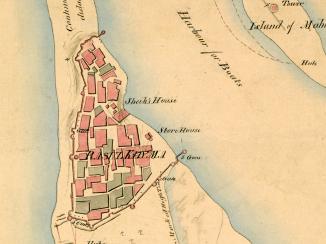
The General Treaty with the Arab Tribes of the Persian Gulf An agreement made in 1820 between Britain and ten tribal rulers of the eastern Arabian coast, often seen as marking the start of 150 years of British hegemony in the region. , as it was titled, was the culmination of several decades of conflict between Britain and the Qawasim One of the ruling families of the United Arab Emirates; also used to refer to a confederation of seafaring Arabs led by the Qāsimī tribe from Ras al Khaima. (referred to by British officials as Joasmees), an Arab tribe based around the port of Ra’s al-Khaymah. The Qawasim One of the ruling families of the United Arab Emirates; also used to refer to a confederation of seafaring Arabs led by the Qāsimī tribe from Ras al Khaima. led a large network of tribes with an expanding influence on both shores of the Gulf. Their rising influence, however, brought them into conflict with other local powers, particularly Oman, ruled by the Imam of Muscat, with whom Britain had formed an alliance in 1798. For Britain, the purpose of that alliance was to secure access to the Gulf, partly for its commercial potential but primarily because the Gulf lay on the main line of communication between Britain and its expanding Indian empire. Securing access to the Gulf was therefore vital for the British administration in India.
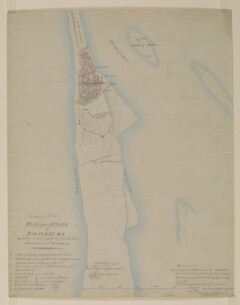
Britain perceived the Qawasim’s rise as a threat to its unfettered access to the Gulf. A British military expedition in 1809 briefly captured Ra’s al-Khaymah but did little to diminish the tribe’s strong presence in the Gulf. In July 1816, William Bruce, the British Resident at Bushehr, reported on the Imam of Muscat’s attempts to challenge the Qawasim’s influence in Bahrain and advocated the use of force to curb the tribe’s growing power.
Archive items in this article
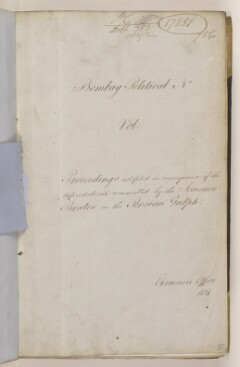



Rising Tension with Indian Trading Communities
As British influence in India expanded, it brought further conflict with the Qawasim One of the ruling families of the United Arab Emirates; also used to refer to a confederation of seafaring Arabs led by the Qāsimī tribe from Ras al Khaima. . The India Office The department of the British Government to which the Government of India reported between 1858 and 1947. The successor to the Court of Directors. Records contain many reports from early nineteenth century detailing raids carried out by the Qawasim One of the ruling families of the United Arab Emirates; also used to refer to a confederation of seafaring Arabs led by the Qāsimī tribe from Ras al Khaima. on shipping in the Indian Ocean. There was a long history of tensions between Arab and Indian trading communities and it is unclear whether all the attacks attributed to the Qawasim One of the ruling families of the United Arab Emirates; also used to refer to a confederation of seafaring Arabs led by the Qāsimī tribe from Ras al Khaima. were indeed carried out by them. Nevertheless, many Indian merchants began to appeal to the British authorities for assistance.

As allegations against the Qawasim One of the ruling families of the United Arab Emirates; also used to refer to a confederation of seafaring Arabs led by the Qāsimī tribe from Ras al Khaima. mounted, British officials in Bombay [Mumbai] sensed an opportunity to finally crush their rivals in the Gulf. In December 1819, with assistance from Oman, Britain sent a military expedition to the Gulf. The result was an overwhelming defeat for the Qawasim One of the ruling families of the United Arab Emirates; also used to refer to a confederation of seafaring Arabs led by the Qāsimī tribe from Ras al Khaima. , culminating in the capture of their fleet and the occupation of Ra’s al-Khaymah. Shortly after, Major-General William Grant Keir (later known as William Keir Grant) wrote from Ras al-Khaymah stating that the British capture of the port had ‘completely broken’ the ‘piratical force’ in the region (IOR/R/15/1/19, f. 142r). It was in the aftermath of this crushing military campaign that the treaty was created.

The Contents of the Treaty
The treaty was produced in English and Arabic and was first signed on 8 January 1820, with more signatories added in the following weeks. The first article of the treaty states: ‘[t]here shall be a cessation of plunder and piracy by land and sea on the part of the Arabs, who are parties to this contract, for ever [sic]’ (IOR/L/PS/10/606, f. 131r). In describing the actions of the Qawasim One of the ruling families of the United Arab Emirates; also used to refer to a confederation of seafaring Arabs led by the Qāsimī tribe from Ras al Khaima. as ‘piracy’, the treaty echoes language used by Bruce and Keir. Such references are common in the correspondence of British officials and military officers, who didn’t view seafaring Arabs as a political entity with whom relations could be conducted as equal partners. Instead, the British authorities labelled them as pirates, lawless marauders who sought only to disrupt and destroy maritime trade, both in the Gulf and in the Indian Ocean.

The treaty also established a new system of maritime conduct, requiring Arab ships to carry a register and port clearance detailing the vessel’s specification, ownership, crew, ports of origin and destination. These ships were also required to fly ‘the flag of the friendly Arabs’, a red rectangle in a white border, to signify their adherence to the terms of the treaty. The treaty further states that, following compliance with these demands, ‘the vessels of the friendly Arabs, bearing their flag above described, shall enter into all the British ports and into the ports of the allies of the British … and they shall buy and sell therein’ (IOR/R/15/1/735, f. 6r). By complying with the treaty’s terms, the Qawasim One of the ruling families of the United Arab Emirates; also used to refer to a confederation of seafaring Arabs led by the Qāsimī tribe from Ras al Khaima. and their allies were to be weaned off their ‘piratical’ habits and integrated into the maritime trading system that Britain had established in the Gulf and in the Indian Ocean.
The Legacy of the Treaty
The treaty established a new order in the Gulf and marked the beginning of a long-lasting British involvement in the region. A naval force remained to implement the new arrangements and a series of subsequent treaties saw Britain act as the enforcer of an ongoing truce between the different coastal Arab tribes. By the early twentieth century, Britain had assumed responsibility for the defence and foreign policy of these tribes and was increasingly intervening in the administration and development of their territories. In short, the Arabian coast of the Gulf had effectively become a British protectorate.

This position was maintained until 1971 when Britain withdrew from the region and the states of the United Arab Emirates, Qatar and Bahrain were established. These states are therefore a direct legacy of the 1820 treaty and remain governed by many of the same ruling families with whom Britain began treaty relations over two hundred years ago. Though largely unknown today, the General Treaty is central to understanding the modern history of the Gulf and Britain’s role in it.
What’s In a Name? The General Treaty’s Many Titles
Over time, treaties often become known by shorter and more memorable titles. During the 1820s and 1830s, British officials referred to the 1820 treaty variously as ‘The General Treaty’, ‘The Treaty’ and ‘The General Treaty of Peace’. As the nineteenth century wore on, the latter title became increasingly the accepted one and appeared in volume one of Charles Rathbone Low’s History of the Indian Navy (1613-1863), published in 1877. It was also adopted by John Gordon Lorimer in his Gazetteer of the Persian Gulf The historical term used to describe the body of water between the Arabian Peninsula and Iran. , Oman and Central Arabia, produced in two parts in 1908 and 1915.
Related Articles


Rather confusingly, from the mid to late-nineteenth century, another long-form title for the treaty began to appear. The second edition of Charles Umpherston Aitchison’s A Collection of Treaties, Engagements, and Sanads Relating to India and Neighbouring Countries, first published in full in 1892, contains a copy of the treaty, but refers to it on the contents page as: ‘General Treaty with the Arab Chiefs for the cessation of plunder and piracy by land and sea’. This title was retained in subsequent editions of Aitchison’s Collection of Treaties and is replicated in other contexts.
Conclusion
The confusion over the name of the 1820 treaty partly stems from the ambiguity of its original title, which is an example and a reminder of Britain’s effort to downplay its involvement in the Gulf. It is telling that, as British hegemony increased in the region throughout the nineteenth century, the preferred title for the agreement underpinning its position was ‘The General Treaty of Peace’. That the treaty was given such an innocuous-sounding name is an unlikely coincidence, as it both obscured the military force that lay behind and the unequal relationships it imposed on the rulers who signed it.
