Show menu
Search form
Search the site
Explore Qatar Digital Library
Articles From Our Experts
Glossary
About
العربية
English
Search form
Search the site
العربية
English
Articles From Our Experts
Filter articles by:
What
Introductory Articles
(0)
Arabic Manuscripts
(2)
Maps
(0)
The British Empire in the Gulf
(0)
Commerce and Communication
(0)
People and Places
(0)
Culture and Religion
(7)
Sciences and Medicine
(0)
Power and Politics
(0)
Sound and Music
(16)
Introductory Articles
(0)
Arabic Manuscripts
(2)
Maps
(0)
The British Empire in the Gulf
(0)
Commerce and Communication
(0)
People and Places
(0)
Culture and Religion
(7)
Sciences and Medicine
(0)
Power and Politics
(0)
Sound and Music
(16)
Where
Bahrain
(4)
Egypt
(1)
India
(0)
Iran
(0)
Iraq
(4)
Kuwait
(4)
Oman
(2)
Pakistan
(1)
Qatar
(3)
Saudi Arabia
(0)
United Arab Emirates
(0)
Yemen
(0)
Bahrain
(4)
Egypt
(1)
India
(0)
Iran
(0)
Iraq
(4)
Kuwait
(4)
Oman
(2)
Pakistan
(1)
Qatar
(3)
Saudi Arabia
(0)
United Arab Emirates
(0)
Yemen
(0)
When
Pre-1600
(1)
1600–1649
(0)
1650–1699
(1)
1700–1749
(0)
1750–1799
(0)
1800‒1849
(0)
1850‒1899
(1)
1900–1949
(4)
1950–1999
(1)
Pre-1600
(1)
1600–1649
(0)
1650–1699
(1)
1700–1749
(0)
1750–1799
(0)
1800‒1849
(0)
1850‒1899
(1)
1900–1949
(4)
1950–1999
(1)
16
of
276
articles to explore
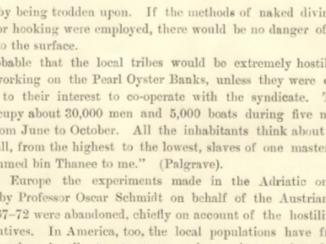
The extremely difficult and elaborate work of sailing ships and boats for pearl-diving and fishing in the Gulf region was essential in giving birth to a group of the most exciting music genres in the Arab world. Today, we wonder how this happened and how these genres could survive.
Fann Al-Baḥri: The great art of the sea
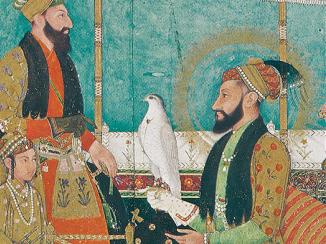
Scribal notes in a Mughal-period manuscript of fourteen musical texts shed light on its historical context and the process of its creation.
A Mughal Musical Miscellany: the creation of Or. 2361
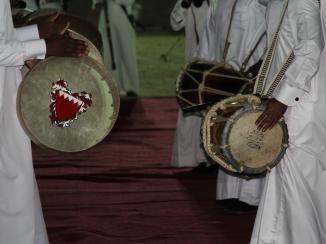
The music of the upper Gulf region is well known for its intricate rhythms, hand-clapping and sung poetry. In addition to this, its musical instruments have evolved or been incorporated into various genres.
A Rich Culture Expressed in Music: musical instruments in the Upper Gulf region
There is still so much we do not know about the history of independent Arab recording companies in the ‘shellac era’ (1897-1960s). A handful of record sleeves, that would have once been thrown away, tell us about how some of them were connected.
Arabic Music Record Sleeves and What They Can Tell Us
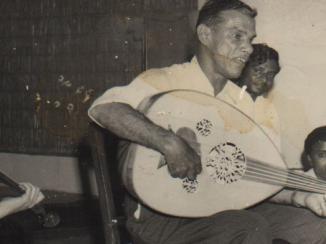
Salim Rashid Suri, an Omani ṣawt singer and oud player became famous as the ‘singing sailor’ and for developing a truly unique style, which took influence from musical sources across the Middle East and India.
The Singing Sailor, Salim Rashid Suri: A Ṣawt Musician from Oman
The people of the upper Gulf coast have created a rich and multifaceted musical culture. Unfortunately, these musical genres are hardly known outside this region and there is a risk that some of this heritage will be lost forever.
Interlocking Patterns Meet Arabic Poetry: musical genres in the Upper Gulf region
Mohamed Bin Fares and Dhahi Bin Walid are regarded as the founders of the traditional urban Gulf musical genre ṣawt, which is still performed in the region.
The Founders of Bahraini Sawt Music: Mohamed Bin Fares and Dhahi Bin Walid
Join a musician and a curator for a deep dive into a unique work on musical notation from sixteenth-century Damascus.
Melodies and Music Theory: In conversation with Maya Youssef
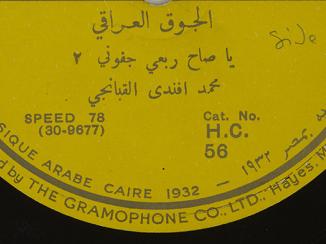
Thanks to the recording sessions at the first Arabic Music Congress in 1932 in Cairo, we can still listen to a selection of early Arabic music recordings. Additionally, several documents and reports are available, allowing us to learn about the formation of ‘Arabic music’ and musicological discussions in the first part of the twentieth century.
Microtones: The Piano and Muhammad Al-Qubanshi – The First Congress of Arabic Music and Early Recordings from Iraq
Who were the founders of traditional ṣawt music and why did their musical journey start in Kuwait?
The Cradle of Arabic Sawt Music: The early musician generations in Kuwait
Pesta and Rifi Songs, which developed in the twentieth century from Iraqi maqam, became more popular because they were recorded on shellac and broadcast throughout Iraq in the mid-century.
Love and Separation in Baghdad: Pesta and Rifi Songs on Shellac Discs
Kept alive until today by a very small number of chalgi Baghdad ensembles and through remaining shellac recordings, Iraqi maqam is a sophisticated musical genre from urban Iraq that developed in the 1920s‒1940s.
Dusty Streets and Hot Music in Baghdad: Iraqi Maqam Music and Chalgi Ensembles
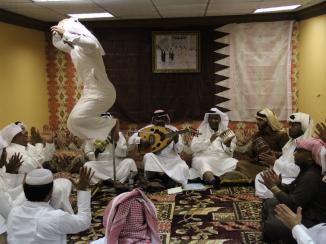
Though nowadays Qatar is well-known for its immense natural oil and gas reserves and the rapid modernisation of society, it has a rich heritage of music and dance intimately related to pearl-diving, sea trade and Bedouin traditions.
Modernity meets Tradition: Reflections on traditional music in Qatar
Ṣawt, the urban music of the Arabian Peninsula and the Gulf, has evolved from diverse musical traditions, including sea music, and was profoundly influenced by Indian, African and classical Arabic music.
Sing, Play, and Be Merry: The unique ṣawt music of the Arabian Peninsula
In the Sultanate of Oman, traditional music, poetry and dance are still part and parcel of everyday life and national celebrations alike.
Sea meets Desert: Reflections on traditional music in Oman
Kuwait has maintained a thriving traditional music culture; in particular bahri, or sea music, and ṣawt have remained at the heart of the music scene.
Hidden Treasures: Reflections on traditional music in Kuwait
http://www.qdl.qa/en/articles-from-our-experts?themes%5B0%5D=3464