
!['A Grandfather's Tale: Memoirs being mainly concerned with service in the Indian Army and the Indian Political Service in India and the Persian Gulf from 1932-1947' [‎41v] (82/118)](https://iiif.qdl.qa/iiif/images/81055/vdc_100000000880.0x0002e8/Mss Eur F226_23_0082.jp2/full/!1200,1200/0/default.jpg "'A Grandfather's Tale: Memoirs being mainly concerned with service in the Indian Army and the Indian Political Service in India and the Persian Gulf from 1932-1947' [‎41v] (82/118)")
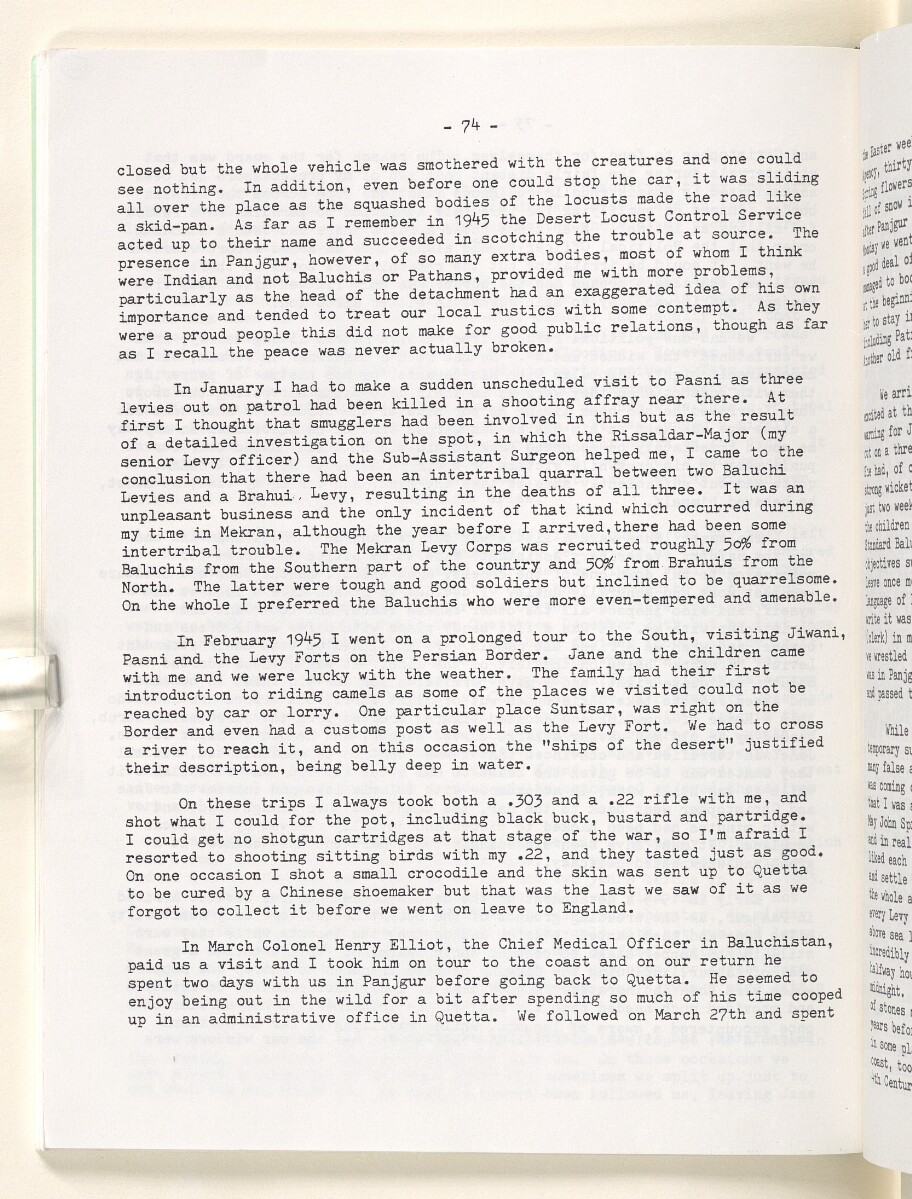
'A Grandfather's Tale: Memoirs being mainly concerned with service in the Indian Army and the Indian Political Service in India and the Persian Gulf from 1932-1947' [41v] (82/118)
The record is made up of 1 file (57 folios). It was created in Jul 1984. It was written in English. The original is part of the British Library: India Office The department of the British Government to which the Government of India reported between 1858 and 1947. The successor to the Court of Directors. Records and Private Papers Documents collected in a private capacity. .
Transcription
This transcription is created automatically. It may contain errors.
closed but the whole vehicle was smothered with the creatures and one could
see nothing. In addition, even before one could stop the car, was sliding
all over the place as the squashed bodies of the locusts made the road like
a skid-pan. As far as I remember in 19^5 the Desert Locust Control Service
acted up to their name and succeeded in scotching the trouble at source. The
presence in Panjgur, however, of so many extra bodies, most of whom I think
were Indian and not Baluchis or Pathans, provided me with more problems,
particularly as the head of the detachment had an exaggerated idea of his own
importance and tended to treat our local rustics with some contempt. As they
were a proud people this did not make for good public relations, tnough as far
as I recall the peace was never actually broken.
In January I had to make a sudden unscheduled visit to Pasni as three
levies out on patrol had been killed in a shooting affray near there. At
first I thought that smugglers had been involved in this but as the resul
of a detailed investigation on the spot, in which the Rissaldar--ajor
senior Levy officer) and the Sub-Assistant Surgeon helped me, I came to the
conclusion that there had been an intertribal quarral between two Baluchi
Levies and a Brahui - Levy, resulting in the deaths of all three. It was an
unpleasant business and the only incident of that kind which occurred during
my time in Mekran, although the year before I arrived,there had been some
intertribal trouble. The Mekran Levy Corps was recruited roughly 5o% from
Baluchis from the Southern part of the country and from Brahuis from the
North. The latter were tough and good soldiers but inclined to be quarrelsome.
On the whole I preferred the Baluchis who were more even-tempered and amenable.
In February 19^5 I went on a prolonged tour to the South, visiting Jiwani,
Pasni and. the Levy Forts on the Persian Border. Jane and the children came
with me and we were lucky with the weather. The family had their first
introduction to riding camels as some of the places we visited could not be
reached by car or lorry. One particular place Suntsar, was right on the
Border and even had a customs post as well as the Levy Fort. We had to cross
a river to reach it, and on this occasion the "ships of the desert” justified
their description, being belly deep in water.
On these trips I always took both a .303 and a .22 rifle with me, and
shot what I could for the pot, including black buck, bustard and partridge.
I could get no shotgun cartridges at that stage of the war, so I'm afraid I
resorted to shooting sitting birds with my . 22 , and they tasted just as good.
On one occasion I shot a small crocodile and the skin was sent up to Quetta
to be cured by a Chinese shoemaker but that was the last we saw of it as we
forgot to collect it before we went on leave to England.
In March Colonel Henry Elliot, the Chief Medical Officer in Baluchistan,
paid us a visit and I took him on tour to the coast and on our return he
spent two days with us in Panjgur before going back to Quetta. He seemed to
enjoy being out in the wild for a bit after spending so much of his time cooped
up in an administrative office in Quetta. We followed on March 27th and spent
About this item
- Content
A memoir written by Major Hugh Dunstan Holwell Rance about his career in the Indian Army and the Indian Political Service The branch of the British Government of India with responsibility for managing political relations between British-ruled India and its surrounding states, and by extension the Gulf, during the period 1937-47. ( IPS The branch of the British Government of India with responsibility for managing political relations between British-ruled India and its surrounding states, and by extension the Gulf, during the period 1937-47. ), 1932-47. The memoir details:
- His childhood and education
- His service in the Indian Army, 1932-36 and 1940-43
- His service in the IPS The branch of the British Government of India with responsibility for managing political relations between British-ruled India and its surrounding states, and by extension the Gulf, during the period 1937-47. , 1936-40, at Baroda [Vadodara], Simla [Shimla], Agra, Rajkot, Bushire [Bushehr], Shiraz and Bahrain
- His service in the IPS The branch of the British Government of India with responsibility for managing political relations between British-ruled India and its surrounding states, and by extension the Gulf, during the period 1937-47. , 1943-47, at Quetta, Mekran [Makran], Bahrain, the Trucial Coast A name used by Britain from the nineteenth century to 1971 to refer to the present-day United Arab Emirates. [United Arab Emirates] and Shiraz
- His career with the Colonial Service in Northern Rhodesia [Zambia] and at the Colonial Office in London, 1948-51
- His career in the private sector, 1952-76.
Folios 56-58 contain photocopies of maps showing parts of India, Pakistan, Afghanistan, Iran and the Gulf.
- Extent and format
- 1 file (57 folios)
- Physical characteristics
Foliation: the foliation sequence (used for referencing) commences at the front cover with 1, and terminates at the inside back cover with 59; these numbers are written in pencil, are circled, and are located in the top right corner of the recto The front of a sheet of paper or leaf, often abbreviated to 'r'. side of each folio.
Pagination: a typed pagination sequence is present between ff 6-55.
- Written in
- English in Latin script View the complete information for this record
Use and share this item
- Share this item
'A Grandfather's Tale: Memoirs being mainly concerned with service in the Indian Army and the Indian Political Service in India and the Persian Gulf from 1932-1947' [41v] (82/118), British Library: India Office Records and Private Papers, Mss Eur F226/23, in Qatar Digital Library <https://www.qdl.qa/archive/81055/vdc_100184307281.0x000065> [accessed 1 August 2026]
https://www.qdl.qa/en/archive/81055/vdc_100184307281.0x000065
Copy and paste the code below into your web page where you would like to embed the image.
<meta charset="utf-8"><a href="https://www.qdl.qa/en/archive/81055/vdc_100184307281.0x000065">'A Grandfather's Tale: Memoirs being mainly concerned with service in the Indian Army and the Indian Political Service in India and the Persian Gulf from 1932-1947' [‎41v] (82/118)</a> <a href="https://www.qdl.qa/en/archive/81055/vdc_100184307281.0x000065"> <img src="https://iiif.qdl.qa/iiif/images/81055/vdc_100000000880.0x0002e8/Mss Eur F226_23_0082.jp2/full/!280,240/0/default.jpg" alt="" /> </a>
This record has a IIIF manifest available as follows. If you have a compatible viewer you can drag the icon to load it.https://www.qdl.qa/en/iiif/81055/vdc_100000000880.0x0002e8/manifestOpen in Universal viewerOpen in Mirador viewerMore options for embedding images
Copyright: How to use this content
- Reference
- Mss Eur F226/23
- Title
- 'A Grandfather's Tale: Memoirs being mainly concerned with service in the Indian Army and the Indian Political Service in India and the Persian Gulf from 1932-1947'
- Pages
- front, front-i, 2r:55v, back-i, back
- Author
- East India Company, the Board of Control, the India Office, or other British Government Department
- Usage terms
- Open Government Licence