
![Annotated Copy of <em>Persia and the Persian Question</em> by George Curzon, with Inserted Papers [‎879r] (1774/1814)](https://iiif.qdl.qa/iiif/images/81055/vdc_100000001491.0x00033b/Mss Eur F111_33_1804.jp2/full/!1200,1200/0/default.jpg "Annotated Copy of <em>Persia and the Persian Question</em> by George Curzon, with Inserted Papers [‎879r] (1774/1814)")
Annotated Copy of Persia and the Persian Question by George Curzon, with Inserted Papers [879r] (1774/1814)
The record is made up of 2 volumes with inserts (898 folios). It was created in 1892-1924. It was written in English, Urdu and German. The original is part of the British Library: India Office The department of the British Government to which the Government of India reported between 1858 and 1947. The successor to the Court of Directors. Records and Private Papers Documents collected in a private capacity. .
Transcription
This transcription is created automatically. It may contain errors.
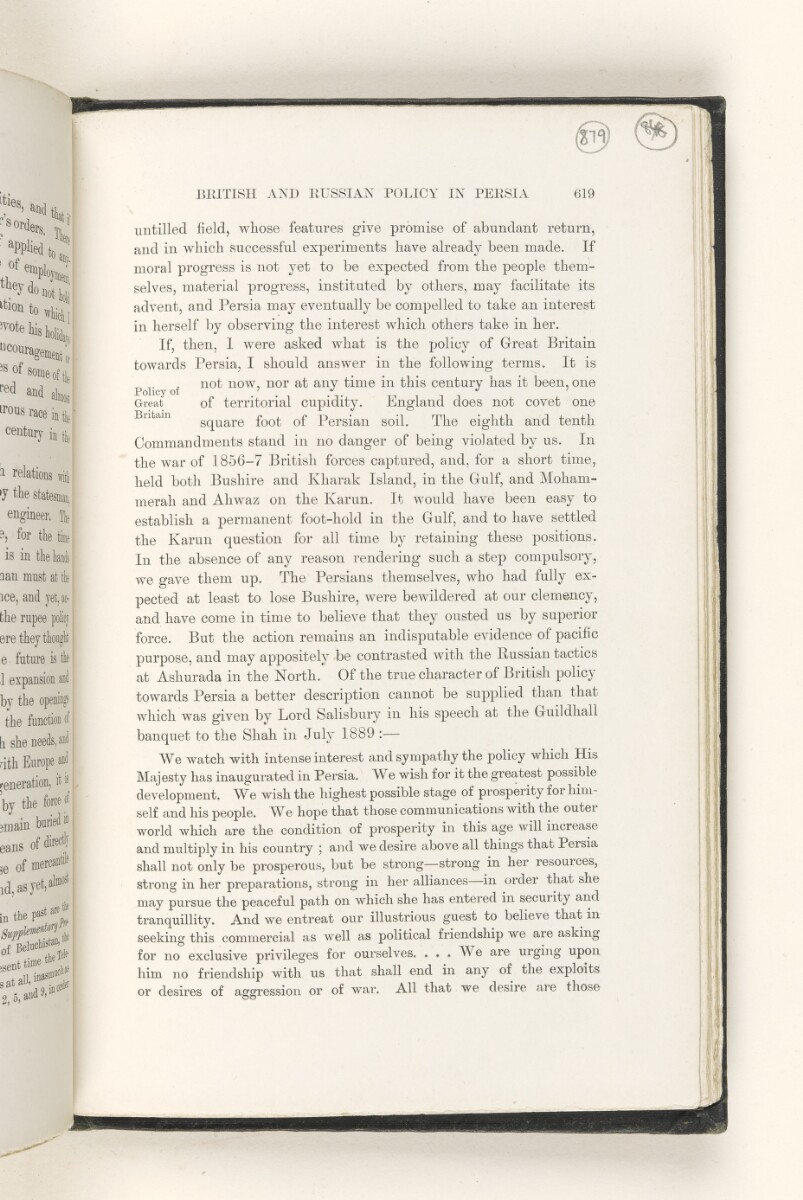
BRITISH AND RUSSIAN POLICY IN PERSIA
619
Policy of
Great
Britain
untilled field, whose features give promise of abundant return,
and in which successful experiments have already been made. If
moral progress is not yet to be expected from the people them
selves, material progress, instituted by others, may facilitate its
advent, and Persia may eventually be compelled to take an interest
in herself by observing the interest which others take in her.
If, then, I were asked what is the policy of Great Britain
towards Persia, I should answer in the following terms. It is
not now, nor at any time in this century has it been, one
of territorial cupidity. England does not covet one
square foot of Persian soil. The eighth and tenth
Commandments stand in no danger of being violated by us. In
the war of 1856-7 British forces captured, and, for a short time,
held both Bushire and Kharak Island, in the Gulf, and Moham-
merah and Ahwaz on the Karim. It would have been easy to
establish a permanent foot-hold in the Gulf, and to have settled
the Karun question for all time by retaining these positions.
In the absence of any reason rendering such a step compulsory,
we gave them up. The Persians themselves, who had fully ex
pected at least to lose Bushire, were bewildered at our clemency,
and have come in time to believe that they ousted us by superior
force. But the action remains an indisputable evidence of pacific
purpose, and may appositely be contrasted with the Russian tactics
at Ashurada in the North. Of the true character of British policy
towards Persia a better description cannot be supplied than that
which was given by Lord Salisbury in his speech at the Guildhall
banquet to the Shah in July 1889 :—
We watch with intense interest and sympathy the policy which His
Majesty has inaugurated in Persia. We wish for it the greatest possible
development. We wish the highest possible stage of prosperity for him
self and his people. e hope that those communications with the outei
world which are the condition of prosperity in this age will increase
and multiply in his country ; and we desire above all things that Persia
shall not only be prosperous, but be strong—strong in her resouices,
strong in her preparations, strong in her alliances in order that she
may pursue the peaceful path on which she has entered in security and
tranquillity. And we entreat our illustrious guest to believe that in
seeking this commercial as well as political friendship we are asking
for no exclusive privileges for ourselves. . . . We are urging upon
him no friendship with us that shall end in any of the exploits
or desires of aggression or of war. All that we desire are those
About this item
- Content
These two volumes are George Curzon's own personal annotated copies of both volumes of his book Persia and the Persian Question , which was published in 1892. Alongside the volumes are various loose papers relating to Persia [Iran], consisting of the following: received correspondence; newspaper cuttings; publishers' press releases; cuttings from various booksellers' catalogues; various journal and magazine articles; two items of printed official British correspondence; several prints of photographs and sketches; and a few handwritten notes by Curzon.
In most cases these papers, which range in date from 1892 to 1924, relate to the chapters in the book where they were originally inserted, suggesting that they were kept by Curzon with the intention of using them to inform a revised edition of the book.
Of particular note among the small amount of correspondence are two letters received by Curzon in 1914 and 1915 from retired schoolmaster and Islamic scholar Sayyid Mazhar Hasan Musawi of Saharanpur, Uttar Pradesh, India (ff 5-9 and ff 44-53). These letters, which are written in Urdu and are accompanied by English translations, discuss in detail several inaccuracies found in the Urdu version of Persia and the Persian Question .
The various prints of photographs and sketches, which were originally inserted into volume two, are of different locations in the Gulf region. Several of these appear to have been produced in preparation for the publication of the second volume of John Gordon Lorimer's Gazetteer of the Persian Gulf The historical term used to describe the body of water between the Arabian Peninsula and Iran. , Oman and Central Arabia (i.e. the 'Geographical and Statistical' section) in 1908, as they are identical to the versions found in that volume.
Also of note among the loose papers are an illustrated article from Country Life dated 5 June 1920, entitled 'The People of Persia' (ff 36-37), and a printed family tree of the Shah of Persia [Aḥmad Shah Qājār], produced in preparation of his visit to Britain in 1919 (f 233).
Volume one of Persia and the Persian Question contains a map of Persia, Afghanistan and Beluchistan [Balochistan], which is folded inside the front cover (f 1).
The German language material consists of a publisher's press release for two books authored by German archaeologist Ernst Emil Herzfeld (ff 29-30).
- Extent and format
- 2 volumes with inserts (898 folios)
- Physical characteristics
Foliation: this shelfmark consists of two physical volumes. The foliation sequence commences at the first folio of volume one (1-463), and terminates at the last folio of volume two (ff 464-898); these numbers are written in pencil, are circled, and are located in the top right corner of the recto The front of a sheet of paper or leaf, often abbreviated to 'r'. side of each folio. Each volume contains a large number of loose leaves, which have been foliated in the order that they were inserted into the volume; for conservation reasons, these loose folios have been removed from the volume and stored separately. The foliation sequence does not include the front and back covers of the two volumes.
Pagination: the file also contains an original printed pagination sequence.
- Written in
- English, Urdu and German in Latin and Arabic script View the complete information for this record
Use and share this item
- Share this item
Annotated Copy of Persia and the Persian Question by George Curzon, with Inserted Papers [879r] (1774/1814), British Library: India Office Records and Private Papers, Mss Eur F111/33, in Qatar Digital Library <https://www.qdl.qa/archive/81055/vdc_100157213850.0x0000af> [accessed 5 June 2026]
https://www.qdl.qa/en/archive/81055/vdc_100157213850.0x0000af
Copy and paste the code below into your web page where you would like to embed the image.
<meta charset="utf-8"><a href="https://www.qdl.qa/en/archive/81055/vdc_100157213850.0x0000af">Annotated Copy of <em>Persia and the Persian Question</em> by George Curzon, with Inserted Papers [‎879r] (1774/1814)</a> <a href="https://www.qdl.qa/en/archive/81055/vdc_100157213850.0x0000af"> <img src="https://iiif.qdl.qa/iiif/images/81055/vdc_100000001491.0x00033b/Mss Eur F111_33_1804.jp2/full/!280,240/0/default.jpg" alt="" /> </a>
This record has a IIIF manifest available as follows. If you have a compatible viewer you can drag the icon to load it.https://www.qdl.qa/en/iiif/81055/vdc_100000001491.0x00033b/manifestOpen in Universal viewerOpen in Mirador viewerMore options for embedding images
Copyright: How to use this content
- Reference
- Mss Eur F111/33
- Title
- Annotated Copy of Persia and the Persian Questionby George Curzon, with Inserted Papers
- Pages
- 54r:135v, 147r:149v, 158r:180v, 183r:221v, 224r:224v, 227r:246v, 248r:257v, 259r:260v, 268r:362v, 364r:364v, 367r:388v, 390r:400v, 402r:416v, 419r:432v, 434r:444v, 448r:462v, 464r:471v, 475r:481v, 483r:513v, 516r:525v, 527r:544v, 546r:563v, 566r:598v, 600r:622v, 624r:656v, 658r:665v, 667r:675v, 678r:684v, 687r:688v, 691r:691v, 693r:693v, 695r:708v, 711r:721v, 724r:726v, 728r:729v, 731r:736v, 742r:742v, 746r:757v, 759r:761v, 763r:763v, 765r:765v, 772r:777v, 780r:789v, 793r:794v, 797r:809v, 811r:821v, 825r:840v, 843r:898v
- Author
- Curzon, George Nathaniel, 1st Marquess Curzon of Kedleston
- Usage terms
- Public Domain