
![Annotated Copy of <em>Persia and the Persian Question</em> by George Curzon, with Inserted Papers [‎870v] (1757/1814)](https://iiif.qdl.qa/iiif/images/81055/vdc_100000001491.0x00033b/Mss Eur F111_33_1787.jp2/full/!1200,1200/0/default.jpg "Annotated Copy of <em>Persia and the Persian Question</em> by George Curzon, with Inserted Papers [‎870v] (1757/1814)")
Annotated Copy of Persia and the Persian Question by George Curzon, with Inserted Papers [870v] (1757/1814)
The record is made up of 2 volumes with inserts (898 folios). It was created in 1892-1924. It was written in English, Urdu and German. The original is part of the British Library: India Office The department of the British Government to which the Government of India reported between 1858 and 1947. The successor to the Court of Directors. Records and Private Papers Documents collected in a private capacity. .
Transcription
This transcription is created automatically. It may contain errors.
£
602 PERSIA
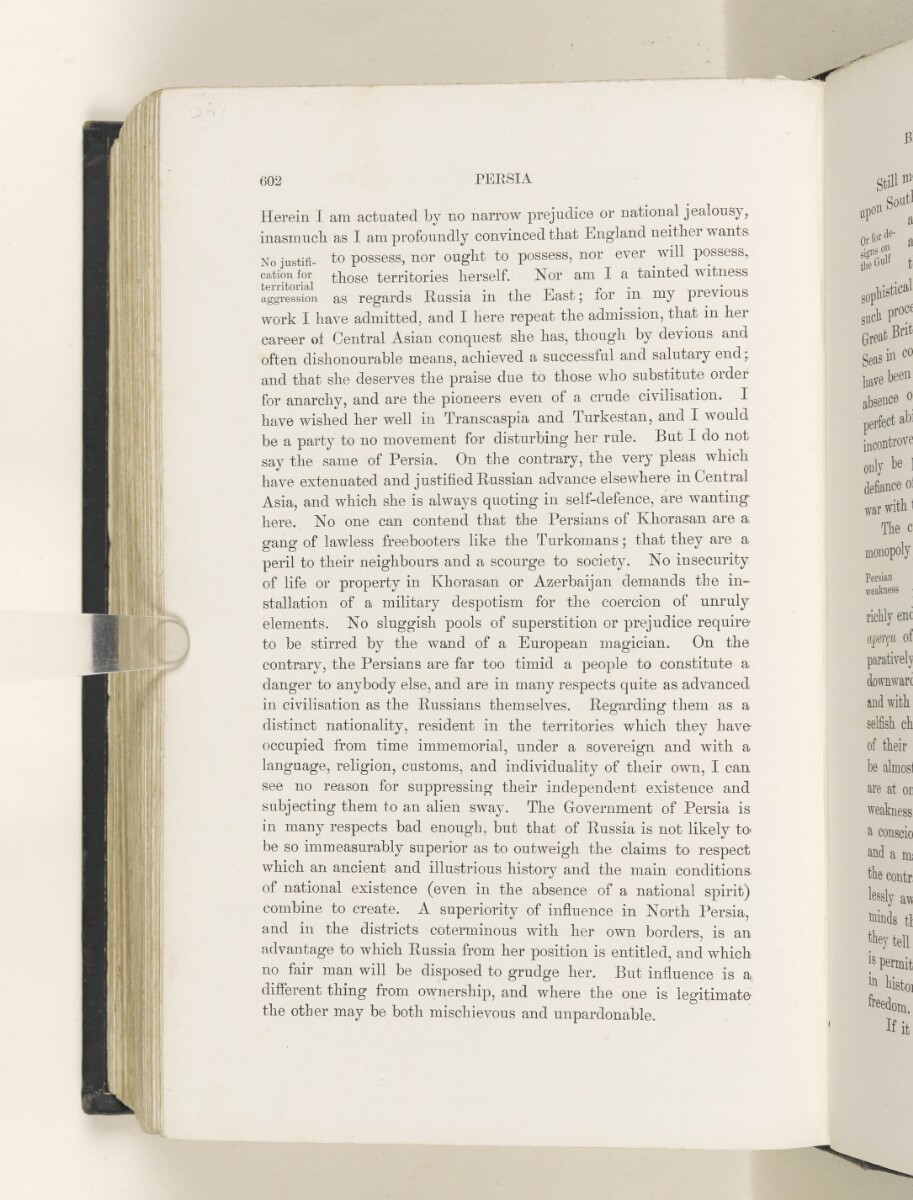
Herein I am actuated by no narrow prejudice or national jealousy,
inasmuch as I am profoundly convinced that England neithei wants
No justifi- f° possess, nor ought to possess, nor ever will possess,
cation for those territories herself. Nor am I a tainted witness
“ssioL as regards Russia in the East; for in my previous
work I have admitted, and I here repeat the admission, that in hei
career ol Central Asian conquest she has, though by devious and
often dishonourable means, achieved a successful and salutary end
and that she deserves the praise due to those who substitute order
for anarchy, and are the pioneers even of a crude civilisation. I
have wished her well in Transcaspia and Turkestan, and I would
be a party to no movement for disturbing her rule. But I do not
say the same of Persia. On the contrary, the very pleas which
have extenuated and justified Russian advance elsewhere in Central
Asia, and which she is always quoting in self-defence, are wanting
here. No one can contend that the Persians of Khorasan are a
gang of lawless freebooters like the Turkomans; that they are a
peril to their neighbours and a scourge to society. No insecurity
of life or property in Khorasan or Azerbaijan demands the in
stallation of a military despotism for the coercion of unruly
elements. No sluggish pools of superstition or prejudice require-
to be stirred by the wand of a European magician. On the
contrary, the Persians are far too timid a people to constitute a
danger to anybody else, and are in many respects quite as advanced
in civilisation as the Russians themselves. Regarding them as a
distinct nationality, resident in the territories which they have-
occupied from time immemorial, under a sovereign and with a
language, religion, customs, and individuality of their own, I can
see no reason for suppressing their independent existence and
subjecting them to an alien sway. The Government of Persia is
in many respects bad enough, but that of Russia is not likely R>
be so immeasurably superior as to outweigh the claims to respect
which an ancient and illustrious history and the main conditions
of national existence (even in the absence of a national spirit)
combine to create. A superiority of influence in North Persia,
and in the districts coterminous with her own borders, is an
advantage to which Russia from her position is entitled, and which
no fair man will be disposed to grudge her. But influence is a
different thing from ownership, and where the one is legitimate-
the other may be both mischievous and unpardonable.
StiH r» (
< Sout !
Or f° r
i-ae-
sig 1 ^
on
OuH
sopl> cal
suck P r ° ce
Great Brit
Seas ^ c0
have been
absence o:
perfect abi
incontrove
only be ]
defiance oi
war with 1
Tbe c:
Persian
weakness •
richly end
aprqu of
downward
and with
selfish ch
of their
be almost
are at on
weakness,
a conscio
and a mi
fhe contn
lessly aw
minds ff
%tell
I s permit
in Mstoi
freedom.
If it
About this item
- Content
These two volumes are George Curzon's own personal annotated copies of both volumes of his book Persia and the Persian Question , which was published in 1892. Alongside the volumes are various loose papers relating to Persia [Iran], consisting of the following: received correspondence; newspaper cuttings; publishers' press releases; cuttings from various booksellers' catalogues; various journal and magazine articles; two items of printed official British correspondence; several prints of photographs and sketches; and a few handwritten notes by Curzon.
In most cases these papers, which range in date from 1892 to 1924, relate to the chapters in the book where they were originally inserted, suggesting that they were kept by Curzon with the intention of using them to inform a revised edition of the book.
Of particular note among the small amount of correspondence are two letters received by Curzon in 1914 and 1915 from retired schoolmaster and Islamic scholar Sayyid Mazhar Hasan Musawi of Saharanpur, Uttar Pradesh, India (ff 5-9 and ff 44-53). These letters, which are written in Urdu and are accompanied by English translations, discuss in detail several inaccuracies found in the Urdu version of Persia and the Persian Question .
The various prints of photographs and sketches, which were originally inserted into volume two, are of different locations in the Gulf region. Several of these appear to have been produced in preparation for the publication of the second volume of John Gordon Lorimer's Gazetteer of the Persian Gulf The historical term used to describe the body of water between the Arabian Peninsula and Iran. , Oman and Central Arabia (i.e. the 'Geographical and Statistical' section) in 1908, as they are identical to the versions found in that volume.
Also of note among the loose papers are an illustrated article from Country Life dated 5 June 1920, entitled 'The People of Persia' (ff 36-37), and a printed family tree of the Shah of Persia [Aḥmad Shah Qājār], produced in preparation of his visit to Britain in 1919 (f 233).
Volume one of Persia and the Persian Question contains a map of Persia, Afghanistan and Beluchistan [Balochistan], which is folded inside the front cover (f 1).
The German language material consists of a publisher's press release for two books authored by German archaeologist Ernst Emil Herzfeld (ff 29-30).
- Extent and format
- 2 volumes with inserts (898 folios)
- Physical characteristics
Foliation: this shelfmark consists of two physical volumes. The foliation sequence commences at the first folio of volume one (1-463), and terminates at the last folio of volume two (ff 464-898); these numbers are written in pencil, are circled, and are located in the top right corner of the recto The front of a sheet of paper or leaf, often abbreviated to 'r'. side of each folio. Each volume contains a large number of loose leaves, which have been foliated in the order that they were inserted into the volume; for conservation reasons, these loose folios have been removed from the volume and stored separately. The foliation sequence does not include the front and back covers of the two volumes.
Pagination: the file also contains an original printed pagination sequence.
- Written in
- English, Urdu and German in Latin and Arabic script View the complete information for this record
Use and share this item
- Share this item
Annotated Copy of Persia and the Persian Question by George Curzon, with Inserted Papers [870v] (1757/1814), British Library: India Office Records and Private Papers, Mss Eur F111/33, in Qatar Digital Library <https://www.qdl.qa/archive/81055/vdc_100157213850.0x00009e> [accessed 4 June 2026]
https://www.qdl.qa/en/archive/81055/vdc_100157213850.0x00009e
Copy and paste the code below into your web page where you would like to embed the image.
<meta charset="utf-8"><a href="https://www.qdl.qa/en/archive/81055/vdc_100157213850.0x00009e">Annotated Copy of <em>Persia and the Persian Question</em> by George Curzon, with Inserted Papers [‎870v] (1757/1814)</a> <a href="https://www.qdl.qa/en/archive/81055/vdc_100157213850.0x00009e"> <img src="https://iiif.qdl.qa/iiif/images/81055/vdc_100000001491.0x00033b/Mss Eur F111_33_1787.jp2/full/!280,240/0/default.jpg" alt="" /> </a>
This record has a IIIF manifest available as follows. If you have a compatible viewer you can drag the icon to load it.https://www.qdl.qa/en/iiif/81055/vdc_100000001491.0x00033b/manifestOpen in Universal viewerOpen in Mirador viewerMore options for embedding images
Copyright: How to use this content
- Reference
- Mss Eur F111/33
- Title
- Annotated Copy of Persia and the Persian Questionby George Curzon, with Inserted Papers
- Pages
- 54r:135v, 147r:149v, 158r:180v, 183r:221v, 224r:224v, 227r:246v, 248r:257v, 259r:260v, 268r:362v, 364r:364v, 367r:388v, 390r:400v, 402r:416v, 419r:432v, 434r:444v, 448r:462v, 464r:471v, 475r:481v, 483r:513v, 516r:525v, 527r:544v, 546r:563v, 566r:598v, 600r:622v, 624r:656v, 658r:665v, 667r:675v, 678r:684v, 687r:688v, 691r:691v, 693r:693v, 695r:708v, 711r:721v, 724r:726v, 728r:729v, 731r:736v, 742r:742v, 746r:757v, 759r:761v, 763r:763v, 765r:765v, 772r:777v, 780r:789v, 793r:794v, 797r:809v, 811r:821v, 825r:840v, 843r:898v
- Author
- Curzon, George Nathaniel, 1st Marquess Curzon of Kedleston
- Usage terms
- Public Domain