
![Annotated Copy of <em>Persia and the Persian Question</em> by George Curzon, with Inserted Papers [‎866v] (1749/1814)](https://iiif.qdl.qa/iiif/images/81055/vdc_100000001491.0x00033b/Mss Eur F111_33_1779.jp2/full/!1200,1200/0/default.jpg "Annotated Copy of <em>Persia and the Persian Question</em> by George Curzon, with Inserted Papers [‎866v] (1749/1814)")
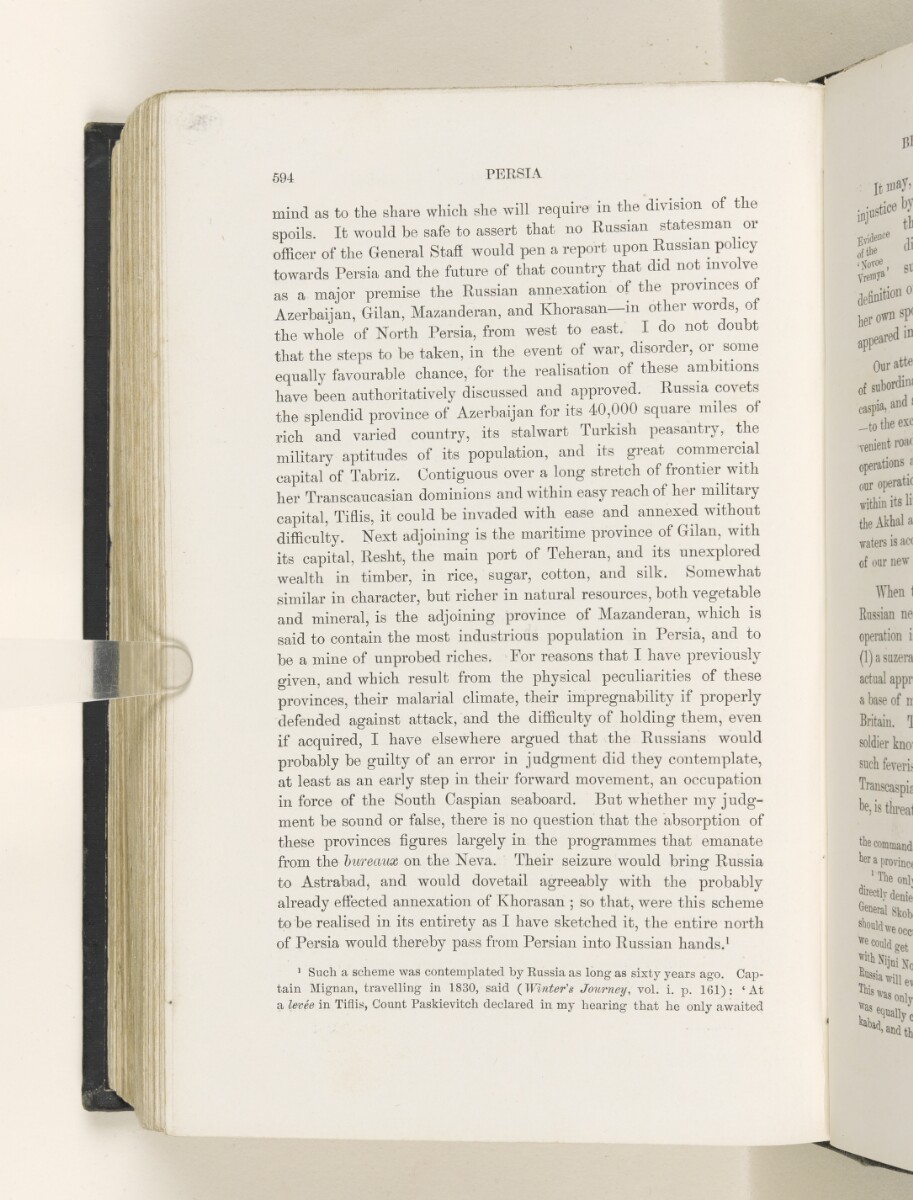
Annotated Copy of Persia and the Persian Question by George Curzon, with Inserted Papers [866v] (1749/1814)
The record is made up of 2 volumes with inserts (898 folios). It was created in 1892-1924. It was written in English, Urdu and German. The original is part of the British Library: India Office The department of the British Government to which the Government of India reported between 1858 and 1947. The successor to the Court of Directors. Records and Private Papers Documents collected in a private capacity. .
Transcription
This transcription is created automatically. It may contain errors.
594
PERSIA
mind as to the share which she will require in the division of the
spoils. It would be safe to assert that no Russian statesman or
officer of the General Staff would pen a report upon Russian po icy
towards Persia and the future of that country that did not involve
as a major premise the Russian annexation of the provinces o^
Azerbaijan, Gilan, Mazanderan, and Khorasan—in other words, of
the whole of North Persia, from west to east. I do not doubt
that the steps to be taken, in the event of war, disorder, or some
equally favourable chance, for the realisation of these ambitions
have been authoritatively discussed and approved. Russia covets
the splendid province of Azerbaijan for its 40,000 square miles of
rich and varied country, its stalwart Turkish peasantry, the
military aptitudes of its population, and its great commercial
capital of Tabriz. Contiguous over a long stretch of frontier with
her Transcaucasian dominions and within easy reach of her military
capital, Tiflis, it could be invaded with ease and annexed without
difficulty. Next adjoining is the maritime province of Gilan, with
its capital, Resht, the main port of Teheran, and its unexplored
wealth in timber, in rice, sugar, cotton, and silk. Somewhat
similar in character, but richer in natural resources, both vegetable
and mineral, is the adjoining province of Mazanderan, which is
said to contain the most industrious population in Persia, and to
be a mine of unprobed riches. For reasons that I have previously
given, and which result from the physical peculiarities of these
provinces, their malarial climate, their impregnability if properly
defended against attack, and the difficulty of holding them, even
if acquired, I have elsewhere argued that the Russians would
probably be guilty of an error in judgment did they contemplate,
at least as an early step in their forward movement, an occupation
in force of the South Caspian seaboard. But whether my judg
ment be sound or false, there is no question that the absorption of
these provinces figures largely in the programmes that emanate
from the bureaux on the Neva. Their seizure would bring Russia
to Astrabad, and would dovetail agreeably with the probably
already effected annexation of Khorasan ; so that, were this scheme
to be realised in its entirety as I have sketched it, the entire north
of Persia would thereby pass from Persian into Russian hands. 1
1 Such a scheme was contemplated by Russia as long as sixty years ago. Cap
tain Mignan, travelling in 1830, said ( Winter's Journey, vol. i. p. 161): ‘At
a levee in Tiflis, Count Paskievitch declared in my hearing that he only awaited
About this item
- Content
These two volumes are George Curzon's own personal annotated copies of both volumes of his book Persia and the Persian Question , which was published in 1892. Alongside the volumes are various loose papers relating to Persia [Iran], consisting of the following: received correspondence; newspaper cuttings; publishers' press releases; cuttings from various booksellers' catalogues; various journal and magazine articles; two items of printed official British correspondence; several prints of photographs and sketches; and a few handwritten notes by Curzon.
In most cases these papers, which range in date from 1892 to 1924, relate to the chapters in the book where they were originally inserted, suggesting that they were kept by Curzon with the intention of using them to inform a revised edition of the book.
Of particular note among the small amount of correspondence are two letters received by Curzon in 1914 and 1915 from retired schoolmaster and Islamic scholar Sayyid Mazhar Hasan Musawi of Saharanpur, Uttar Pradesh, India (ff 5-9 and ff 44-53). These letters, which are written in Urdu and are accompanied by English translations, discuss in detail several inaccuracies found in the Urdu version of Persia and the Persian Question .
The various prints of photographs and sketches, which were originally inserted into volume two, are of different locations in the Gulf region. Several of these appear to have been produced in preparation for the publication of the second volume of John Gordon Lorimer's Gazetteer of the Persian Gulf The historical term used to describe the body of water between the Arabian Peninsula and Iran. , Oman and Central Arabia (i.e. the 'Geographical and Statistical' section) in 1908, as they are identical to the versions found in that volume.
Also of note among the loose papers are an illustrated article from Country Life dated 5 June 1920, entitled 'The People of Persia' (ff 36-37), and a printed family tree of the Shah of Persia [Aḥmad Shah Qājār], produced in preparation of his visit to Britain in 1919 (f 233).
Volume one of Persia and the Persian Question contains a map of Persia, Afghanistan and Beluchistan [Balochistan], which is folded inside the front cover (f 1).
The German language material consists of a publisher's press release for two books authored by German archaeologist Ernst Emil Herzfeld (ff 29-30).
- Extent and format
- 2 volumes with inserts (898 folios)
- Physical characteristics
Foliation: this shelfmark consists of two physical volumes. The foliation sequence commences at the first folio of volume one (1-463), and terminates at the last folio of volume two (ff 464-898); these numbers are written in pencil, are circled, and are located in the top right corner of the recto The front of a sheet of paper or leaf, often abbreviated to 'r'. side of each folio. Each volume contains a large number of loose leaves, which have been foliated in the order that they were inserted into the volume; for conservation reasons, these loose folios have been removed from the volume and stored separately. The foliation sequence does not include the front and back covers of the two volumes.
Pagination: the file also contains an original printed pagination sequence.
- Written in
- English, Urdu and German in Latin and Arabic script View the complete information for this record
Use and share this item
- Share this item
Annotated Copy of Persia and the Persian Question by George Curzon, with Inserted Papers [866v] (1749/1814), British Library: India Office Records and Private Papers, Mss Eur F111/33, in Qatar Digital Library <https://www.qdl.qa/archive/81055/vdc_100157213850.0x000096> [accessed 19 August 2026]
https://www.qdl.qa/en/archive/81055/vdc_100157213850.0x000096
Copy and paste the code below into your web page where you would like to embed the image.
<meta charset="utf-8"><a href="https://www.qdl.qa/en/archive/81055/vdc_100157213850.0x000096">Annotated Copy of <em>Persia and the Persian Question</em> by George Curzon, with Inserted Papers [‎866v] (1749/1814)</a> <a href="https://www.qdl.qa/en/archive/81055/vdc_100157213850.0x000096"> <img src="https://iiif.qdl.qa/iiif/images/81055/vdc_100000001491.0x00033b/Mss Eur F111_33_1779.jp2/full/!280,240/0/default.jpg" alt="" /> </a>
This record has a IIIF manifest available as follows. If you have a compatible viewer you can drag the icon to load it.https://www.qdl.qa/en/iiif/81055/vdc_100000001491.0x00033b/manifestOpen in Universal viewerOpen in Mirador viewerMore options for embedding images
Copyright: How to use this content
- Reference
- Mss Eur F111/33
- Title
- Annotated Copy of Persia and the Persian Questionby George Curzon, with Inserted Papers
- Pages
- 54r:135v, 147r:149v, 158r:180v, 183r:221v, 224r:224v, 227r:246v, 248r:257v, 259r:260v, 268r:362v, 364r:364v, 367r:388v, 390r:400v, 402r:416v, 419r:432v, 434r:444v, 448r:462v, 464r:471v, 475r:481v, 483r:513v, 516r:525v, 527r:544v, 546r:563v, 566r:598v, 600r:622v, 624r:656v, 658r:665v, 667r:675v, 678r:684v, 687r:688v, 691r:691v, 693r:693v, 695r:708v, 711r:721v, 724r:726v, 728r:729v, 731r:736v, 742r:742v, 746r:757v, 759r:761v, 763r:763v, 765r:765v, 772r:777v, 780r:789v, 793r:794v, 797r:809v, 811r:821v, 825r:840v, 843r:898v
- Author
- Curzon, George Nathaniel, 1st Marquess Curzon of Kedleston
- Usage terms
- Public Domain