
![Annotated Copy of <em>Persia and the Persian Question</em> by George Curzon, with Inserted Papers [‎845r] (1706/1814)](https://iiif.qdl.qa/iiif/images/81055/vdc_100000001491.0x00033b/Mss Eur F111_33_1736.jp2/full/!1200,1200/0/default.jpg "Annotated Copy of <em>Persia and the Persian Question</em> by George Curzon, with Inserted Papers [‎845r] (1706/1814)")
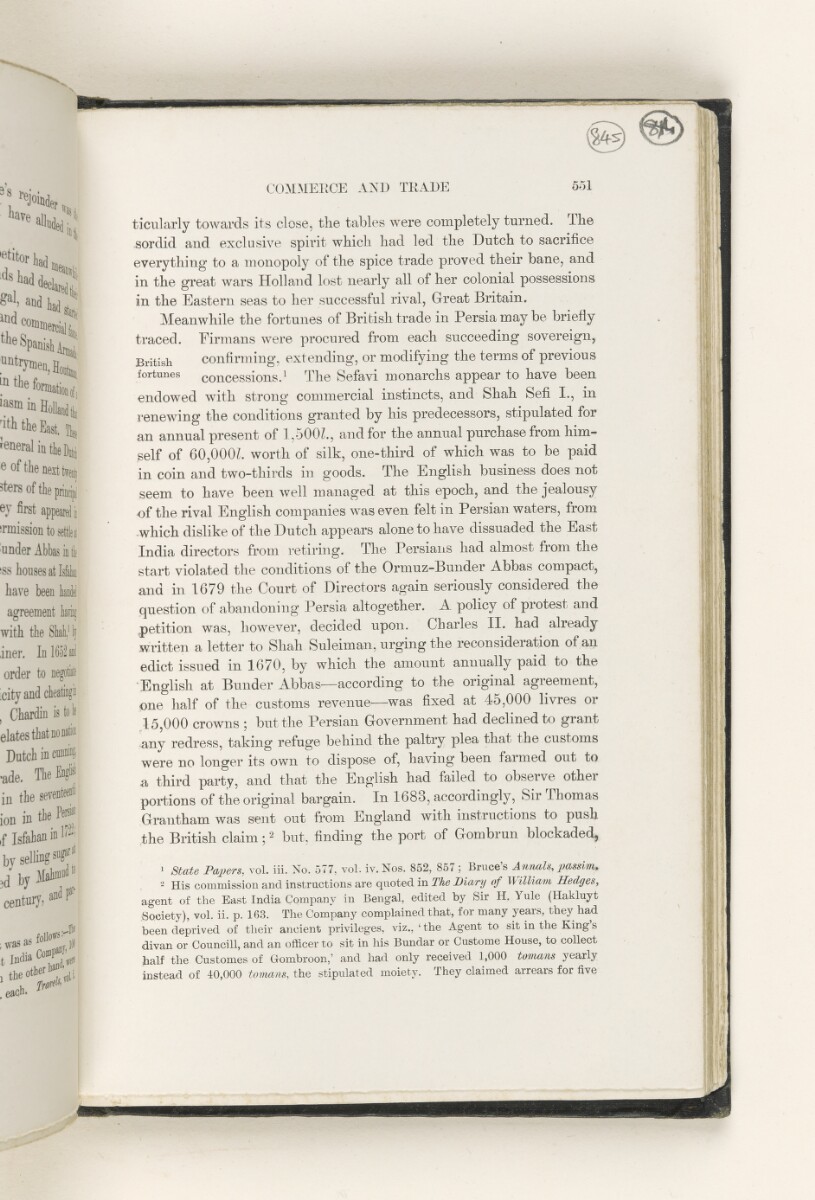
Annotated Copy of Persia and the Persian Question by George Curzon, with Inserted Papers [845r] (1706/1814)
The record is made up of 2 volumes with inserts (898 folios). It was created in 1892-1924. It was written in English, Urdu and German. The original is part of the British Library: India Office The department of the British Government to which the Government of India reported between 1858 and 1947. The successor to the Court of Directors. Records and Private Papers Documents collected in a private capacity. .
Transcription
This transcription is created automatically. It may contain errors.
COMMEKCE AND TRADE
551
ticularly towards its close, the tables were completely turned, the
sordid and exclusive spirit which had led the Dutch to sacrifice
everything to a monopoly of the spice trade proved their bane, and
in the great wars Holland lost nearly all of her colonial possessions
in the Eastern seas to her successful rival, Great Britain.
Meanwhile the fortunes of British trade in Persia may be briefly
traced. Firmans were procured from each succeeding sovereign,
British confirming, extending, or modifying the terms of previous
fortunes concessions. 1 The Sefavi monarchs appear to have been
endowed with strong commercial instincts, and Shah Sefi I., in
renewing the conditions granted by his predecessors, stipulated for
an annual present of 1,500L, and for the annual purchase from him
self of 60,000L worth of silk, one-third of which was to be paid
in coin and two-thirds in goods. The English business does not
seem to have been well managed at this epoch, and the jealousy
of the rival English companies was even felt in Persian waters, from
which dislike of the Dutch appears alone to have dissuaded the East
India directors from retiring. The Persians had almost from the
start violated the conditions of the Ormuz-Bunder Abbas compact,
and in 1679 the
Court of Directors
The London-based directors of the East India Company who dealt with the daily conduct of the Company's affairs.
again seriously considered the
question of abandoning Persia altogether. A policy of protest and
petition was, however, decided upon. Charles II. had already
written a letter to Shah Suleiman, urging the reconsideration of an
edict issued in 1670, by which the amount annually paid to the
English at Bunder Abbas—according to the original agreement,
one half of the customs revenue—was fixed at 45,000 livres or
15,000 crowns ; but the Persian Government had declined to grant
any redress, taking refuge behind the paltry plea that the customs
were no longer its own to dispose of, having been farmed out to
a third party, and that the English had failed to observe othei
portions of the original bargain. In 1683, accordingly, Sir Thomas
Grantham was sent out from England with instructions to push
the British claim; 2 but, finding the port of Gombrun blockaded,
1 State Papers, vol. iii. No. 577, vol. iv. Nos. 852, 857 ; Bruces Annals, passim*
2 His commission and instructions are quoted in The Diary of William Hedges,
agent of the East India Company in Bengal, edited by Sir H. Yule (Hakluyt
Society), vol. ii. p. 168. The Company complained that, for many years, they had
been deprived of their ancient privileges, viz., ‘ the Agent to sit in the King s
divan or Councill, and an officer to sit in his Bundar or Custome House, to collect
half the Customes of Gombroon,’ and had only received 1,000
tomans
10,000 Persian dinars, or a gold coin of that value.
yearly
instead of 40,000
tomans
10,000 Persian dinars, or a gold coin of that value.
, the stipulated moiety. They claimed arrears for five
About this item
- Content
These two volumes are George Curzon's own personal annotated copies of both volumes of his book Persia and the Persian Question , which was published in 1892. Alongside the volumes are various loose papers relating to Persia [Iran], consisting of the following: received correspondence; newspaper cuttings; publishers' press releases; cuttings from various booksellers' catalogues; various journal and magazine articles; two items of printed official British correspondence; several prints of photographs and sketches; and a few handwritten notes by Curzon.
In most cases these papers, which range in date from 1892 to 1924, relate to the chapters in the book where they were originally inserted, suggesting that they were kept by Curzon with the intention of using them to inform a revised edition of the book.
Of particular note among the small amount of correspondence are two letters received by Curzon in 1914 and 1915 from retired schoolmaster and Islamic scholar Sayyid Mazhar Hasan Musawi of Saharanpur, Uttar Pradesh, India (ff 5-9 and ff 44-53). These letters, which are written in Urdu and are accompanied by English translations, discuss in detail several inaccuracies found in the Urdu version of Persia and the Persian Question .
The various prints of photographs and sketches, which were originally inserted into volume two, are of different locations in the Gulf region. Several of these appear to have been produced in preparation for the publication of the second volume of John Gordon Lorimer's Gazetteer of the Persian Gulf The historical term used to describe the body of water between the Arabian Peninsula and Iran. , Oman and Central Arabia (i.e. the 'Geographical and Statistical' section) in 1908, as they are identical to the versions found in that volume.
Also of note among the loose papers are an illustrated article from Country Life dated 5 June 1920, entitled 'The People of Persia' (ff 36-37), and a printed family tree of the Shah of Persia [Aḥmad Shah Qājār], produced in preparation of his visit to Britain in 1919 (f 233).
Volume one of Persia and the Persian Question contains a map of Persia, Afghanistan and Beluchistan [Balochistan], which is folded inside the front cover (f 1).
The German language material consists of a publisher's press release for two books authored by German archaeologist Ernst Emil Herzfeld (ff 29-30).
- Extent and format
- 2 volumes with inserts (898 folios)
- Physical characteristics
Foliation: this shelfmark consists of two physical volumes. The foliation sequence commences at the first folio of volume one (1-463), and terminates at the last folio of volume two (ff 464-898); these numbers are written in pencil, are circled, and are located in the top right corner of the recto The front of a sheet of paper or leaf, often abbreviated to 'r'. side of each folio. Each volume contains a large number of loose leaves, which have been foliated in the order that they were inserted into the volume; for conservation reasons, these loose folios have been removed from the volume and stored separately. The foliation sequence does not include the front and back covers of the two volumes.
Pagination: the file also contains an original printed pagination sequence.
- Written in
- English, Urdu and German in Latin and Arabic script View the complete information for this record
Use and share this item
- Share this item
Annotated Copy of Persia and the Persian Question by George Curzon, with Inserted Papers [845r] (1706/1814), British Library: India Office Records and Private Papers, Mss Eur F111/33, in Qatar Digital Library <https://www.qdl.qa/archive/81055/vdc_100157213850.0x00006b> [accessed 21 August 2026]
https://www.qdl.qa/en/archive/81055/vdc_100157213850.0x00006b
Copy and paste the code below into your web page where you would like to embed the image.
<meta charset="utf-8"><a href="https://www.qdl.qa/en/archive/81055/vdc_100157213850.0x00006b">Annotated Copy of <em>Persia and the Persian Question</em> by George Curzon, with Inserted Papers [‎845r] (1706/1814)</a> <a href="https://www.qdl.qa/en/archive/81055/vdc_100157213850.0x00006b"> <img src="https://iiif.qdl.qa/iiif/images/81055/vdc_100000001491.0x00033b/Mss Eur F111_33_1736.jp2/full/!280,240/0/default.jpg" alt="" /> </a>
This record has a IIIF manifest available as follows. If you have a compatible viewer you can drag the icon to load it.https://www.qdl.qa/en/iiif/81055/vdc_100000001491.0x00033b/manifestOpen in Universal viewerOpen in Mirador viewerMore options for embedding images
Copyright: How to use this content
- Reference
- Mss Eur F111/33
- Title
- Annotated Copy of Persia and the Persian Questionby George Curzon, with Inserted Papers
- Pages
- 54r:135v, 147r:149v, 158r:180v, 183r:221v, 224r:224v, 227r:246v, 248r:257v, 259r:260v, 268r:362v, 364r:364v, 367r:388v, 390r:400v, 402r:416v, 419r:432v, 434r:444v, 448r:462v, 464r:471v, 475r:481v, 483r:513v, 516r:525v, 527r:544v, 546r:563v, 566r:598v, 600r:622v, 624r:656v, 658r:665v, 667r:675v, 678r:684v, 687r:688v, 691r:691v, 693r:693v, 695r:708v, 711r:721v, 724r:726v, 728r:729v, 731r:736v, 742r:742v, 746r:757v, 759r:761v, 763r:763v, 765r:765v, 772r:777v, 780r:789v, 793r:794v, 797r:809v, 811r:821v, 825r:840v, 843r:898v
- Author
- Curzon, George Nathaniel, 1st Marquess Curzon of Kedleston
- Usage terms
- Public Domain