
![Annotated Copy of <em>Persia and the Persian Question</em> by George Curzon, with Inserted Papers [‎830v] (1677/1814)](https://iiif.qdl.qa/iiif/images/81055/vdc_100000001491.0x00033b/Mss Eur F111_33_1707.jp2/full/!1200,1200/0/default.jpg "Annotated Copy of <em>Persia and the Persian Question</em> by George Curzon, with Inserted Papers [‎830v] (1677/1814)")
Annotated Copy of Persia and the Persian Question by George Curzon, with Inserted Papers [830v] (1677/1814)
The record is made up of 2 volumes with inserts (898 folios). It was created in 1892-1924. It was written in English, Urdu and German. The original is part of the British Library: India Office The department of the British Government to which the Government of India reported between 1858 and 1947. The successor to the Court of Directors. Records and Private Papers Documents collected in a private capacity. .
Transcription
This transcription is created automatically. It may contain errors.
K
526
PERSIA
Artistic
produc
tions
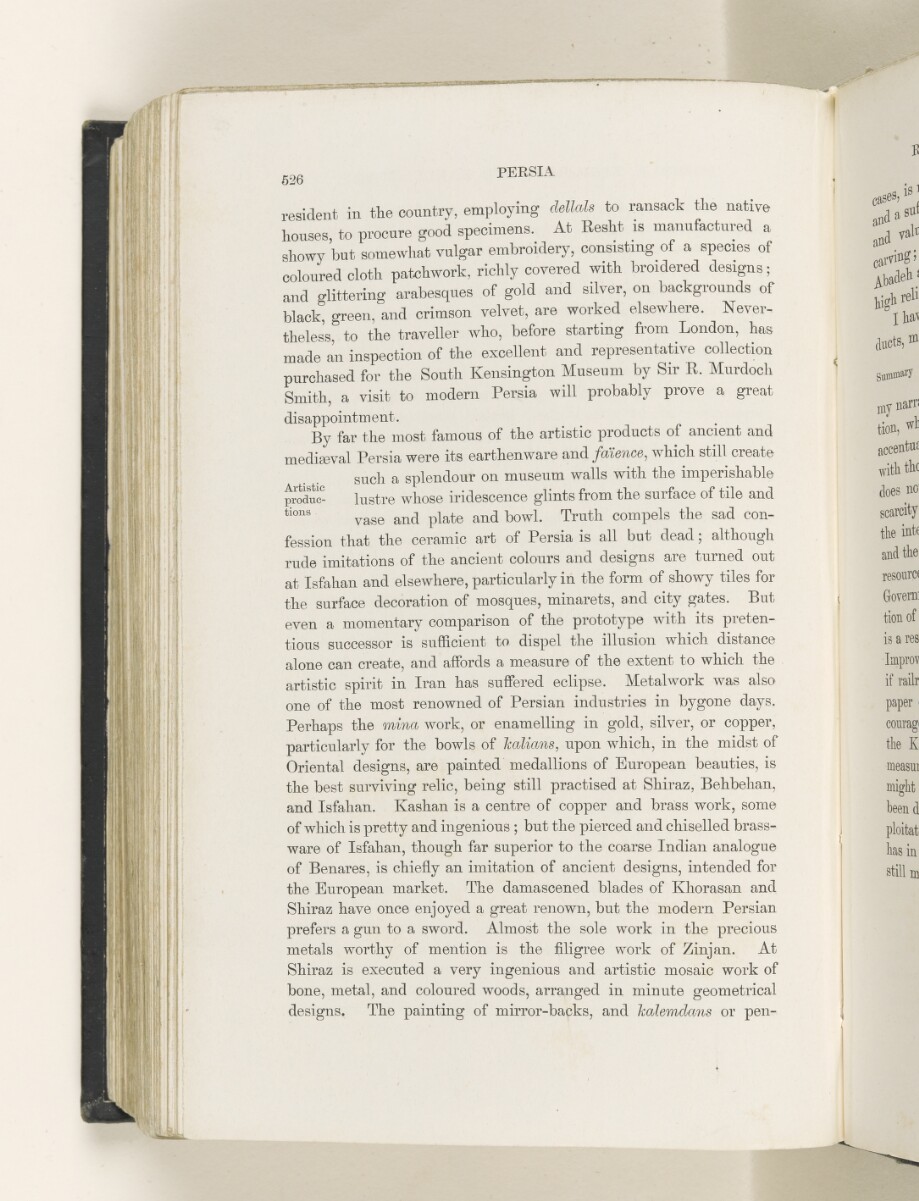
resident in the country, employing dellals to ransack the native
houses to procure good specimens. At Resht is manufactured a
showy but somewhat vulgar embroidery, consisting of a species of
coloured cloth patchwork, richly covered with broxdered designs;
and glittering arabesques of gold and silver, on backgrounds of
black, green, and crimson velvet, are worked elsewhere. Never
theless, to the traveller who, before starting fiom London, has
made an inspection of the excellent and representative collection
purchased for the South Kensington Museum by Sir R. Murdoch
Smith, a visit to modem Persia will probably prove a great
disappointment.
By far tlie most famous of tlie artistic products of ancient and
mediseval Persia were its earthenware and faience, which still create
such a splendour on museum walls with the imperishable
lustre whose iridescence glints from the surface of tile and
vase and plate and bowl. Truth compels the sad con
fession that the ceramic art of Persia is all but dead; although
rude imitations of the ancient colours and designs are turned out
at Isfahan and elsewhere, particularly in the form of showy tiles for
the surface decoration of mosques, minarets, and city gates. But
even a momentary comparison of the prototype with its preten
tious successor is sufficient to dispel the illusion which distance
alone can create, and affords a measure of the extent to which the
artistic spirit in Iran has suffered eclipse. Metalwork was also
one of the most renowned of Persian industries in bygone days.
Perhaps the mina work, or enamelling in gold, silver, or copper,
particularly for the bowls of 'kalians, upon which, in the midst of
Oriental designs, are painted medallions of European beauties, is
the best surviving relic, being still practised at Shiraz, Behbehan,
and Isfahan. Kashan is a centre of copper and brass work, some
of which is pretty and ingenious ; but the pierced and chiselled brass-
ware of Isfahan, though far superior to the coarse Indian analogue
of Benares, is chiefly an imitation of ancient designs, intended for
the European market. The damascened blades of Khorasan and
Shiraz have once enjoyed a great renown, but the modern Persian
prefers a gun to a sword. Almost the sole work in the precious
metals worthy of mention is the filigree work of Zinjan. At
Shiraz is executed a very ingenious and artistic mosaic work of
bone, metal, and coloured woods, arranged in minute geometrical
designs. The painting of mirror-backs, and kalemdans or pen-
About this item
- Content
These two volumes are George Curzon's own personal annotated copies of both volumes of his book Persia and the Persian Question , which was published in 1892. Alongside the volumes are various loose papers relating to Persia [Iran], consisting of the following: received correspondence; newspaper cuttings; publishers' press releases; cuttings from various booksellers' catalogues; various journal and magazine articles; two items of printed official British correspondence; several prints of photographs and sketches; and a few handwritten notes by Curzon.
In most cases these papers, which range in date from 1892 to 1924, relate to the chapters in the book where they were originally inserted, suggesting that they were kept by Curzon with the intention of using them to inform a revised edition of the book.
Of particular note among the small amount of correspondence are two letters received by Curzon in 1914 and 1915 from retired schoolmaster and Islamic scholar Sayyid Mazhar Hasan Musawi of Saharanpur, Uttar Pradesh, India (ff 5-9 and ff 44-53). These letters, which are written in Urdu and are accompanied by English translations, discuss in detail several inaccuracies found in the Urdu version of Persia and the Persian Question .
The various prints of photographs and sketches, which were originally inserted into volume two, are of different locations in the Gulf region. Several of these appear to have been produced in preparation for the publication of the second volume of John Gordon Lorimer's Gazetteer of the Persian Gulf The historical term used to describe the body of water between the Arabian Peninsula and Iran. , Oman and Central Arabia (i.e. the 'Geographical and Statistical' section) in 1908, as they are identical to the versions found in that volume.
Also of note among the loose papers are an illustrated article from Country Life dated 5 June 1920, entitled 'The People of Persia' (ff 36-37), and a printed family tree of the Shah of Persia [Aḥmad Shah Qājār], produced in preparation of his visit to Britain in 1919 (f 233).
Volume one of Persia and the Persian Question contains a map of Persia, Afghanistan and Beluchistan [Balochistan], which is folded inside the front cover (f 1).
The German language material consists of a publisher's press release for two books authored by German archaeologist Ernst Emil Herzfeld (ff 29-30).
- Extent and format
- 2 volumes with inserts (898 folios)
- Physical characteristics
Foliation: this shelfmark consists of two physical volumes. The foliation sequence commences at the first folio of volume one (1-463), and terminates at the last folio of volume two (ff 464-898); these numbers are written in pencil, are circled, and are located in the top right corner of the recto The front of a sheet of paper or leaf, often abbreviated to 'r'. side of each folio. Each volume contains a large number of loose leaves, which have been foliated in the order that they were inserted into the volume; for conservation reasons, these loose folios have been removed from the volume and stored separately. The foliation sequence does not include the front and back covers of the two volumes.
Pagination: the file also contains an original printed pagination sequence.
- Written in
- English, Urdu and German in Latin and Arabic script View the complete information for this record
Use and share this item
- Share this item
Annotated Copy of Persia and the Persian Question by George Curzon, with Inserted Papers [830v] (1677/1814), British Library: India Office Records and Private Papers, Mss Eur F111/33, in Qatar Digital Library <https://www.qdl.qa/archive/81055/vdc_100157213850.0x00004e> [accessed 21 July 2026]
https://www.qdl.qa/en/archive/81055/vdc_100157213850.0x00004e
Copy and paste the code below into your web page where you would like to embed the image.
<meta charset="utf-8"><a href="https://www.qdl.qa/en/archive/81055/vdc_100157213850.0x00004e">Annotated Copy of <em>Persia and the Persian Question</em> by George Curzon, with Inserted Papers [‎830v] (1677/1814)</a> <a href="https://www.qdl.qa/en/archive/81055/vdc_100157213850.0x00004e"> <img src="https://iiif.qdl.qa/iiif/images/81055/vdc_100000001491.0x00033b/Mss Eur F111_33_1707.jp2/full/!280,240/0/default.jpg" alt="" /> </a>
This record has a IIIF manifest available as follows. If you have a compatible viewer you can drag the icon to load it.https://www.qdl.qa/en/iiif/81055/vdc_100000001491.0x00033b/manifestOpen in Universal viewerOpen in Mirador viewerMore options for embedding images
Copyright: How to use this content
- Reference
- Mss Eur F111/33
- Title
- Annotated Copy of Persia and the Persian Questionby George Curzon, with Inserted Papers
- Pages
- 54r:135v, 147r:149v, 158r:180v, 183r:221v, 224r:224v, 227r:246v, 248r:257v, 259r:260v, 268r:362v, 364r:364v, 367r:388v, 390r:400v, 402r:416v, 419r:432v, 434r:444v, 448r:462v, 464r:471v, 475r:481v, 483r:513v, 516r:525v, 527r:544v, 546r:563v, 566r:598v, 600r:622v, 624r:656v, 658r:665v, 667r:675v, 678r:684v, 687r:688v, 691r:691v, 693r:693v, 695r:708v, 711r:721v, 724r:726v, 728r:729v, 731r:736v, 742r:742v, 746r:757v, 759r:761v, 763r:763v, 765r:765v, 772r:777v, 780r:789v, 793r:794v, 797r:809v, 811r:821v, 825r:840v, 843r:898v
- Author
- Curzon, George Nathaniel, 1st Marquess Curzon of Kedleston
- Usage terms
- Public Domain