
![Annotated Copy of <em>Persia and the Persian Question</em> by George Curzon, with Inserted Papers [‎807r] (1630/1814)](https://iiif.qdl.qa/iiif/images/81055/vdc_100000001491.0x00033b/Mss Eur F111_33_1660.jp2/full/!1200,1200/0/default.jpg "Annotated Copy of <em>Persia and the Persian Question</em> by George Curzon, with Inserted Papers [‎807r] (1630/1814)")
Annotated Copy of Persia and the Persian Question by George Curzon, with Inserted Papers [807r] (1630/1814)
The record is made up of 2 volumes with inserts (898 folios). It was created in 1892-1924. It was written in English, Urdu and German. The original is part of the British Library: India Office The department of the British Government to which the Government of India reported between 1858 and 1947. The successor to the Court of Directors. Records and Private Papers Documents collected in a private capacity. .
Transcription
This transcription is created automatically. It may contain errors.
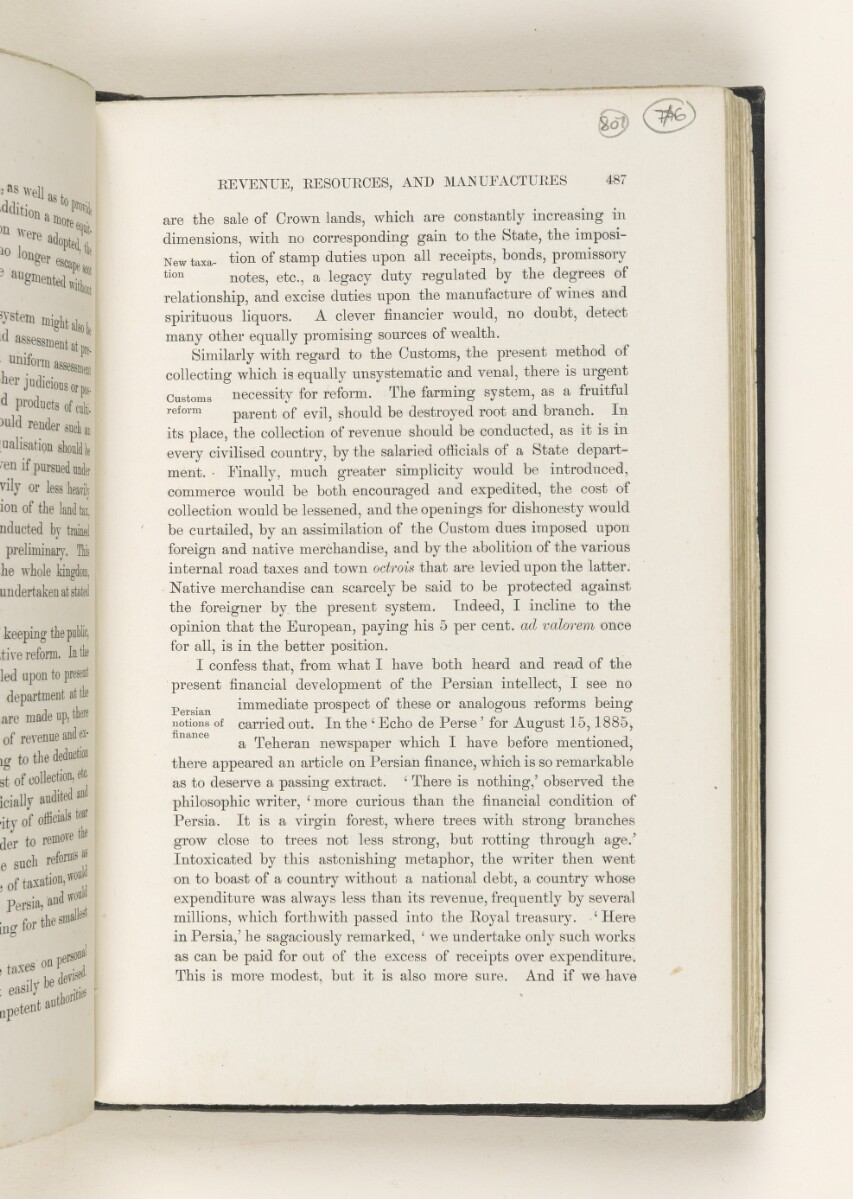
REVENUE, RESOURCES, AND MANUFACTURES 48:
are the sale of Crown lands, which are constantly increasing in
dimensions, wiih no corresponding gain to the State, the imposi-
New taxa- ti° n stamp duties upon all receipts, bonds, promissory
tion notes, etc., a legacy duty regulated by the degrees of
relationship, and excise duties upon the manufacture of wines and
spirituous liquors. A clever financier would, no doubt, detect
many other equally promising sources of wealth.
Similarly with regard to the Customs, the present method ol
collecting which is equally unsystematic and venal, there is urgent
Customs necessity for reform. The farming system, as a fruitful
reform parent of evil, should be destroyed root and branch. In
its place, the collection of revenue should be conducted, as it is in
every civilised country, by the salaried officials of a State depart
ment. • Finally, much greater simplicity would be introduced,
commerce would be both encouraged and expedited, the cost of
collection would be lessened, and the openings for dishonesty would
be curtailed, by an assimilation of the Custom dues imposed upon
foreign and native merchandise, and by the abolition of the various
internal road taxes and town octrois that are levied upon the latter.
Native merchandise can scarcely be said to be protected against
the foreigner by the present system. Indeed, I incline to the
opinion that the European, paying his 5 per cent, ad valorem once
for all, is in the better position.
I confess that, from what I have both heard and read of the
present financial development of the Persian intellect, I see no
Persian immediate prospect of these or analogous reforms being
notions of carried out. In the ‘ Echo de Perse ’ for August 15,1885,
finance • •
a Teheran newspaper which I have before mentioned,
there appeared an article on Persian finance, which is so remarkable
as to deserve a passing extract. ‘ There is nothing,’ observed the
philosophic
writer
The lowest of the four classes into which East India Company civil servants were divided. A Writer’s duties originally consisted mostly of copying documents and book-keeping.
, ‘ more curious than the financial condition of
Persia. It is a virgin forest, where trees with strong branches
grow close to trees not less strong, but rotting through age.’
Intoxicated by this astonishing metaphor, the
writer
The lowest of the four classes into which East India Company civil servants were divided. A Writer’s duties originally consisted mostly of copying documents and book-keeping.
then went
on to boast of a country without a national debt, a country whose
expenditure was always less than its revenue, frequently by several
millions, which forthwith passed into the Poyal treasury. c Here
in Persia,’ he sagaciously remarked, 4 we undertake only such works
as can be paid for out of the excess of receipts over expenditure.
This is more modest, but it is also more sure. And if we have
About this item
- Content
These two volumes are George Curzon's own personal annotated copies of both volumes of his book Persia and the Persian Question , which was published in 1892. Alongside the volumes are various loose papers relating to Persia [Iran], consisting of the following: received correspondence; newspaper cuttings; publishers' press releases; cuttings from various booksellers' catalogues; various journal and magazine articles; two items of printed official British correspondence; several prints of photographs and sketches; and a few handwritten notes by Curzon.
In most cases these papers, which range in date from 1892 to 1924, relate to the chapters in the book where they were originally inserted, suggesting that they were kept by Curzon with the intention of using them to inform a revised edition of the book.
Of particular note among the small amount of correspondence are two letters received by Curzon in 1914 and 1915 from retired schoolmaster and Islamic scholar Sayyid Mazhar Hasan Musawi of Saharanpur, Uttar Pradesh, India (ff 5-9 and ff 44-53). These letters, which are written in Urdu and are accompanied by English translations, discuss in detail several inaccuracies found in the Urdu version of Persia and the Persian Question .
The various prints of photographs and sketches, which were originally inserted into volume two, are of different locations in the Gulf region. Several of these appear to have been produced in preparation for the publication of the second volume of John Gordon Lorimer's Gazetteer of the Persian Gulf The historical term used to describe the body of water between the Arabian Peninsula and Iran. , Oman and Central Arabia (i.e. the 'Geographical and Statistical' section) in 1908, as they are identical to the versions found in that volume.
Also of note among the loose papers are an illustrated article from Country Life dated 5 June 1920, entitled 'The People of Persia' (ff 36-37), and a printed family tree of the Shah of Persia [Aḥmad Shah Qājār], produced in preparation of his visit to Britain in 1919 (f 233).
Volume one of Persia and the Persian Question contains a map of Persia, Afghanistan and Beluchistan [Balochistan], which is folded inside the front cover (f 1).
The German language material consists of a publisher's press release for two books authored by German archaeologist Ernst Emil Herzfeld (ff 29-30).
- Extent and format
- 2 volumes with inserts (898 folios)
- Physical characteristics
Foliation: this shelfmark consists of two physical volumes. The foliation sequence commences at the first folio of volume one (1-463), and terminates at the last folio of volume two (ff 464-898); these numbers are written in pencil, are circled, and are located in the top right corner of the recto The front of a sheet of paper or leaf, often abbreviated to 'r'. side of each folio. Each volume contains a large number of loose leaves, which have been foliated in the order that they were inserted into the volume; for conservation reasons, these loose folios have been removed from the volume and stored separately. The foliation sequence does not include the front and back covers of the two volumes.
Pagination: the file also contains an original printed pagination sequence.
- Written in
- English, Urdu and German in Latin and Arabic script View the complete information for this record
Use and share this item
- Share this item
Annotated Copy of Persia and the Persian Question by George Curzon, with Inserted Papers [807r] (1630/1814), British Library: India Office Records and Private Papers, Mss Eur F111/33, in Qatar Digital Library <https://www.qdl.qa/archive/81055/vdc_100157213850.0x00001f> [accessed 18 July 2026]
https://www.qdl.qa/en/archive/81055/vdc_100157213850.0x00001f
Copy and paste the code below into your web page where you would like to embed the image.
<meta charset="utf-8"><a href="https://www.qdl.qa/en/archive/81055/vdc_100157213850.0x00001f">Annotated Copy of <em>Persia and the Persian Question</em> by George Curzon, with Inserted Papers [‎807r] (1630/1814)</a> <a href="https://www.qdl.qa/en/archive/81055/vdc_100157213850.0x00001f"> <img src="https://iiif.qdl.qa/iiif/images/81055/vdc_100000001491.0x00033b/Mss Eur F111_33_1660.jp2/full/!280,240/0/default.jpg" alt="" /> </a>
This record has a IIIF manifest available as follows. If you have a compatible viewer you can drag the icon to load it.https://www.qdl.qa/en/iiif/81055/vdc_100000001491.0x00033b/manifestOpen in Universal viewerOpen in Mirador viewerMore options for embedding images
Copyright: How to use this content
- Reference
- Mss Eur F111/33
- Title
- Annotated Copy of Persia and the Persian Questionby George Curzon, with Inserted Papers
- Pages
- 54r:135v, 147r:149v, 158r:180v, 183r:221v, 224r:224v, 227r:246v, 248r:257v, 259r:260v, 268r:362v, 364r:364v, 367r:388v, 390r:400v, 402r:416v, 419r:432v, 434r:444v, 448r:462v, 464r:471v, 475r:481v, 483r:513v, 516r:525v, 527r:544v, 546r:563v, 566r:598v, 600r:622v, 624r:656v, 658r:665v, 667r:675v, 678r:684v, 687r:688v, 691r:691v, 693r:693v, 695r:708v, 711r:721v, 724r:726v, 728r:729v, 731r:736v, 742r:742v, 746r:757v, 759r:761v, 763r:763v, 765r:765v, 772r:777v, 780r:789v, 793r:794v, 797r:809v, 811r:821v, 825r:840v, 843r:898v
- Author
- Curzon, George Nathaniel, 1st Marquess Curzon of Kedleston
- Usage terms
- Public Domain