
![Annotated Copy of <em>Persia and the Persian Question</em> by George Curzon, with Inserted Papers [‎789v] (1595/1814)](https://iiif.qdl.qa/iiif/images/81055/vdc_100000001491.0x00033b/Mss Eur F111_33_1621.jp2/full/!1200,1200/0/default.jpg "Annotated Copy of <em>Persia and the Persian Question</em> by George Curzon, with Inserted Papers [‎789v] (1595/1814)")
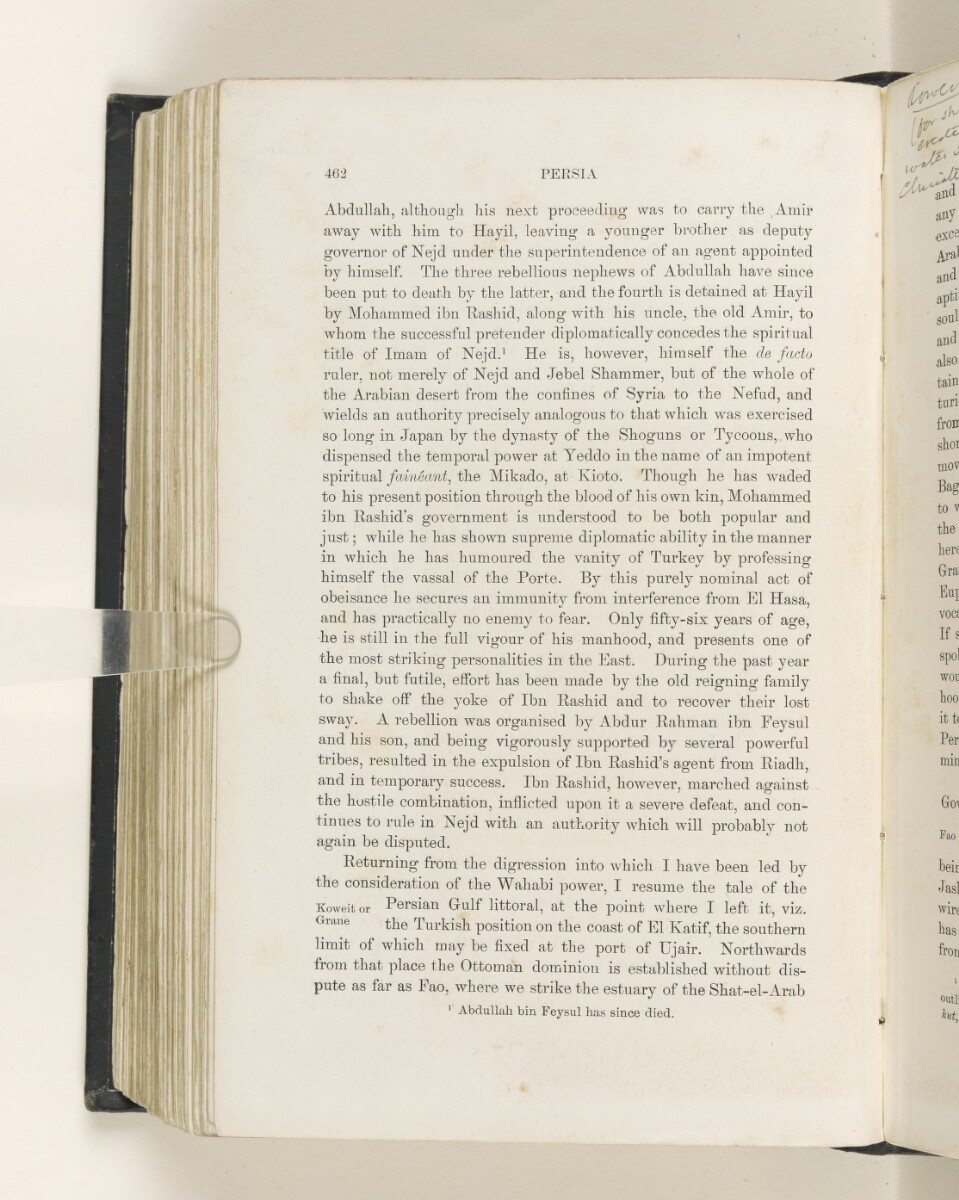
Annotated Copy of Persia and the Persian Question by George Curzon, with Inserted Papers [789v] (1595/1814)
The record is made up of 2 volumes with inserts (898 folios). It was created in 1892-1924. It was written in English, Urdu and German. The original is part of the British Library: India Office The department of the British Government to which the Government of India reported between 1858 and 1947. The successor to the Court of Directors. Records and Private Papers Documents collected in a private capacity. .
Transcription
This transcription is created automatically. It may contain errors.
462 PERSIA
Abdullah, although his next proceeding was to carry the Amir
away with him to Hayil, leaving a younger brother as deputy
governor of Nejd under the superintendence of an agent appointed
by himself. The three rebellious nephews of Abdullah have since
been put to death by the latter, and the fourth is detained at Hayil
by Mohammed ibn Rashid, along with his uncle, the old Amir, to
whom the successful pretender diplomatically concedes the spiritual
title of Imam of Nejd. 1 He is, however, himself the de facto
ruler, not merely of Nejd and Jebel Shammer, but of the whole of
the Arabian desert from the confines of Syria to the Nefud, and
wields an authority precisely analogous to that which was exercised
so long in Japan by the dynasty of the Shoguns or Tycoons, who
dispensed the temporal power at Yeddo in the name of an impotent
spiritual faineant, the Mikado, at Kioto. Though he has waded
to his present position through the blood of his own kin, Mohammed
ibn Rashid's government is understood to be both popular and
just; while he has shown supreme diplomatic ability in the manner
in which he has humoured the vanity of Turkey by professing
himself the vassal of the Porte. By this purely nominal act of
obeisance he secures an immunity from interference from El Hasa,
and has practically no enemy to fear. Only fifty-six years of age,
he is still in the full vigour of his manhood, and presents one of
the most striking personalities in the East. During the past year
a final, but futile, effort has been made by the old reigning family
to shake off the yoke of Ibn Rashid and to recover their lost
sway. A rebellion was organised by Abdur Rahman ibn Feysul
and his son, and being vigorously supported by several powerful
tribes, resulted in the expulsion of Ibn Rashid’s agent from Riadh,
and in temporary success. Ibn Rashid, however, marched against
the hostile combination, inflicted upon it a severe defeat, and con
tinues to rule in Nejd with an authority which will probably not
again be disputed.
Returning from the digression into which I have been led by
the consideration of the Wahabi power, I resume the tale of the
Koweit or
Persian Gulf
The historical term used to describe the body of water between the Arabian Peninsula and Iran.
littoral, at the point where I left it, viz.
the Turkish position on the coast of El Katif, the southern
limit of which may be fixed at the port of IT]air. Northwards
fiom that place the Ottoman dominion is established without dis
pute as far as Pao, where we strike the estuary of the Shat-el-Arab
1 Abdullah bin Feysul has since died.
any
■exce
Aral
, and
apfd
SOlll!
and
also
tain!
turii
frorr
shor
mov
Bag
to U
the
here
Grai
Eui:
voce
If s
spol
won
hooi
it t(
Pen
min
Go\
Fao
beic
Jasl
wire
has
fron
i
outlj
About this item
- Content
These two volumes are George Curzon's own personal annotated copies of both volumes of his book Persia and the Persian Question , which was published in 1892. Alongside the volumes are various loose papers relating to Persia [Iran], consisting of the following: received correspondence; newspaper cuttings; publishers' press releases; cuttings from various booksellers' catalogues; various journal and magazine articles; two items of printed official British correspondence; several prints of photographs and sketches; and a few handwritten notes by Curzon.
In most cases these papers, which range in date from 1892 to 1924, relate to the chapters in the book where they were originally inserted, suggesting that they were kept by Curzon with the intention of using them to inform a revised edition of the book.
Of particular note among the small amount of correspondence are two letters received by Curzon in 1914 and 1915 from retired schoolmaster and Islamic scholar Sayyid Mazhar Hasan Musawi of Saharanpur, Uttar Pradesh, India (ff 5-9 and ff 44-53). These letters, which are written in Urdu and are accompanied by English translations, discuss in detail several inaccuracies found in the Urdu version of Persia and the Persian Question .
The various prints of photographs and sketches, which were originally inserted into volume two, are of different locations in the Gulf region. Several of these appear to have been produced in preparation for the publication of the second volume of John Gordon Lorimer's Gazetteer of the Persian Gulf The historical term used to describe the body of water between the Arabian Peninsula and Iran. , Oman and Central Arabia (i.e. the 'Geographical and Statistical' section) in 1908, as they are identical to the versions found in that volume.
Also of note among the loose papers are an illustrated article from Country Life dated 5 June 1920, entitled 'The People of Persia' (ff 36-37), and a printed family tree of the Shah of Persia [Aḥmad Shah Qājār], produced in preparation of his visit to Britain in 1919 (f 233).
Volume one of Persia and the Persian Question contains a map of Persia, Afghanistan and Beluchistan [Balochistan], which is folded inside the front cover (f 1).
The German language material consists of a publisher's press release for two books authored by German archaeologist Ernst Emil Herzfeld (ff 29-30).
- Extent and format
- 2 volumes with inserts (898 folios)
- Physical characteristics
Foliation: this shelfmark consists of two physical volumes. The foliation sequence commences at the first folio of volume one (1-463), and terminates at the last folio of volume two (ff 464-898); these numbers are written in pencil, are circled, and are located in the top right corner of the recto The front of a sheet of paper or leaf, often abbreviated to 'r'. side of each folio. Each volume contains a large number of loose leaves, which have been foliated in the order that they were inserted into the volume; for conservation reasons, these loose folios have been removed from the volume and stored separately. The foliation sequence does not include the front and back covers of the two volumes.
Pagination: the file also contains an original printed pagination sequence.
- Written in
- English, Urdu and German in Latin and Arabic script View the complete information for this record
Use and share this item
- Share this item
Annotated Copy of Persia and the Persian Question by George Curzon, with Inserted Papers [789v] (1595/1814), British Library: India Office Records and Private Papers, Mss Eur F111/33, in Qatar Digital Library <https://www.qdl.qa/archive/81055/vdc_100157213849.0x0000c4> [accessed 18 July 2026]
https://www.qdl.qa/en/archive/81055/vdc_100157213849.0x0000c4
Copy and paste the code below into your web page where you would like to embed the image.
<meta charset="utf-8"><a href="https://www.qdl.qa/en/archive/81055/vdc_100157213849.0x0000c4">Annotated Copy of <em>Persia and the Persian Question</em> by George Curzon, with Inserted Papers [‎789v] (1595/1814)</a> <a href="https://www.qdl.qa/en/archive/81055/vdc_100157213849.0x0000c4"> <img src="https://iiif.qdl.qa/iiif/images/81055/vdc_100000001491.0x00033b/Mss Eur F111_33_1621.jp2/full/!280,240/0/default.jpg" alt="" /> </a>
This record has a IIIF manifest available as follows. If you have a compatible viewer you can drag the icon to load it.https://www.qdl.qa/en/iiif/81055/vdc_100000001491.0x00033b/manifestOpen in Universal viewerOpen in Mirador viewerMore options for embedding images
Copyright: How to use this content
- Reference
- Mss Eur F111/33
- Title
- Annotated Copy of Persia and the Persian Questionby George Curzon, with Inserted Papers
- Pages
- 54r:135v, 147r:149v, 158r:180v, 183r:221v, 224r:224v, 227r:246v, 248r:257v, 259r:260v, 268r:362v, 364r:364v, 367r:388v, 390r:400v, 402r:416v, 419r:432v, 434r:444v, 448r:462v, 464r:471v, 475r:481v, 483r:513v, 516r:525v, 527r:544v, 546r:563v, 566r:598v, 600r:622v, 624r:656v, 658r:665v, 667r:675v, 678r:684v, 687r:688v, 691r:691v, 693r:693v, 695r:708v, 711r:721v, 724r:726v, 728r:729v, 731r:736v, 742r:742v, 746r:757v, 759r:761v, 763r:763v, 765r:765v, 772r:777v, 780r:789v, 793r:794v, 797r:809v, 811r:821v, 825r:840v, 843r:898v
- Author
- Curzon, George Nathaniel, 1st Marquess Curzon of Kedleston
- Usage terms
- Public Domain