
![Annotated Copy of <em>Persia and the Persian Question</em> by George Curzon, with Inserted Papers [‎781v] (1579/1814)](https://iiif.qdl.qa/iiif/images/81055/vdc_100000001491.0x00033b/Mss Eur F111_33_1605.jp2/full/!1200,1200/0/default.jpg "Annotated Copy of <em>Persia and the Persian Question</em> by George Curzon, with Inserted Papers [‎781v] (1579/1814)")
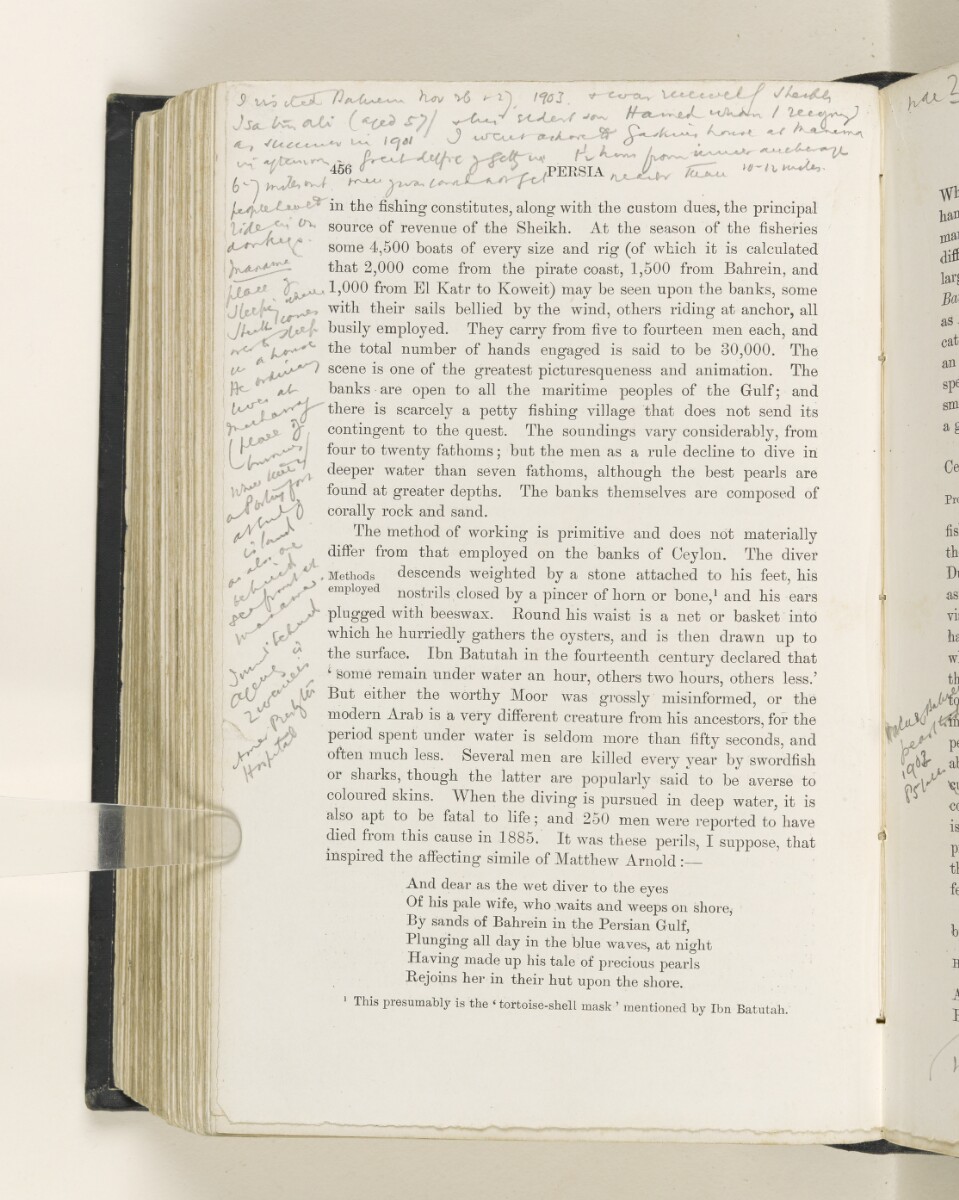
Annotated Copy of Persia and the Persian Question by George Curzon, with Inserted Papers [781v] (1579/1814)
The record is made up of 2 volumes with inserts (898 folios). It was created in 1892-1924. It was written in English, Urdu and German. The original is part of the British Library: India Office The department of the British Government to which the Government of India reported between 1858 and 1947. The successor to the Court of Directors. Records and Private Papers Documents collected in a private capacity. .
Transcription
This transcription is created automatically. It may contain errors.
J) Vvq c-C *• ^ ^ h^-dy v6
? r - <?UU* f ^ 7 /
J
U^- c - C e t->tJ f
M-a- * ' £./ 1 t/k Vw 1 •• / '^ r
<t^ sul<^~ *v \J^7cfti' 3 S Ua -
r&ry.vJtiL t
> ^ v • 1 ’
r' f /
^ j^JL^kSV' f<J
tySL,. ,A~.\.X^' ( A
10 ^ l
^ ^ ^rvt^J ,rw ^ , K ^
juLSI^UL f ■ *» '" in the fishing constitutes, along with the custom dues, the principal
13/^/' ‘ source of revenue of the Sheikh. At the season of the fisheries
A f ! some 4,500 boats of every size and rig (of which it is calculated
that 2,000 come from the pirate coast, 1,500 from Bahrein, and
’ (r> from El Katr to Koweit) may be seen upon the banks, some
AtV-v with their sails bellied by the wind, others riding at anchor, all
busily employed. They carry from five to fourteen men each, and
^ number of hands engaged is said to be 30,000. The
(5 * / scene is one of the greatest picturesqueness and animation. The
banks are open to all the maritime peoples of the Gulf; and
there is scarcely a petty fishing village that does not send its
contingent to the quest. The
soundings
Measurements of the depth of a body of water.
vary considerably, from
four to twenty fathoms; but the men as a rule decline to dive in
deeper water than seven fathoms, although the best pearls are
found at greater depths. The banks themselves are composed of
corally rock and sand.
The method of working is primitive and does not materially
differ from that employed on the banks of Ceylon. The diver
Methods descends weighted by a stone attached to his feet, his
employed nostrils closed by a pincer of horn or bone, 1 and his ears
plugged with beeswax. Bound his waist is a net or basket into
which he hurriedly gathers the oysters, and is then drawn up to
the surface. Ibn Batutah in the fourteenth century declared that
L some remain under water an hour, others two hours, others less.’
But either the worthy Moor was grossly misinformed, or the
modern Arab is a very different creature from his ancestors, for the
peiiod spent under water is seldom more than fifty seconds, and
often much less. Several men are killed every year by swordfish
or sharks, though the latter are popularly said to be averse to
colomed skins. 4Ahen the diving is pursued in deep water, it is
also apt to be fatal to life; and 250 men were reported to have
died from this cause in 1885. It was these perils, I suppose, that
inspired the affecting simile of Matthew Arnold :
And dear as the wet diver to the eyes
Of his pale wife, who waits and weeps on shore,
By sands of Bahrein in the
Persian Gulf
The historical term used to describe the body of water between the Arabian Peninsula and Iran.
,
Plunging all day in the blue waves, at night
Having made up his tale of precious pearls
Bejoins her in their hut upon the shore.
1 This presumably is the ‘ tortoise-shell mask ’ mentioned by Ibn Batutah.
About this item
- Content
These two volumes are George Curzon's own personal annotated copies of both volumes of his book Persia and the Persian Question , which was published in 1892. Alongside the volumes are various loose papers relating to Persia [Iran], consisting of the following: received correspondence; newspaper cuttings; publishers' press releases; cuttings from various booksellers' catalogues; various journal and magazine articles; two items of printed official British correspondence; several prints of photographs and sketches; and a few handwritten notes by Curzon.
In most cases these papers, which range in date from 1892 to 1924, relate to the chapters in the book where they were originally inserted, suggesting that they were kept by Curzon with the intention of using them to inform a revised edition of the book.
Of particular note among the small amount of correspondence are two letters received by Curzon in 1914 and 1915 from retired schoolmaster and Islamic scholar Sayyid Mazhar Hasan Musawi of Saharanpur, Uttar Pradesh, India (ff 5-9 and ff 44-53). These letters, which are written in Urdu and are accompanied by English translations, discuss in detail several inaccuracies found in the Urdu version of Persia and the Persian Question .
The various prints of photographs and sketches, which were originally inserted into volume two, are of different locations in the Gulf region. Several of these appear to have been produced in preparation for the publication of the second volume of John Gordon Lorimer's Gazetteer of the Persian Gulf The historical term used to describe the body of water between the Arabian Peninsula and Iran. , Oman and Central Arabia (i.e. the 'Geographical and Statistical' section) in 1908, as they are identical to the versions found in that volume.
Also of note among the loose papers are an illustrated article from Country Life dated 5 June 1920, entitled 'The People of Persia' (ff 36-37), and a printed family tree of the Shah of Persia [Aḥmad Shah Qājār], produced in preparation of his visit to Britain in 1919 (f 233).
Volume one of Persia and the Persian Question contains a map of Persia, Afghanistan and Beluchistan [Balochistan], which is folded inside the front cover (f 1).
The German language material consists of a publisher's press release for two books authored by German archaeologist Ernst Emil Herzfeld (ff 29-30).
- Extent and format
- 2 volumes with inserts (898 folios)
- Physical characteristics
Foliation: this shelfmark consists of two physical volumes. The foliation sequence commences at the first folio of volume one (1-463), and terminates at the last folio of volume two (ff 464-898); these numbers are written in pencil, are circled, and are located in the top right corner of the recto The front of a sheet of paper or leaf, often abbreviated to 'r'. side of each folio. Each volume contains a large number of loose leaves, which have been foliated in the order that they were inserted into the volume; for conservation reasons, these loose folios have been removed from the volume and stored separately. The foliation sequence does not include the front and back covers of the two volumes.
Pagination: the file also contains an original printed pagination sequence.
- Written in
- English, Urdu and German in Latin and Arabic script View the complete information for this record
Use and share this item
- Share this item
Annotated Copy of Persia and the Persian Question by George Curzon, with Inserted Papers [781v] (1579/1814), British Library: India Office Records and Private Papers, Mss Eur F111/33, in Qatar Digital Library <https://www.qdl.qa/archive/81055/vdc_100157213849.0x0000b4> [accessed 21 July 2026]
https://www.qdl.qa/en/archive/81055/vdc_100157213849.0x0000b4
Copy and paste the code below into your web page where you would like to embed the image.
<meta charset="utf-8"><a href="https://www.qdl.qa/en/archive/81055/vdc_100157213849.0x0000b4">Annotated Copy of <em>Persia and the Persian Question</em> by George Curzon, with Inserted Papers [‎781v] (1579/1814)</a> <a href="https://www.qdl.qa/en/archive/81055/vdc_100157213849.0x0000b4"> <img src="https://iiif.qdl.qa/iiif/images/81055/vdc_100000001491.0x00033b/Mss Eur F111_33_1605.jp2/full/!280,240/0/default.jpg" alt="" /> </a>
This record has a IIIF manifest available as follows. If you have a compatible viewer you can drag the icon to load it.https://www.qdl.qa/en/iiif/81055/vdc_100000001491.0x00033b/manifestOpen in Universal viewerOpen in Mirador viewerMore options for embedding images
Copyright: How to use this content
- Reference
- Mss Eur F111/33
- Title
- Annotated Copy of Persia and the Persian Questionby George Curzon, with Inserted Papers
- Pages
- 54r:135v, 147r:149v, 158r:180v, 183r:221v, 224r:224v, 227r:246v, 248r:257v, 259r:260v, 268r:362v, 364r:364v, 367r:388v, 390r:400v, 402r:416v, 419r:432v, 434r:444v, 448r:462v, 464r:471v, 475r:481v, 483r:513v, 516r:525v, 527r:544v, 546r:563v, 566r:598v, 600r:622v, 624r:656v, 658r:665v, 667r:675v, 678r:684v, 687r:688v, 691r:691v, 693r:693v, 695r:708v, 711r:721v, 724r:726v, 728r:729v, 731r:736v, 742r:742v, 746r:757v, 759r:761v, 763r:763v, 765r:765v, 772r:777v, 780r:789v, 793r:794v, 797r:809v, 811r:821v, 825r:840v, 843r:898v
- Author
- Curzon, George Nathaniel, 1st Marquess Curzon of Kedleston
- Usage terms
- Public Domain