
![Annotated Copy of <em>Persia and the Persian Question</em> by George Curzon, with Inserted Papers [‎775v] (1567/1814)](https://iiif.qdl.qa/iiif/images/81055/vdc_100000001491.0x00033b/Mss Eur F111_33_1591.jp2/full/!1200,1200/0/default.jpg "Annotated Copy of <em>Persia and the Persian Question</em> by George Curzon, with Inserted Papers [‎775v] (1567/1814)")
Annotated Copy of Persia and the Persian Question by George Curzon, with Inserted Papers [775v] (1567/1814)
The record is made up of 2 volumes with inserts (898 folios). It was created in 1892-1924. It was written in English, Urdu and German. The original is part of the British Library: India Office The department of the British Government to which the Government of India reported between 1858 and 1947. The successor to the Court of Directors. Records and Private Papers Documents collected in a private capacity. .
Transcription
This transcription is created automatically. It may contain errors.
Th
fc) ul I'AU <h lF&yj& "'
J^JrJU.-^ ^fp -., u , , H’.U* J
Vr’ j v ‘peesi^p v h., ' //
fjQ^J' > /i Xr/sfrZK bCkrtTfiJl*'** fa k,£<* s*( COr lti >
^V^V^-Kjfy. i) A^-'-^C
l ^ o(f^ rVK M ~P*sk *' * ■ * fa
qJ^
li
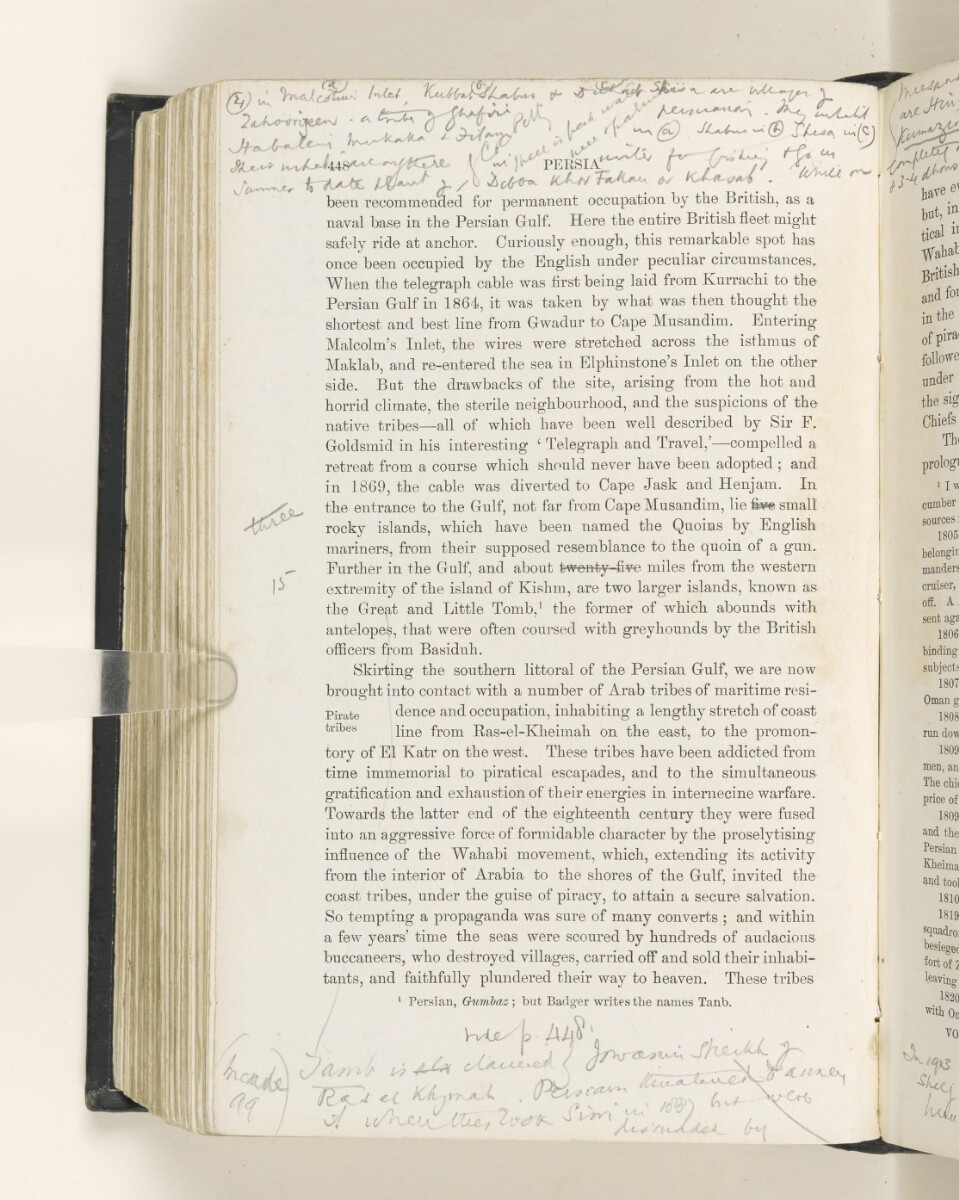
been recommended for permanent occupation by the British, as a
naval base in the
Persian Gulf
The historical term used to describe the body of water between the Arabian Peninsula and Iran.
. Here the entire British fleet might
safely ride at anchor. Curiously enough, this remarkable spot has
once been occupied by the English under peculiar circumstances^
When the telegraph cable was first being laid from Kurrachi to the
Persian Gulf
The historical term used to describe the body of water between the Arabian Peninsula and Iran.
in 1864, it was taken by what was then thought the
shortest and best line from Gwadur to Cape Musandim. Entering
Malcolm’s Inlet, the wires were stretched across the isthmus of
Maklab, and re-entered the sea in Elphinstone’s Inlet on the other
side. But the drawbacks of the site, arising from the hot and
horrid climate, the sterile neighbourhood, and the suspicions of the
native tribes—all of which have been well described by Sir E.
Goldsmid in his interesting c Telegraph and Travel,’—compelled a
retreat from a course which should never have been adopted ; and
in 1869, the cable was diverted to Cape Task and Henjam. In
the entrance to the Gulf, not far from Cape Musandim, lie small
rocky islands, which have been named the Quoins by English
mariners, from their supposed resemblance to the quoin of a gun.
Further in the Gulf, and about twenty-five miles from the western
extremity of the island of Kishm, are two larger islands, known as
the Great and Little Tomb, 1 the former of which abounds with
antelopes, that were often coursed with greyhounds by the British
officers from Basiduh.
Skirting the southern littoral of the
Persian Gulf
The historical term used to describe the body of water between the Arabian Peninsula and Iran.
, we are now
brought into contact with a number of Arab tribes of maritime resi
dence and occupation, inhabiting a lengthy stretch of coast
line from Ras-el-Kheimah on the east, to the promon
tory of El Katr on the west. These tribes have been addicted from
time immemorial to piratical escapades, and to the simultaneous
gratification and exhaustion of their energies in internecine warfare.
Towards the latter end of the eighteenth century they were fused
into an aggressive force of formidable character by the proselytising
influence of the Wahabi movement, which, extending its activity
from the interior of Arabia to the shores of the Gulf, invited the
coast tribes, under the guise of piracy, to attain a secure salvation.
So tempting a propaganda was sure of many converts ; and within
a few years’ time the seas were scoured by hundreds of audacious
buccaneers, who destroyed villages, carried off and sold their inhabi
tants, and faithfully plundered their way to heaven. These tribes
1 Persian, Gumbaz ; but Badger writes the names Tanb.
Pirate
tribes
4i r , 7 j \ Ja m % / a o ^^' c(
jy ■ /l/ |V
%■
«.£ KLjrr^t. , N Aw/
vV I (A~c
a. e
yvt v '/11 A At
bub ^
ideal i r
^Vabab
British
and for
in b ie 1
ofpira<
follow 0
under 1
the sig
Chiefs
Tin
prologt
1 i w
cumber
sources:
1805.
belongin
manders
cruiser,;
off. AJ
sent aga
1806.
binding
subjects
1807
Oman g
1808
run
dow
A term adopted by British officials to refer to local sailing vessels in the western Indian Ocean.
1809
men, am
The chic
price of
1809
and the
Persian
kheima
and tool
1810
1819
sqaadroi
besieged
krt of 2
leaving
1820
with On
Vo:
i'ui u
About this item
- Content
These two volumes are George Curzon's own personal annotated copies of both volumes of his book Persia and the Persian Question , which was published in 1892. Alongside the volumes are various loose papers relating to Persia [Iran], consisting of the following: received correspondence; newspaper cuttings; publishers' press releases; cuttings from various booksellers' catalogues; various journal and magazine articles; two items of printed official British correspondence; several prints of photographs and sketches; and a few handwritten notes by Curzon.
In most cases these papers, which range in date from 1892 to 1924, relate to the chapters in the book where they were originally inserted, suggesting that they were kept by Curzon with the intention of using them to inform a revised edition of the book.
Of particular note among the small amount of correspondence are two letters received by Curzon in 1914 and 1915 from retired schoolmaster and Islamic scholar Sayyid Mazhar Hasan Musawi of Saharanpur, Uttar Pradesh, India (ff 5-9 and ff 44-53). These letters, which are written in Urdu and are accompanied by English translations, discuss in detail several inaccuracies found in the Urdu version of Persia and the Persian Question .
The various prints of photographs and sketches, which were originally inserted into volume two, are of different locations in the Gulf region. Several of these appear to have been produced in preparation for the publication of the second volume of John Gordon Lorimer's Gazetteer of the Persian Gulf The historical term used to describe the body of water between the Arabian Peninsula and Iran. , Oman and Central Arabia (i.e. the 'Geographical and Statistical' section) in 1908, as they are identical to the versions found in that volume.
Also of note among the loose papers are an illustrated article from Country Life dated 5 June 1920, entitled 'The People of Persia' (ff 36-37), and a printed family tree of the Shah of Persia [Aḥmad Shah Qājār], produced in preparation of his visit to Britain in 1919 (f 233).
Volume one of Persia and the Persian Question contains a map of Persia, Afghanistan and Beluchistan [Balochistan], which is folded inside the front cover (f 1).
The German language material consists of a publisher's press release for two books authored by German archaeologist Ernst Emil Herzfeld (ff 29-30).
- Extent and format
- 2 volumes with inserts (898 folios)
- Physical characteristics
Foliation: this shelfmark consists of two physical volumes. The foliation sequence commences at the first folio of volume one (1-463), and terminates at the last folio of volume two (ff 464-898); these numbers are written in pencil, are circled, and are located in the top right corner of the recto The front of a sheet of paper or leaf, often abbreviated to 'r'. side of each folio. Each volume contains a large number of loose leaves, which have been foliated in the order that they were inserted into the volume; for conservation reasons, these loose folios have been removed from the volume and stored separately. The foliation sequence does not include the front and back covers of the two volumes.
Pagination: the file also contains an original printed pagination sequence.
- Written in
- English, Urdu and German in Latin and Arabic script View the complete information for this record
Use and share this item
- Share this item
Annotated Copy of Persia and the Persian Question by George Curzon, with Inserted Papers [775v] (1567/1814), British Library: India Office Records and Private Papers, Mss Eur F111/33, in Qatar Digital Library <https://www.qdl.qa/archive/81055/vdc_100157213849.0x0000a8> [accessed 5 August 2026]
https://www.qdl.qa/en/archive/81055/vdc_100157213849.0x0000a8
Copy and paste the code below into your web page where you would like to embed the image.
<meta charset="utf-8"><a href="https://www.qdl.qa/en/archive/81055/vdc_100157213849.0x0000a8">Annotated Copy of <em>Persia and the Persian Question</em> by George Curzon, with Inserted Papers [‎775v] (1567/1814)</a> <a href="https://www.qdl.qa/en/archive/81055/vdc_100157213849.0x0000a8"> <img src="https://iiif.qdl.qa/iiif/images/81055/vdc_100000001491.0x00033b/Mss Eur F111_33_1591.jp2/full/!280,240/0/default.jpg" alt="" /> </a>
This record has a IIIF manifest available as follows. If you have a compatible viewer you can drag the icon to load it.https://www.qdl.qa/en/iiif/81055/vdc_100000001491.0x00033b/manifestOpen in Universal viewerOpen in Mirador viewerMore options for embedding images
Copyright: How to use this content
- Reference
- Mss Eur F111/33
- Title
- Annotated Copy of Persia and the Persian Questionby George Curzon, with Inserted Papers
- Pages
- 54r:135v, 147r:149v, 158r:180v, 183r:221v, 224r:224v, 227r:246v, 248r:257v, 259r:260v, 268r:362v, 364r:364v, 367r:388v, 390r:400v, 402r:416v, 419r:432v, 434r:444v, 448r:462v, 464r:471v, 475r:481v, 483r:513v, 516r:525v, 527r:544v, 546r:563v, 566r:598v, 600r:622v, 624r:656v, 658r:665v, 667r:675v, 678r:684v, 687r:688v, 691r:691v, 693r:693v, 695r:708v, 711r:721v, 724r:726v, 728r:729v, 731r:736v, 742r:742v, 746r:757v, 759r:761v, 763r:763v, 765r:765v, 772r:777v, 780r:789v, 793r:794v, 797r:809v, 811r:821v, 825r:840v, 843r:898v
- Author
- Curzon, George Nathaniel, 1st Marquess Curzon of Kedleston
- Usage terms
- Public Domain