
![Annotated Copy of <em>Persia and the Persian Question</em> by George Curzon, with Inserted Papers [‎672v] (1361/1814)](https://iiif.qdl.qa/iiif/images/81055/vdc_100000001491.0x00033b/Mss Eur F111_33_1377.jp2/full/!1200,1200/0/default.jpg "Annotated Copy of <em>Persia and the Persian Question</em> by George Curzon, with Inserted Papers [‎672v] (1361/1814)")
Annotated Copy of Persia and the Persian Question by George Curzon, with Inserted Papers [672v] (1361/1814)
The record is made up of 2 volumes with inserts (898 folios). It was created in 1892-1924. It was written in English, Urdu and German. The original is part of the British Library: India Office The department of the British Government to which the Government of India reported between 1858 and 1947. The successor to the Court of Directors. Records and Private Papers Documents collected in a private capacity. .
Transcription
This transcription is created automatically. It may contain errors.
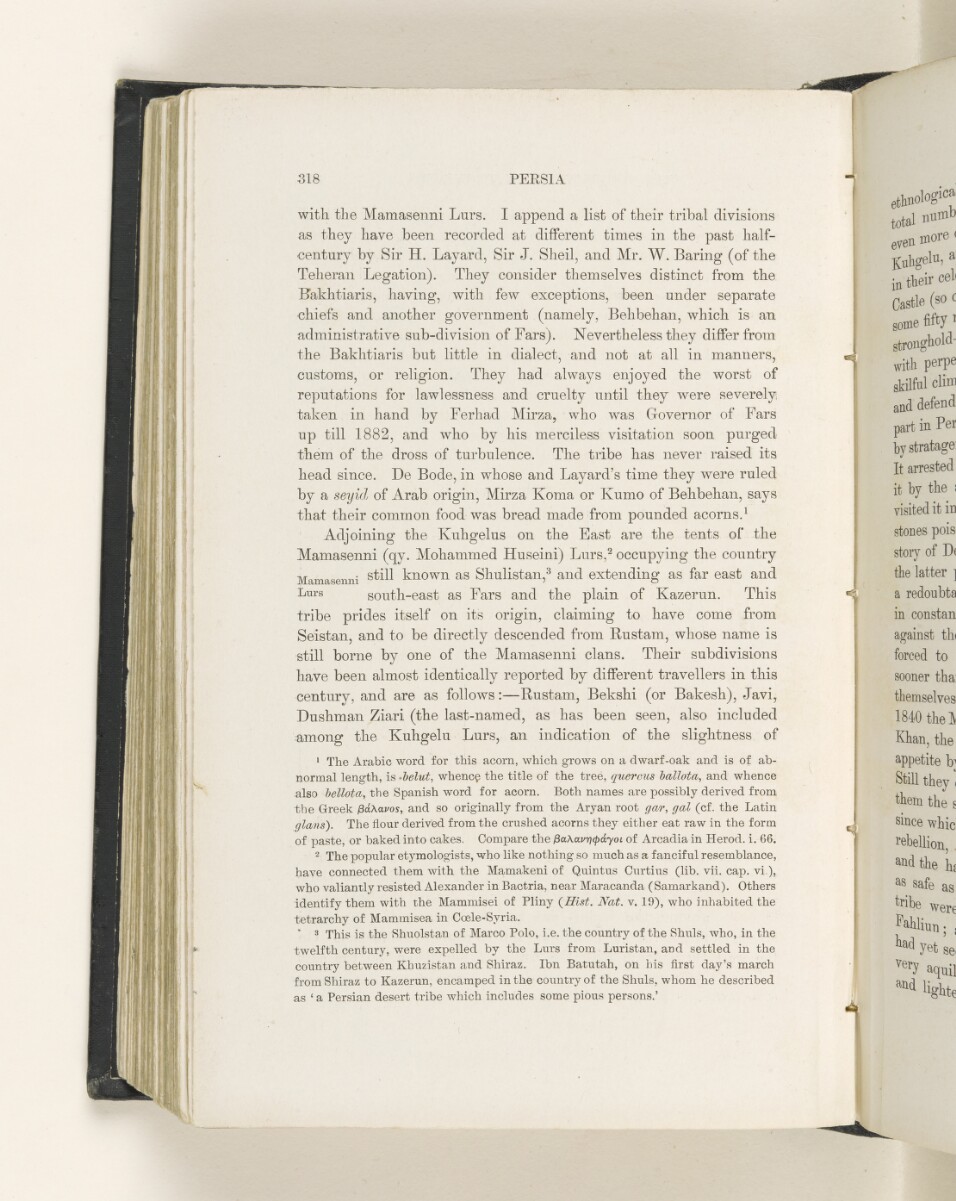
318
PERSIA
with the Mamasenni Lurs. I append a list of their tribal divisions
as they have been recorded at different times in the past half-
century by Sir H. Layard, Sir J. Sheil, and Mr. W. Baring (of the
Teheran Legation). They consider tliemselves distinct from the
Bakhtiaris, having, with few exceptions, been under separate
chiefs and another government (namely, Behbehan, which is an
administrative sub-division of Ears). Nevertheless they differ from
the Bakhtiaris but little in dialect, and not at all in manners,
customs, or religion. They had always enjoyed the worst of
reputations for lawlessness and cruelty until they were severely
taken in hand by Ferhad Mirza, who was Governor of Ears
up till 1882, and who by his merciless visitation soon purged
them of the dross of turbulence. The tribe has never raised its
head since. De Bode, in whose and Bayard’s time they were ruled
by a seyid of Arab origin, Mirza Koma or Kumo of Behbehan, says
that their common food was bread made from pounded acorns. 1
Adjoining the Kuhgelus on the East are the tents of the
Mamasenni (qy. Mohammed Huseini) Lurs, 2 occupying the country
Mamasenni known as Shulistan, 3 and extending as far east and
Lurs south-east as Ears and the plain of Kazerun. This
tribe prides itself on its origin, claiming to have come from
Seistan, and to be directly descended from Rustam, whose name is
still borne by one of the Mamasenni clans. Their subdivisions
have been almost identically reported by different travellers in this
century, and are as follows:—Rustam, Bekshi (or Bakesh), Javi,
Dushman Ziari (the last-named, as has been seen, also included
among the Kuhgelu Lurs, an indication of the slightness of
1 The Arabic word for this acorn, which grows on a dwarf-oak and is of ab
normal length, is -belut, whence the title of the tree, quercus ballota, and whence
also bellota, the Spanish word for acorn. Both names are possibly derived from
the Greek pdAavos, and so originally from the Aryan root gar, gal (cf. the Latin
qlans). The flour derived from the crushed acorns they either eat raw in the form
of paste, or baked into cakes. Compare the paAavricpdyol of Arcadia in Herod, i. 66 .
2 The popular etymologists, who like nothing so much as a fanciful resemblance,
have connected them with the Mamakeni of Quintus Curtius (lib. vii. cap. vi),
who valiantly resisted Alexander in Bactria, near Maracanda (Samarkand). Others
identify them with the Mammisei of Pliny {Hist. Nat. v. 19), who inhabited the
tetrarchy of Mammisea in Coele-Syria.
* 3 This is the Shuolstan of Marco Polo, i.e. the country of the Shuls, who, in the
twelfth century, were expelled by the Lurs from Luristan, and settled in the
country between Khuzistan and Shiraz. Ibn Batutah, on his first day’s march
from Shiraz to Kazerun, encamped in the country of the Shuls, whom he described
as ‘ a Persian desert tribe which includes some pious persons.’
About this item
- Content
These two volumes are George Curzon's own personal annotated copies of both volumes of his book Persia and the Persian Question , which was published in 1892. Alongside the volumes are various loose papers relating to Persia [Iran], consisting of the following: received correspondence; newspaper cuttings; publishers' press releases; cuttings from various booksellers' catalogues; various journal and magazine articles; two items of printed official British correspondence; several prints of photographs and sketches; and a few handwritten notes by Curzon.
In most cases these papers, which range in date from 1892 to 1924, relate to the chapters in the book where they were originally inserted, suggesting that they were kept by Curzon with the intention of using them to inform a revised edition of the book.
Of particular note among the small amount of correspondence are two letters received by Curzon in 1914 and 1915 from retired schoolmaster and Islamic scholar Sayyid Mazhar Hasan Musawi of Saharanpur, Uttar Pradesh, India (ff 5-9 and ff 44-53). These letters, which are written in Urdu and are accompanied by English translations, discuss in detail several inaccuracies found in the Urdu version of Persia and the Persian Question .
The various prints of photographs and sketches, which were originally inserted into volume two, are of different locations in the Gulf region. Several of these appear to have been produced in preparation for the publication of the second volume of John Gordon Lorimer's Gazetteer of the Persian Gulf The historical term used to describe the body of water between the Arabian Peninsula and Iran. , Oman and Central Arabia (i.e. the 'Geographical and Statistical' section) in 1908, as they are identical to the versions found in that volume.
Also of note among the loose papers are an illustrated article from Country Life dated 5 June 1920, entitled 'The People of Persia' (ff 36-37), and a printed family tree of the Shah of Persia [Aḥmad Shah Qājār], produced in preparation of his visit to Britain in 1919 (f 233).
Volume one of Persia and the Persian Question contains a map of Persia, Afghanistan and Beluchistan [Balochistan], which is folded inside the front cover (f 1).
The German language material consists of a publisher's press release for two books authored by German archaeologist Ernst Emil Herzfeld (ff 29-30).
- Extent and format
- 2 volumes with inserts (898 folios)
- Physical characteristics
Foliation: this shelfmark consists of two physical volumes. The foliation sequence commences at the first folio of volume one (1-463), and terminates at the last folio of volume two (ff 464-898); these numbers are written in pencil, are circled, and are located in the top right corner of the recto The front of a sheet of paper or leaf, often abbreviated to 'r'. side of each folio. Each volume contains a large number of loose leaves, which have been foliated in the order that they were inserted into the volume; for conservation reasons, these loose folios have been removed from the volume and stored separately. The foliation sequence does not include the front and back covers of the two volumes.
Pagination: the file also contains an original printed pagination sequence.
- Written in
- English, Urdu and German in Latin and Arabic script View the complete information for this record
Use and share this item
- Share this item
Annotated Copy of Persia and the Persian Question by George Curzon, with Inserted Papers [672v] (1361/1814), British Library: India Office Records and Private Papers, Mss Eur F111/33, in Qatar Digital Library <https://www.qdl.qa/archive/81055/vdc_100157213848.0x0000a2> [accessed 18 July 2026]
https://www.qdl.qa/en/archive/81055/vdc_100157213848.0x0000a2
Copy and paste the code below into your web page where you would like to embed the image.
<meta charset="utf-8"><a href="https://www.qdl.qa/en/archive/81055/vdc_100157213848.0x0000a2">Annotated Copy of <em>Persia and the Persian Question</em> by George Curzon, with Inserted Papers [‎672v] (1361/1814)</a> <a href="https://www.qdl.qa/en/archive/81055/vdc_100157213848.0x0000a2"> <img src="https://iiif.qdl.qa/iiif/images/81055/vdc_100000001491.0x00033b/Mss Eur F111_33_1377.jp2/full/!280,240/0/default.jpg" alt="" /> </a>
This record has a IIIF manifest available as follows. If you have a compatible viewer you can drag the icon to load it.https://www.qdl.qa/en/iiif/81055/vdc_100000001491.0x00033b/manifestOpen in Universal viewerOpen in Mirador viewerMore options for embedding images
Copyright: How to use this content
- Reference
- Mss Eur F111/33
- Title
- Annotated Copy of Persia and the Persian Questionby George Curzon, with Inserted Papers
- Pages
- 54r:135v, 147r:149v, 158r:180v, 183r:221v, 224r:224v, 227r:246v, 248r:257v, 259r:260v, 268r:362v, 364r:364v, 367r:388v, 390r:400v, 402r:416v, 419r:432v, 434r:444v, 448r:462v, 464r:471v, 475r:481v, 483r:513v, 516r:525v, 527r:544v, 546r:563v, 566r:598v, 600r:622v, 624r:656v, 658r:665v, 667r:675v, 678r:684v, 687r:688v, 691r:691v, 693r:693v, 695r:708v, 711r:721v, 724r:726v, 728r:729v, 731r:736v, 742r:742v, 746r:757v, 759r:761v, 763r:763v, 765r:765v, 772r:777v, 780r:789v, 793r:794v, 797r:809v, 811r:821v, 825r:840v, 843r:898v
- Author
- Curzon, George Nathaniel, 1st Marquess Curzon of Kedleston
- Usage terms
- Public Domain