
![Annotated Copy of <em>Persia and the Persian Question</em> by George Curzon, with Inserted Papers [‎668r] (1352/1814)](https://iiif.qdl.qa/iiif/images/81055/vdc_100000001491.0x00033b/Mss Eur F111_33_1368.jp2/full/!1200,1200/0/default.jpg "Annotated Copy of <em>Persia and the Persian Question</em> by George Curzon, with Inserted Papers [‎668r] (1352/1814)")
Annotated Copy of Persia and the Persian Question by George Curzon, with Inserted Papers [668r] (1352/1814)
The record is made up of 2 volumes with inserts (898 folios). It was created in 1892-1924. It was written in English, Urdu and German. The original is part of the British Library: India Office The department of the British Government to which the Government of India reported between 1858 and 1947. The successor to the Court of Directors. Records and Private Papers Documents collected in a private capacity. .
Transcription
This transcription is created automatically. It may contain errors.
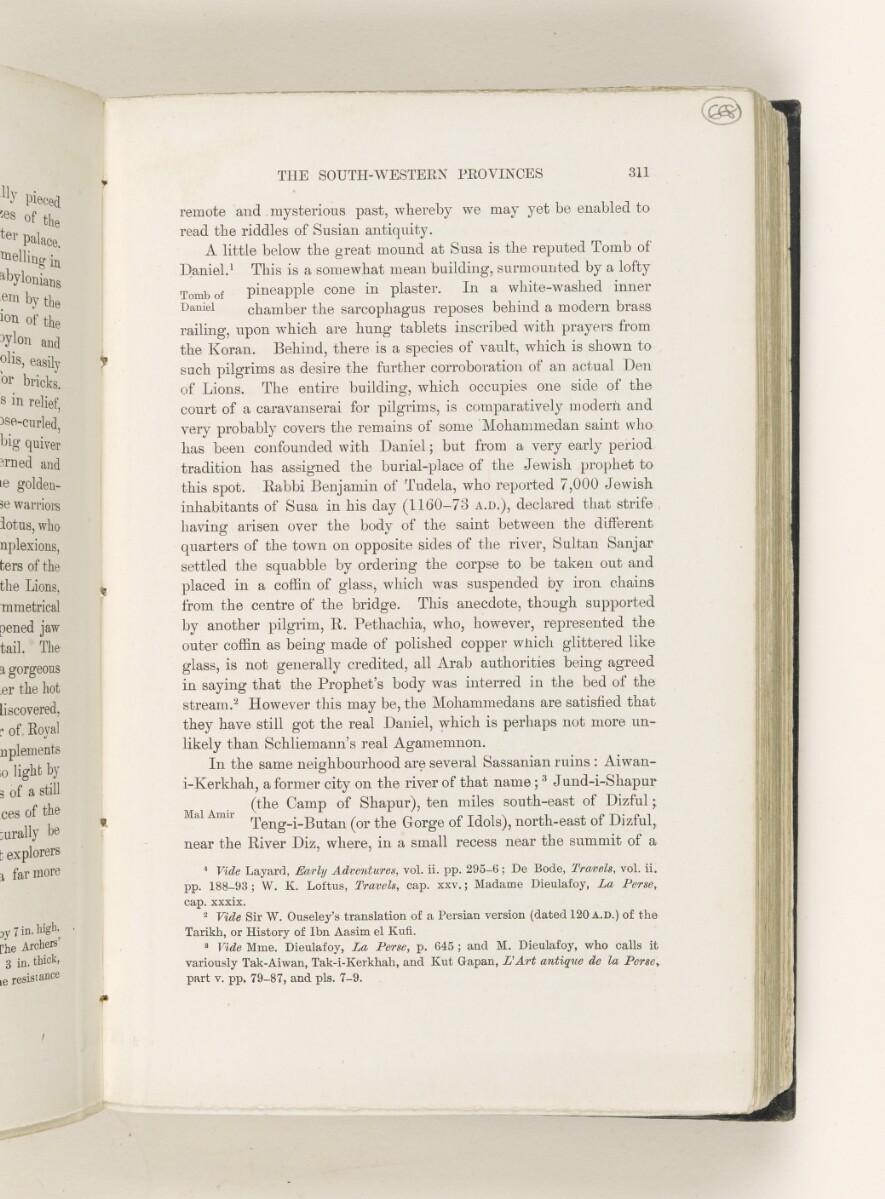
THE SOUTH-WESTERN PROVINCES
311
remote and mysterious past, whereby we may yet be enabled to
read the riddles of Susian antiquity.
A little below the great mound at Susa is the reputed Tomb of
Daniel. 1 This is a somewhat mean building, surmounted by a lofty
Tomb of pineapple cone in plaster. In a white-washed inner
Daniel chamber the sarcophagus reposes behind a modern brass
railing, upon which are hung tablets inscribed with prayers from
the Koran. Behind, there is a species of vault, which is shown to
such pilgrims as desire the further corroboration of an actual Den
of Lions. The entire building, which occupies one side of the
court of a
caravanserai
A roadside inn providing accommodation for caravans (groups of travellers).
for pilgrims, is comparatively modern and
very probably covers the remains of some Mohammedan saint who
has been confounded with Daniel; but from a very early period
tradition has assigned the burial-place of the Jewish prophet to
this spot. Rabbi Benjamin of Tudela, who reported 7,000 Jewish
inhabitants of Susa in his day (1160-73 A.D.), declared that strife ,
having arisen over the body of the saint between the different
quarters of the town on opposite sides of the river, Sultan Sanjar
settled the squabble by ordering the corpse to be taken out and
placed in a coffin of glass, which was suspended by iron chains
from the centre of the bridge. This anecdote, though supported
by another pilgrim, R. Pethachia, who, however, represented the
outer coffin as being made of polished copper winch glittered like
glass, is not generally credited, all Arab authorities being agreed
in saying that the Prophet’s body was interred in the bed of the
stream. 2 However this may be, the Mohammedans are satisfied that
they have still got the real Daniel, which is perhaps not more un
likely than Schliemann’s real Agamemnon.
In the same neighbourhood are several Sassanian ruins : Aiwan-
i-Kerkhah, a former city on the river of that name ; 3 Jund-i-Shapur
(the Camp of Shapur), ten miles south-east of Dizful;
Teng-i-Butan (or the Gorge of Idols), north-east of Dizful,
near the River Diz, where, in a small recess near the summit of a
4 Vide Layarc], Early Adventures, vol. ii. pp. 295-6; De Bode, Travels, vol. ii.
pp. 188-93 ; W. K. Loftus, Travels, cap. xxv.; Madame Dieulafoy, La Perse,
cap. xxxix.
2 Vide Sir W. Ouseley’s translation of a Persian version (dated 120 a.d.) of the
Tarikh, or History of Ibn Aasim el Kufi.
3 Vide Mme. Dieulafoy, La Perse, p. 645 ; and M. Dieulafoy, who calls it
variously Tak-Aiwan, Tak-i-Kerkhah, and Kut Gapan, L!Art antique de la Perse,
part v. pp. 79-87, and pis. 7-9.
About this item
- Content
These two volumes are George Curzon's own personal annotated copies of both volumes of his book Persia and the Persian Question , which was published in 1892. Alongside the volumes are various loose papers relating to Persia [Iran], consisting of the following: received correspondence; newspaper cuttings; publishers' press releases; cuttings from various booksellers' catalogues; various journal and magazine articles; two items of printed official British correspondence; several prints of photographs and sketches; and a few handwritten notes by Curzon.
In most cases these papers, which range in date from 1892 to 1924, relate to the chapters in the book where they were originally inserted, suggesting that they were kept by Curzon with the intention of using them to inform a revised edition of the book.
Of particular note among the small amount of correspondence are two letters received by Curzon in 1914 and 1915 from retired schoolmaster and Islamic scholar Sayyid Mazhar Hasan Musawi of Saharanpur, Uttar Pradesh, India (ff 5-9 and ff 44-53). These letters, which are written in Urdu and are accompanied by English translations, discuss in detail several inaccuracies found in the Urdu version of Persia and the Persian Question .
The various prints of photographs and sketches, which were originally inserted into volume two, are of different locations in the Gulf region. Several of these appear to have been produced in preparation for the publication of the second volume of John Gordon Lorimer's Gazetteer of the Persian Gulf The historical term used to describe the body of water between the Arabian Peninsula and Iran. , Oman and Central Arabia (i.e. the 'Geographical and Statistical' section) in 1908, as they are identical to the versions found in that volume.
Also of note among the loose papers are an illustrated article from Country Life dated 5 June 1920, entitled 'The People of Persia' (ff 36-37), and a printed family tree of the Shah of Persia [Aḥmad Shah Qājār], produced in preparation of his visit to Britain in 1919 (f 233).
Volume one of Persia and the Persian Question contains a map of Persia, Afghanistan and Beluchistan [Balochistan], which is folded inside the front cover (f 1).
The German language material consists of a publisher's press release for two books authored by German archaeologist Ernst Emil Herzfeld (ff 29-30).
- Extent and format
- 2 volumes with inserts (898 folios)
- Physical characteristics
Foliation: this shelfmark consists of two physical volumes. The foliation sequence commences at the first folio of volume one (1-463), and terminates at the last folio of volume two (ff 464-898); these numbers are written in pencil, are circled, and are located in the top right corner of the recto The front of a sheet of paper or leaf, often abbreviated to 'r'. side of each folio. Each volume contains a large number of loose leaves, which have been foliated in the order that they were inserted into the volume; for conservation reasons, these loose folios have been removed from the volume and stored separately. The foliation sequence does not include the front and back covers of the two volumes.
Pagination: the file also contains an original printed pagination sequence.
- Written in
- English, Urdu and German in Latin and Arabic script View the complete information for this record
Use and share this item
- Share this item
Annotated Copy of Persia and the Persian Question by George Curzon, with Inserted Papers [668r] (1352/1814), British Library: India Office Records and Private Papers, Mss Eur F111/33, in Qatar Digital Library <https://www.qdl.qa/archive/81055/vdc_100157213848.0x000099> [accessed 21 August 2026]
https://www.qdl.qa/en/archive/81055/vdc_100157213848.0x000099
Copy and paste the code below into your web page where you would like to embed the image.
<meta charset="utf-8"><a href="https://www.qdl.qa/en/archive/81055/vdc_100157213848.0x000099">Annotated Copy of <em>Persia and the Persian Question</em> by George Curzon, with Inserted Papers [‎668r] (1352/1814)</a> <a href="https://www.qdl.qa/en/archive/81055/vdc_100157213848.0x000099"> <img src="https://iiif.qdl.qa/iiif/images/81055/vdc_100000001491.0x00033b/Mss Eur F111_33_1368.jp2/full/!280,240/0/default.jpg" alt="" /> </a>
This record has a IIIF manifest available as follows. If you have a compatible viewer you can drag the icon to load it.https://www.qdl.qa/en/iiif/81055/vdc_100000001491.0x00033b/manifestOpen in Universal viewerOpen in Mirador viewerMore options for embedding images
Copyright: How to use this content
- Reference
- Mss Eur F111/33
- Title
- Annotated Copy of Persia and the Persian Questionby George Curzon, with Inserted Papers
- Pages
- 54r:135v, 147r:149v, 158r:180v, 183r:221v, 224r:224v, 227r:246v, 248r:257v, 259r:260v, 268r:362v, 364r:364v, 367r:388v, 390r:400v, 402r:416v, 419r:432v, 434r:444v, 448r:462v, 464r:471v, 475r:481v, 483r:513v, 516r:525v, 527r:544v, 546r:563v, 566r:598v, 600r:622v, 624r:656v, 658r:665v, 667r:675v, 678r:684v, 687r:688v, 691r:691v, 693r:693v, 695r:708v, 711r:721v, 724r:726v, 728r:729v, 731r:736v, 742r:742v, 746r:757v, 759r:761v, 763r:763v, 765r:765v, 772r:777v, 780r:789v, 793r:794v, 797r:809v, 811r:821v, 825r:840v, 843r:898v
- Author
- Curzon, George Nathaniel, 1st Marquess Curzon of Kedleston
- Usage terms
- Public Domain