
![Annotated Copy of <em>Persia and the Persian Question</em> by George Curzon, with Inserted Papers [‎662r] (1340/1814)](https://iiif.qdl.qa/iiif/images/81055/vdc_100000001491.0x00033b/Mss Eur F111_33_1356.jp2/full/!1200,1200/0/default.jpg "Annotated Copy of <em>Persia and the Persian Question</em> by George Curzon, with Inserted Papers [‎662r] (1340/1814)")
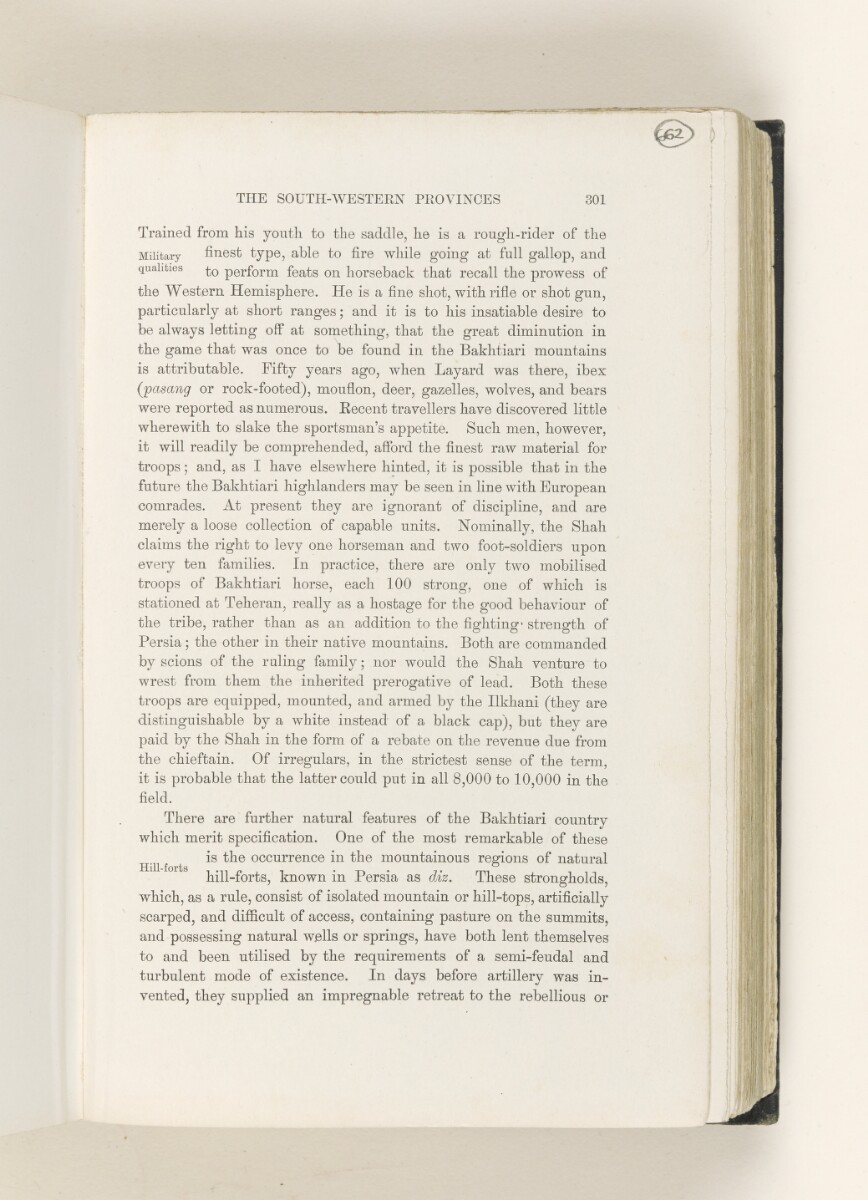
Annotated Copy of Persia and the Persian Question by George Curzon, with Inserted Papers [662r] (1340/1814)
The record is made up of 2 volumes with inserts (898 folios). It was created in 1892-1924. It was written in English, Urdu and German. The original is part of the British Library: India Office The department of the British Government to which the Government of India reported between 1858 and 1947. The successor to the Court of Directors. Records and Private Papers Documents collected in a private capacity. .
Transcription
This transcription is created automatically. It may contain errors.
THE SOUTH-WESTERN PROVINCES
301
Trained from his youth to the saddle, he is a rough-rider of the
Military finest type, able to fire while going at full gallop, and
qualities ^ pe r f orm feats on horseback that recall the prowess of
the Western Hemisphere. He is a fine shot, with rifle or shot gun,
particularly at short ranges; and it is to his insatiable desire to
be always letting off at something, that the great diminution in
the game that was once to be found in the Bakhtiari mountains
is attributable. Fifty years ago, when Layard was there, ibex
(jpasang or rock-footed), mouflon, deer, gazelles, wolves, and bears
were reported as numerous. Recent travellers have discovered little
wherewith to slake the sportsman’s appetite. Such men, however,
it will readily be comprehended, afford the finest raw material for
troops; and, as I have elsewhere hinted, it is possible that in the
future the Bakhtiari highlanders may be seen in line with European
comrades. At present they are ignorant of discipline, and are
merely a loose collection of capable units. Nominally, the Shah
claims the right to levy one horseman and two foot-soldiers upon
every ten families. In practice, there are only two mobilised
troops of Bakhtiari horse, each 100 strong, one of which is
stationed at Teheran, really as a hostage for the good behaviour of
the tribe, rather than as an addition to the fighting’ strength of
Persia; the other in their native mountains. Both are commanded
by scions of the ruling family; nor would the Shah venture to
wrest from them the inherited prerogative of lead. Both these
troops are equipped, mounted, and armed by the
Ilkhani
The paramount chief of certain tribes in south west Iran.
(they are
distinguishable by a white instead of a black cap), but they are
paid by the Shah in the form of a rebate on the revenue due from
the chieftain. Of irregulars, in the strictest sense of the term,
it is probable that the latter could put in all 8,000 to 10,000 in the
field.
There are further natural features of the Bakhtiari country
which merit specification. One of the most remarkable of these
f ^ is the occurrence in the mountainous regions of natural
hill-forts, known in Persia as diz. These strongholds,
which, as a rule, consist of isolated mountain or hill-tops, artificially
scarped, and difficult of access, containing pasture on the summits,
and possessing natural wells or springs, have both lent themselves
to and been utilised by the requirements of a semi-feudal and
turbulent mode of existence. In days before artillery was in
vented, they supplied an impregnable retreat to the rebellious or
.
About this item
- Content
These two volumes are George Curzon's own personal annotated copies of both volumes of his book Persia and the Persian Question , which was published in 1892. Alongside the volumes are various loose papers relating to Persia [Iran], consisting of the following: received correspondence; newspaper cuttings; publishers' press releases; cuttings from various booksellers' catalogues; various journal and magazine articles; two items of printed official British correspondence; several prints of photographs and sketches; and a few handwritten notes by Curzon.
In most cases these papers, which range in date from 1892 to 1924, relate to the chapters in the book where they were originally inserted, suggesting that they were kept by Curzon with the intention of using them to inform a revised edition of the book.
Of particular note among the small amount of correspondence are two letters received by Curzon in 1914 and 1915 from retired schoolmaster and Islamic scholar Sayyid Mazhar Hasan Musawi of Saharanpur, Uttar Pradesh, India (ff 5-9 and ff 44-53). These letters, which are written in Urdu and are accompanied by English translations, discuss in detail several inaccuracies found in the Urdu version of Persia and the Persian Question .
The various prints of photographs and sketches, which were originally inserted into volume two, are of different locations in the Gulf region. Several of these appear to have been produced in preparation for the publication of the second volume of John Gordon Lorimer's Gazetteer of the Persian Gulf The historical term used to describe the body of water between the Arabian Peninsula and Iran. , Oman and Central Arabia (i.e. the 'Geographical and Statistical' section) in 1908, as they are identical to the versions found in that volume.
Also of note among the loose papers are an illustrated article from Country Life dated 5 June 1920, entitled 'The People of Persia' (ff 36-37), and a printed family tree of the Shah of Persia [Aḥmad Shah Qājār], produced in preparation of his visit to Britain in 1919 (f 233).
Volume one of Persia and the Persian Question contains a map of Persia, Afghanistan and Beluchistan [Balochistan], which is folded inside the front cover (f 1).
The German language material consists of a publisher's press release for two books authored by German archaeologist Ernst Emil Herzfeld (ff 29-30).
- Extent and format
- 2 volumes with inserts (898 folios)
- Physical characteristics
Foliation: this shelfmark consists of two physical volumes. The foliation sequence commences at the first folio of volume one (1-463), and terminates at the last folio of volume two (ff 464-898); these numbers are written in pencil, are circled, and are located in the top right corner of the recto The front of a sheet of paper or leaf, often abbreviated to 'r'. side of each folio. Each volume contains a large number of loose leaves, which have been foliated in the order that they were inserted into the volume; for conservation reasons, these loose folios have been removed from the volume and stored separately. The foliation sequence does not include the front and back covers of the two volumes.
Pagination: the file also contains an original printed pagination sequence.
- Written in
- English, Urdu and German in Latin and Arabic script View the complete information for this record
Use and share this item
- Share this item
Annotated Copy of Persia and the Persian Question by George Curzon, with Inserted Papers [662r] (1340/1814), British Library: India Office Records and Private Papers, Mss Eur F111/33, in Qatar Digital Library <https://www.qdl.qa/archive/81055/vdc_100157213848.0x00008d> [accessed 21 July 2026]
https://www.qdl.qa/en/archive/81055/vdc_100157213848.0x00008d
Copy and paste the code below into your web page where you would like to embed the image.
<meta charset="utf-8"><a href="https://www.qdl.qa/en/archive/81055/vdc_100157213848.0x00008d">Annotated Copy of <em>Persia and the Persian Question</em> by George Curzon, with Inserted Papers [‎662r] (1340/1814)</a> <a href="https://www.qdl.qa/en/archive/81055/vdc_100157213848.0x00008d"> <img src="https://iiif.qdl.qa/iiif/images/81055/vdc_100000001491.0x00033b/Mss Eur F111_33_1356.jp2/full/!280,240/0/default.jpg" alt="" /> </a>
This record has a IIIF manifest available as follows. If you have a compatible viewer you can drag the icon to load it.https://www.qdl.qa/en/iiif/81055/vdc_100000001491.0x00033b/manifestOpen in Universal viewerOpen in Mirador viewerMore options for embedding images
Copyright: How to use this content
- Reference
- Mss Eur F111/33
- Title
- Annotated Copy of Persia and the Persian Questionby George Curzon, with Inserted Papers
- Pages
- 54r:135v, 147r:149v, 158r:180v, 183r:221v, 224r:224v, 227r:246v, 248r:257v, 259r:260v, 268r:362v, 364r:364v, 367r:388v, 390r:400v, 402r:416v, 419r:432v, 434r:444v, 448r:462v, 464r:471v, 475r:481v, 483r:513v, 516r:525v, 527r:544v, 546r:563v, 566r:598v, 600r:622v, 624r:656v, 658r:665v, 667r:675v, 678r:684v, 687r:688v, 691r:691v, 693r:693v, 695r:708v, 711r:721v, 724r:726v, 728r:729v, 731r:736v, 742r:742v, 746r:757v, 759r:761v, 763r:763v, 765r:765v, 772r:777v, 780r:789v, 793r:794v, 797r:809v, 811r:821v, 825r:840v, 843r:898v
- Author
- Curzon, George Nathaniel, 1st Marquess Curzon of Kedleston
- Usage terms
- Public Domain