
![Annotated Copy of <em>Persia and the Persian Question</em> by George Curzon, with Inserted Papers [‎635r] (1286/1814)](https://iiif.qdl.qa/iiif/images/81055/vdc_100000001491.0x00033b/Mss Eur F111_33_1302.jp2/full/!1200,1200/0/default.jpg "Annotated Copy of <em>Persia and the Persian Question</em> by George Curzon, with Inserted Papers [‎635r] (1286/1814)")
Annotated Copy of Persia and the Persian Question by George Curzon, with Inserted Papers [635r] (1286/1814)
The record is made up of 2 volumes with inserts (898 folios). It was created in 1892-1924. It was written in English, Urdu and German. The original is part of the British Library: India Office The department of the British Government to which the Government of India reported between 1858 and 1947. The successor to the Court of Directors. Records and Private Papers Documents collected in a private capacity. .
Transcription
This transcription is created automatically. It may contain errors.
^ as hakeixl
lan 1874
S ^ since
ash kid riv er
if noi
Y chapter on
^ 0Y the 200
' e ^oldsmid’s
Groldsmid
^ been done;
al line wkicli
a this region
of a Persian
its features
en estimated
he 80,000 of
encountered
Ihe Mekran
md, is com- 3
which have
ire consider-
cultivation.
L entrancing
ked ravines,
at Jalk in
iown on the
innter. la
nperature is
the highest
s, who give ?
■ descent, of
,t the end of
ppo, whence
elled by the
lusein.
ieoplc whom
oth of them
>r Aryam iset
5 t be rejected .
THE EASTERN AND SOUTH-EASTERN PROVINCES 259
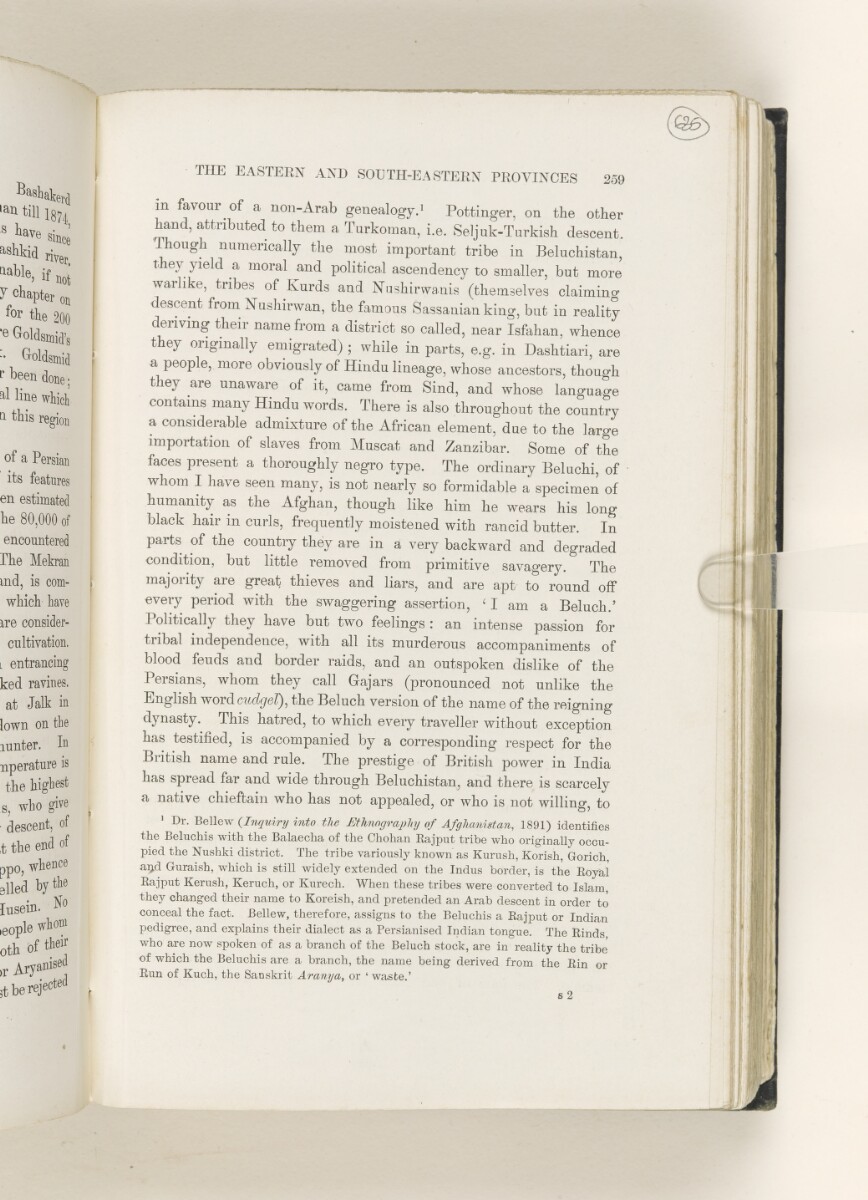
m favour of a non-Arab genealogy. 1 Pottinger, on the other
hand, attributed to them a Turkoman, i.e. Seljuk-Turkish descent.
Though numerically the most important tribe in Beluchistan,
they yield a moral and political ascendency to smaller, but more
warlike, tribes of Kurds and Nushirwanis (themselves claiming
descent from Kushirwan, the famous Sassanian king, but in reality
cleiiving theii name from a district so called, near Isfahan, whence
they originally emigrated) ; while in parts, e.g. in Dashtiari, are
a people, more obviously of Hindu lineage, whose ancestors, though
they are unaware of it, came from Sind, and whose language
contains many Hindu words. There is also throughout the country
a considerable admixture of the African element, due to the large
importation of slaves from Muscat and Zanzibar. Some of the
faces present a thoroughly negro type. The ordinary Beluchi, of
whom I have seen many, is not nearly so formidable a specimen of
humanity as the Afghan, though like him be wears his long
black hair in curls, frequently moistened with rancid butter. In
parts of the country they are in a very backward and degraded
condition, but little removed from primitive savagery. The
majority are great thieves and liars, and are apt to round off
every period with the swaggering assertion, ‘ I am a Beluch.’
Politically they have but two feelings : an intense passion for
tribal independence, with all its murderous accompaniments of
blood feuds and border raids, and an outspoken dislike of the
Persians, whom they call Gajars (pronounced not unlike the
English word cudgel), the Beluch version of the name of the reigning
dynasty. This hatred, to which every traveller without exception
has testified, is accompanied by a corresponding respect for the
British name and rule. The prestige of British power in India
has spread far and wide through Beluchistan, and there is scarcely
a native chieftain who has not appealed, or who is not willing, to
1 Dr. Bellew {Inquiry into the Ethnography of Afghanistan, 1891) identifies
the Beluchis with the Balaecha of the Chohan Rajput tribe who originally occu
pied the Nushki district. The tribe variously known as Kurush, Korish, Gorich.
aijd Guraish, which is still widely extended on the Indus border, is the Royal
Rajput Kerush, Keruch, or Kurech. When these tribes were converted to Islam,
they changed their name to Koreish, and pretended an Arab descent in order to
conceal the fact. Bellew, therefore, assigns to the Beluchis a Rajput or Indian
pedigree, and explains their dialect as a Persianised Indian tongue. The Rinds,
who are now spoken of as a branch of the Beluch stock, are in reality the tribe
of which the Beluchis are a branch, the name being derived from the Rin or
Run of Kuch, the Sanskrit Aranya, or ‘ waste.’
s 2
About this item
- Content
These two volumes are George Curzon's own personal annotated copies of both volumes of his book Persia and the Persian Question , which was published in 1892. Alongside the volumes are various loose papers relating to Persia [Iran], consisting of the following: received correspondence; newspaper cuttings; publishers' press releases; cuttings from various booksellers' catalogues; various journal and magazine articles; two items of printed official British correspondence; several prints of photographs and sketches; and a few handwritten notes by Curzon.
In most cases these papers, which range in date from 1892 to 1924, relate to the chapters in the book where they were originally inserted, suggesting that they were kept by Curzon with the intention of using them to inform a revised edition of the book.
Of particular note among the small amount of correspondence are two letters received by Curzon in 1914 and 1915 from retired schoolmaster and Islamic scholar Sayyid Mazhar Hasan Musawi of Saharanpur, Uttar Pradesh, India (ff 5-9 and ff 44-53). These letters, which are written in Urdu and are accompanied by English translations, discuss in detail several inaccuracies found in the Urdu version of Persia and the Persian Question .
The various prints of photographs and sketches, which were originally inserted into volume two, are of different locations in the Gulf region. Several of these appear to have been produced in preparation for the publication of the second volume of John Gordon Lorimer's Gazetteer of the Persian Gulf The historical term used to describe the body of water between the Arabian Peninsula and Iran. , Oman and Central Arabia (i.e. the 'Geographical and Statistical' section) in 1908, as they are identical to the versions found in that volume.
Also of note among the loose papers are an illustrated article from Country Life dated 5 June 1920, entitled 'The People of Persia' (ff 36-37), and a printed family tree of the Shah of Persia [Aḥmad Shah Qājār], produced in preparation of his visit to Britain in 1919 (f 233).
Volume one of Persia and the Persian Question contains a map of Persia, Afghanistan and Beluchistan [Balochistan], which is folded inside the front cover (f 1).
The German language material consists of a publisher's press release for two books authored by German archaeologist Ernst Emil Herzfeld (ff 29-30).
- Extent and format
- 2 volumes with inserts (898 folios)
- Physical characteristics
Foliation: this shelfmark consists of two physical volumes. The foliation sequence commences at the first folio of volume one (1-463), and terminates at the last folio of volume two (ff 464-898); these numbers are written in pencil, are circled, and are located in the top right corner of the recto The front of a sheet of paper or leaf, often abbreviated to 'r'. side of each folio. Each volume contains a large number of loose leaves, which have been foliated in the order that they were inserted into the volume; for conservation reasons, these loose folios have been removed from the volume and stored separately. The foliation sequence does not include the front and back covers of the two volumes.
Pagination: the file also contains an original printed pagination sequence.
- Written in
- English, Urdu and German in Latin and Arabic script View the complete information for this record
Use and share this item
- Share this item
Annotated Copy of Persia and the Persian Question by George Curzon, with Inserted Papers [635r] (1286/1814), British Library: India Office Records and Private Papers, Mss Eur F111/33, in Qatar Digital Library <https://www.qdl.qa/archive/81055/vdc_100157213848.0x000057> [accessed 30 July 2026]
https://www.qdl.qa/en/archive/81055/vdc_100157213848.0x000057
Copy and paste the code below into your web page where you would like to embed the image.
<meta charset="utf-8"><a href="https://www.qdl.qa/en/archive/81055/vdc_100157213848.0x000057">Annotated Copy of <em>Persia and the Persian Question</em> by George Curzon, with Inserted Papers [‎635r] (1286/1814)</a> <a href="https://www.qdl.qa/en/archive/81055/vdc_100157213848.0x000057"> <img src="https://iiif.qdl.qa/iiif/images/81055/vdc_100000001491.0x00033b/Mss Eur F111_33_1302.jp2/full/!280,240/0/default.jpg" alt="" /> </a>
This record has a IIIF manifest available as follows. If you have a compatible viewer you can drag the icon to load it.https://www.qdl.qa/en/iiif/81055/vdc_100000001491.0x00033b/manifestOpen in Universal viewerOpen in Mirador viewerMore options for embedding images
Copyright: How to use this content
- Reference
- Mss Eur F111/33
- Title
- Annotated Copy of Persia and the Persian Questionby George Curzon, with Inserted Papers
- Pages
- 54r:135v, 147r:149v, 158r:180v, 183r:221v, 224r:224v, 227r:246v, 248r:257v, 259r:260v, 268r:362v, 364r:364v, 367r:388v, 390r:400v, 402r:416v, 419r:432v, 434r:444v, 448r:462v, 464r:471v, 475r:481v, 483r:513v, 516r:525v, 527r:544v, 546r:563v, 566r:598v, 600r:622v, 624r:656v, 658r:665v, 667r:675v, 678r:684v, 687r:688v, 691r:691v, 693r:693v, 695r:708v, 711r:721v, 724r:726v, 728r:729v, 731r:736v, 742r:742v, 746r:757v, 759r:761v, 763r:763v, 765r:765v, 772r:777v, 780r:789v, 793r:794v, 797r:809v, 811r:821v, 825r:840v, 843r:898v
- Author
- Curzon, George Nathaniel, 1st Marquess Curzon of Kedleston
- Usage terms
- Public Domain