
![Annotated Copy of <em>Persia and the Persian Question</em> by George Curzon, with Inserted Papers [‎630r] (1276/1814)](https://iiif.qdl.qa/iiif/images/81055/vdc_100000001491.0x00033b/Mss Eur F111_33_1292.jp2/full/!1200,1200/0/default.jpg "Annotated Copy of <em>Persia and the Persian Question</em> by George Curzon, with Inserted Papers [‎630r] (1276/1814)")
Annotated Copy of Persia and the Persian Question by George Curzon, with Inserted Papers [630r] (1276/1814)
The record is made up of 2 volumes with inserts (898 folios). It was created in 1892-1924. It was written in English, Urdu and German. The original is part of the British Library: India Office The department of the British Government to which the Government of India reported between 1858 and 1947. The successor to the Court of Directors. Records and Private Papers Documents collected in a private capacity. .
Transcription
This transcription is created automatically. It may contain errors.
THE EASTERN AND SOUTH-EASTERN PROVINCES 249
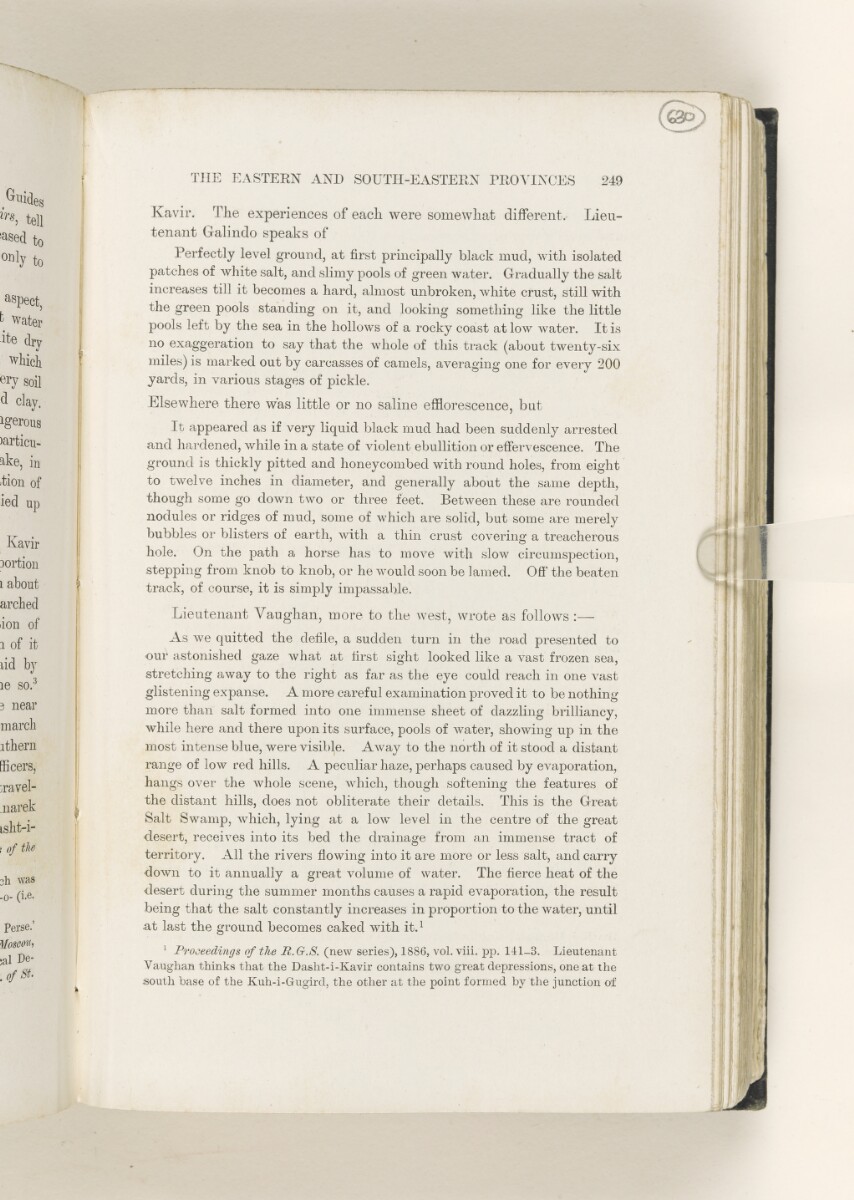
Kavir. The experiences of each were somewhat different. Lieu
tenant Galindo speaks of
Perfectly level ground, at first principally black mud, with isolated
patches of white salt, and slimy pools of green water. Gradually the salt
increases till it becomes a hard, almost unbroken, white crust, still with
the green pools standing on it, and looking something like the little
pools left by the sea in the hollows of a rocky coast at low water. It is
no exaggeration to say that the whole of this track (about twenty-six
miles) is marked out by carcasses of camels, averaging one for every 200
yards, in various stages of pickle.
Elsewhere there was little or no saline efflorescence, but
It appeared as if very liquid black mud had been suddenly arrested
and hardened, while in a state of violent ebullition or effervescence. The
ground is thickly pitted and honeycombed with round holes, from eight
to twelve inches in diameter, and generally about the same depth,
though some go down two or three feet. Between these are rounded
nodules or ridges of mud, some of which are solid, but some are merely
bubbles or blisters of earth, with a thin crust covering a treacherous
hole. On the path a horse has to move with slow circumspection,
stepping from knob to knob, or he would soon be lamed. Off the beaten
track, of course, it is simply impassable.
Lieutenant Vaughan, more to the west, wrote as follows :—
As we quitted the defile, a sudden turn in the road presented to
•our astonished gaze what at first sight looked like a vast frozen sea,
stretching away to the right as far as the eye could reach in one vast
glistening expanse. A more careful examination proved it to be nothing
more than salt formed into one immense sheet of dazzling brilliancy,
while here and there upon its surface, pools of water, showing up in the
most intense blue, were visible. Away to the north of it stood a distant
range of low red hills. A peculiar haze, perhaps caused by evaporation,
hangs over the whole scene, which, though softening the features of
the distant hills, does not obliterate their details. This is the Great
Salt Swamp, which, lying at a low level in the centre of the great
desert, receives into its bed the drainage from an immense tract of
territory. All the rivers flowing into it are more or less salt, and carry
down to it annually a great volume of water. The fierce heat of the
desert during the summer months causes a rapid evaporation, the result
being that the salt constantly increases in proportion to the water, until
at last the ground becomes caked with it. 1
1 Proceedings of the R.G.S. (new series), 1886, vol. viii. pp. 111-3. Lieutenant
Vaughan thinks that the Dasht-i-Kavir contains two great depressions, one at the
south base of the Kuh-i-Gugird, the other at the point formed by the junction of
About this item
- Content
These two volumes are George Curzon's own personal annotated copies of both volumes of his book Persia and the Persian Question , which was published in 1892. Alongside the volumes are various loose papers relating to Persia [Iran], consisting of the following: received correspondence; newspaper cuttings; publishers' press releases; cuttings from various booksellers' catalogues; various journal and magazine articles; two items of printed official British correspondence; several prints of photographs and sketches; and a few handwritten notes by Curzon.
In most cases these papers, which range in date from 1892 to 1924, relate to the chapters in the book where they were originally inserted, suggesting that they were kept by Curzon with the intention of using them to inform a revised edition of the book.
Of particular note among the small amount of correspondence are two letters received by Curzon in 1914 and 1915 from retired schoolmaster and Islamic scholar Sayyid Mazhar Hasan Musawi of Saharanpur, Uttar Pradesh, India (ff 5-9 and ff 44-53). These letters, which are written in Urdu and are accompanied by English translations, discuss in detail several inaccuracies found in the Urdu version of Persia and the Persian Question .
The various prints of photographs and sketches, which were originally inserted into volume two, are of different locations in the Gulf region. Several of these appear to have been produced in preparation for the publication of the second volume of John Gordon Lorimer's Gazetteer of the Persian Gulf The historical term used to describe the body of water between the Arabian Peninsula and Iran. , Oman and Central Arabia (i.e. the 'Geographical and Statistical' section) in 1908, as they are identical to the versions found in that volume.
Also of note among the loose papers are an illustrated article from Country Life dated 5 June 1920, entitled 'The People of Persia' (ff 36-37), and a printed family tree of the Shah of Persia [Aḥmad Shah Qājār], produced in preparation of his visit to Britain in 1919 (f 233).
Volume one of Persia and the Persian Question contains a map of Persia, Afghanistan and Beluchistan [Balochistan], which is folded inside the front cover (f 1).
The German language material consists of a publisher's press release for two books authored by German archaeologist Ernst Emil Herzfeld (ff 29-30).
- Extent and format
- 2 volumes with inserts (898 folios)
- Physical characteristics
Foliation: this shelfmark consists of two physical volumes. The foliation sequence commences at the first folio of volume one (1-463), and terminates at the last folio of volume two (ff 464-898); these numbers are written in pencil, are circled, and are located in the top right corner of the recto The front of a sheet of paper or leaf, often abbreviated to 'r'. side of each folio. Each volume contains a large number of loose leaves, which have been foliated in the order that they were inserted into the volume; for conservation reasons, these loose folios have been removed from the volume and stored separately. The foliation sequence does not include the front and back covers of the two volumes.
Pagination: the file also contains an original printed pagination sequence.
- Written in
- English, Urdu and German in Latin and Arabic script View the complete information for this record
Use and share this item
- Share this item
Annotated Copy of Persia and the Persian Question by George Curzon, with Inserted Papers [630r] (1276/1814), British Library: India Office Records and Private Papers, Mss Eur F111/33, in Qatar Digital Library <https://www.qdl.qa/archive/81055/vdc_100157213848.0x00004d> [accessed 17 July 2026]
https://www.qdl.qa/en/archive/81055/vdc_100157213848.0x00004d
Copy and paste the code below into your web page where you would like to embed the image.
<meta charset="utf-8"><a href="https://www.qdl.qa/en/archive/81055/vdc_100157213848.0x00004d">Annotated Copy of <em>Persia and the Persian Question</em> by George Curzon, with Inserted Papers [‎630r] (1276/1814)</a> <a href="https://www.qdl.qa/en/archive/81055/vdc_100157213848.0x00004d"> <img src="https://iiif.qdl.qa/iiif/images/81055/vdc_100000001491.0x00033b/Mss Eur F111_33_1292.jp2/full/!280,240/0/default.jpg" alt="" /> </a>
This record has a IIIF manifest available as follows. If you have a compatible viewer you can drag the icon to load it.https://www.qdl.qa/en/iiif/81055/vdc_100000001491.0x00033b/manifestOpen in Universal viewerOpen in Mirador viewerMore options for embedding images
Copyright: How to use this content
- Reference
- Mss Eur F111/33
- Title
- Annotated Copy of Persia and the Persian Questionby George Curzon, with Inserted Papers
- Pages
- 54r:135v, 147r:149v, 158r:180v, 183r:221v, 224r:224v, 227r:246v, 248r:257v, 259r:260v, 268r:362v, 364r:364v, 367r:388v, 390r:400v, 402r:416v, 419r:432v, 434r:444v, 448r:462v, 464r:471v, 475r:481v, 483r:513v, 516r:525v, 527r:544v, 546r:563v, 566r:598v, 600r:622v, 624r:656v, 658r:665v, 667r:675v, 678r:684v, 687r:688v, 691r:691v, 693r:693v, 695r:708v, 711r:721v, 724r:726v, 728r:729v, 731r:736v, 742r:742v, 746r:757v, 759r:761v, 763r:763v, 765r:765v, 772r:777v, 780r:789v, 793r:794v, 797r:809v, 811r:821v, 825r:840v, 843r:898v
- Author
- Curzon, George Nathaniel, 1st Marquess Curzon of Kedleston
- Usage terms
- Public Domain