
![Annotated Copy of <em>Persia and the Persian Question</em> by George Curzon, with Inserted Papers [‎598v] (1211/1814)](https://iiif.qdl.qa/iiif/images/81055/vdc_100000001491.0x00033b/Mss Eur F111_33_1225.jp2/full/!1200,1200/0/default.jpg "Annotated Copy of <em>Persia and the Persian Question</em> by George Curzon, with Inserted Papers [‎598v] (1211/1814)")
Annotated Copy of Persia and the Persian Question by George Curzon, with Inserted Papers [598v] (1211/1814)
The record is made up of 2 volumes with inserts (898 folios). It was created in 1892-1924. It was written in English, Urdu and German. The original is part of the British Library: India Office The department of the British Government to which the Government of India reported between 1858 and 1947. The successor to the Court of Directors. Records and Private Papers Documents collected in a private capacity. .
Transcription
This transcription is created automatically. It may contain errors.
196
PEHSIA
place in the chapter of things that have ceased to be ; and its mute
stones find a voice, and address us with the ineffable pathos of
ruin.
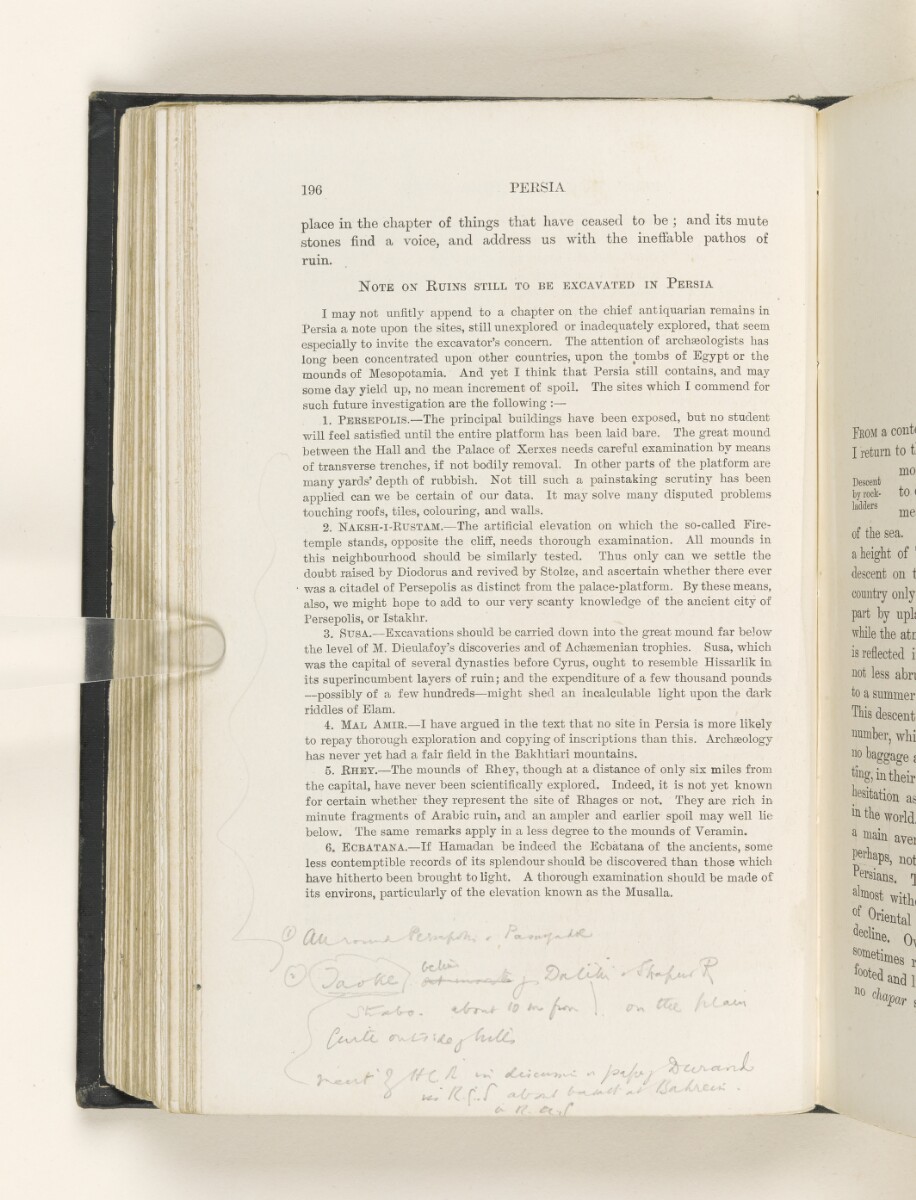
Note on Ruins still to be excavated in Persia
I may not unfitly append to a chapter on the chief antiquarian remains in
Persia a note upon the sites, still unexplored or inadequately explored, that seem
especially to invite the excavator’s concern. The attention of archeologists has
long been concentrated upon other countries, upon the tombs of Egypt or the
mounds of Mesopotamia. And yet I think that Persia still contains, and may
some day yield up, no mean increment of spoil. The sites which I commend for
such future investigation are the following :—
1. Persepolis. —The principal buildings have been exposed, but no student
will feel satisfied until the entire platform has been laid bare. The great mound
between the Hall and the Palace of Xerxes needs careful examination by means
of transverse trenches, if not bodily removal. In other parts of the platform are
many yards’ depth of rubbish. Not till such a painstaking scrutiny has been
applied can we be certain of our data. It may solve many disputed problems
touching roofs, tiles, colouring, and walls.
2. Naksh-i-Rustam.—T he artificial elevation on which the so-called Fire-
temple stands, opposite the cliff, needs thorough examination. All mounds in
this neighbourhood should be similarly tested. Thus only can we settle the
doubt raised by Diodorus and revived by Stolze, and ascertain whether there ever
was a citadel of Persepolis as distinct from the palace-platform. By these means,
also, we might hope to add to our very scanty knowledge of the ancient city of
Persepolis, or Istakhr.
3. Susa.—E xcavations should be carried down into the great mound far below
the level of M. Dieulafoy’s discoveries and of Achsemenian trophies. Susa, which
was the capital of several dynasties before Cyrus, ought to resemble Hissarlik in
its superincumbent layers of ruin ; and the expenditure of a few thousand pounds
—possibly of a few hundreds—might shed an incalculable light upon the dark
riddles of Elam.
4. Mal Amir.—I have argued in the text that no site in Persia is more likely
to repay thorough exploration and copying of inscriptions than this. Archaeology
has never yet had a fair field in the Bakhtiari mountains.
5. Rhey. —The mounds of Rhey, though at a distance of only six miles from
the capital, have never been scientifically explored. Indeed, it is not yet known
for certain whether they represent the site of Rhages or not. They are rich in
minute fragments of Arabic ruin, and an ampler and earlier spoil may well lie
below. The same remarks apply in a less degree to the mounds of Veramin.
6 . Ecbatana.—I f Hamadan be indeed the Ecbatana of the ancients, some
less contemptible records of its splendour should be discovered than those which
have hitherto been brought to light. A thorough examination should be made of
its environs, particularly of the elevation known as the Musalla.
A
A
// ^
l -JC C t C 4 V.V
, v $
About this item
- Content
These two volumes are George Curzon's own personal annotated copies of both volumes of his book Persia and the Persian Question , which was published in 1892. Alongside the volumes are various loose papers relating to Persia [Iran], consisting of the following: received correspondence; newspaper cuttings; publishers' press releases; cuttings from various booksellers' catalogues; various journal and magazine articles; two items of printed official British correspondence; several prints of photographs and sketches; and a few handwritten notes by Curzon.
In most cases these papers, which range in date from 1892 to 1924, relate to the chapters in the book where they were originally inserted, suggesting that they were kept by Curzon with the intention of using them to inform a revised edition of the book.
Of particular note among the small amount of correspondence are two letters received by Curzon in 1914 and 1915 from retired schoolmaster and Islamic scholar Sayyid Mazhar Hasan Musawi of Saharanpur, Uttar Pradesh, India (ff 5-9 and ff 44-53). These letters, which are written in Urdu and are accompanied by English translations, discuss in detail several inaccuracies found in the Urdu version of Persia and the Persian Question .
The various prints of photographs and sketches, which were originally inserted into volume two, are of different locations in the Gulf region. Several of these appear to have been produced in preparation for the publication of the second volume of John Gordon Lorimer's Gazetteer of the Persian Gulf The historical term used to describe the body of water between the Arabian Peninsula and Iran. , Oman and Central Arabia (i.e. the 'Geographical and Statistical' section) in 1908, as they are identical to the versions found in that volume.
Also of note among the loose papers are an illustrated article from Country Life dated 5 June 1920, entitled 'The People of Persia' (ff 36-37), and a printed family tree of the Shah of Persia [Aḥmad Shah Qājār], produced in preparation of his visit to Britain in 1919 (f 233).
Volume one of Persia and the Persian Question contains a map of Persia, Afghanistan and Beluchistan [Balochistan], which is folded inside the front cover (f 1).
The German language material consists of a publisher's press release for two books authored by German archaeologist Ernst Emil Herzfeld (ff 29-30).
- Extent and format
- 2 volumes with inserts (898 folios)
- Physical characteristics
Foliation: this shelfmark consists of two physical volumes. The foliation sequence commences at the first folio of volume one (1-463), and terminates at the last folio of volume two (ff 464-898); these numbers are written in pencil, are circled, and are located in the top right corner of the recto The front of a sheet of paper or leaf, often abbreviated to 'r'. side of each folio. Each volume contains a large number of loose leaves, which have been foliated in the order that they were inserted into the volume; for conservation reasons, these loose folios have been removed from the volume and stored separately. The foliation sequence does not include the front and back covers of the two volumes.
Pagination: the file also contains an original printed pagination sequence.
- Written in
- English, Urdu and German in Latin and Arabic script View the complete information for this record
Use and share this item
- Share this item
Annotated Copy of Persia and the Persian Question by George Curzon, with Inserted Papers [598v] (1211/1814), British Library: India Office Records and Private Papers, Mss Eur F111/33, in Qatar Digital Library <https://www.qdl.qa/archive/81055/vdc_100157213848.0x00000c> [accessed 2 August 2026]
https://www.qdl.qa/en/archive/81055/vdc_100157213848.0x00000c
Copy and paste the code below into your web page where you would like to embed the image.
<meta charset="utf-8"><a href="https://www.qdl.qa/en/archive/81055/vdc_100157213848.0x00000c">Annotated Copy of <em>Persia and the Persian Question</em> by George Curzon, with Inserted Papers [‎598v] (1211/1814)</a> <a href="https://www.qdl.qa/en/archive/81055/vdc_100157213848.0x00000c"> <img src="https://iiif.qdl.qa/iiif/images/81055/vdc_100000001491.0x00033b/Mss Eur F111_33_1225.jp2/full/!280,240/0/default.jpg" alt="" /> </a>
This record has a IIIF manifest available as follows. If you have a compatible viewer you can drag the icon to load it.https://www.qdl.qa/en/iiif/81055/vdc_100000001491.0x00033b/manifestOpen in Universal viewerOpen in Mirador viewerMore options for embedding images
Copyright: How to use this content
- Reference
- Mss Eur F111/33
- Title
- Annotated Copy of Persia and the Persian Questionby George Curzon, with Inserted Papers
- Pages
- 54r:135v, 147r:149v, 158r:180v, 183r:221v, 224r:224v, 227r:246v, 248r:257v, 259r:260v, 268r:362v, 364r:364v, 367r:388v, 390r:400v, 402r:416v, 419r:432v, 434r:444v, 448r:462v, 464r:471v, 475r:481v, 483r:513v, 516r:525v, 527r:544v, 546r:563v, 566r:598v, 600r:622v, 624r:656v, 658r:665v, 667r:675v, 678r:684v, 687r:688v, 691r:691v, 693r:693v, 695r:708v, 711r:721v, 724r:726v, 728r:729v, 731r:736v, 742r:742v, 746r:757v, 759r:761v, 763r:763v, 765r:765v, 772r:777v, 780r:789v, 793r:794v, 797r:809v, 811r:821v, 825r:840v, 843r:898v
- Author
- Curzon, George Nathaniel, 1st Marquess Curzon of Kedleston
- Usage terms
- Public Domain