
![Annotated Copy of <em>Persia and the Persian Question</em> by George Curzon, with Inserted Papers [‎567v] (1149/1814)](https://iiif.qdl.qa/iiif/images/81055/vdc_100000001491.0x00033b/Mss Eur F111_33_1163.jp2/full/!1200,1200/0/default.jpg "Annotated Copy of <em>Persia and the Persian Question</em> by George Curzon, with Inserted Papers [‎567v] (1149/1814)")
Annotated Copy of Persia and the Persian Question by George Curzon, with Inserted Papers [567v] (1149/1814)
The record is made up of 2 volumes with inserts (898 folios). It was created in 1892-1924. It was written in English, Urdu and German. The original is part of the British Library: India Office The department of the British Government to which the Government of India reported between 1858 and 1947. The successor to the Court of Directors. Records and Private Papers Documents collected in a private capacity. .
Transcription
This transcription is created automatically. It may contain errors.
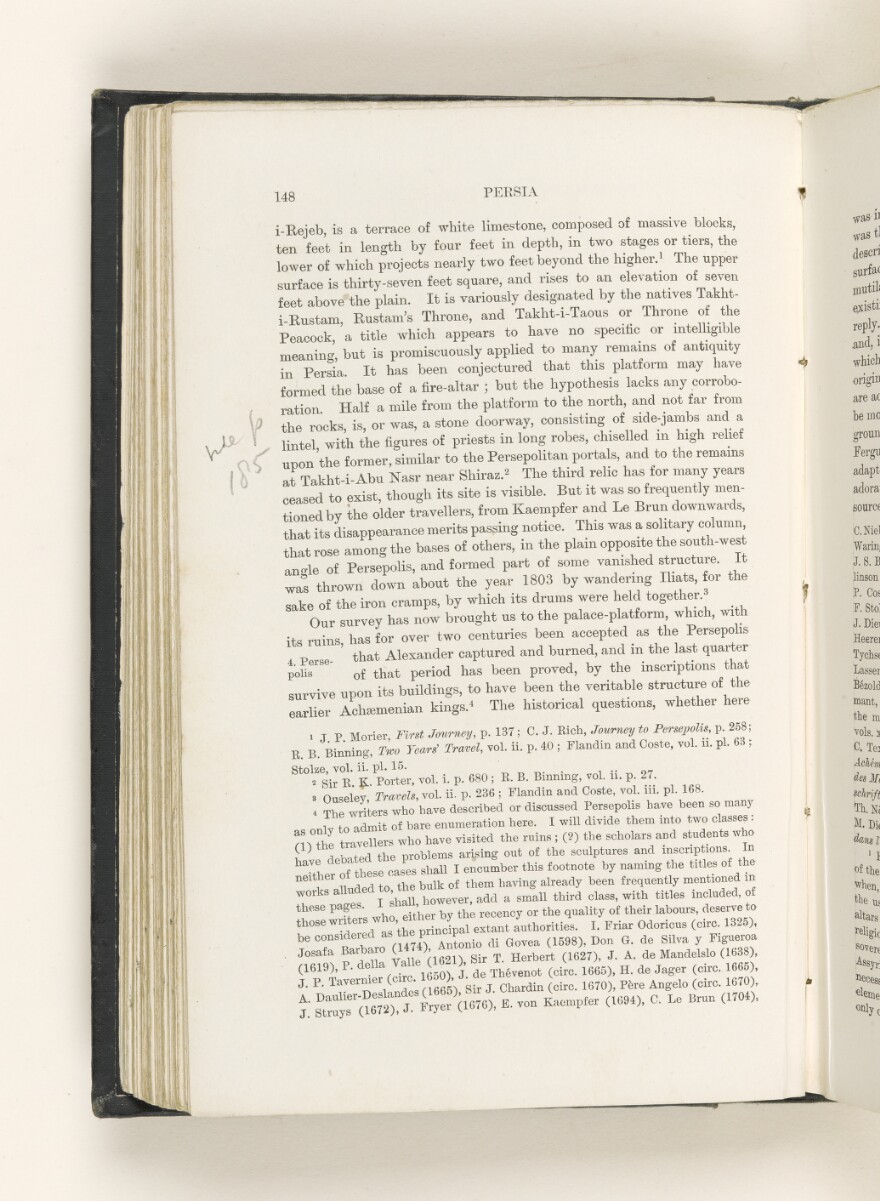
PERSIA
i-Rejeb, is a terrace of white limestone, composed of massive blocks,
ten feet in length by four feet in depth, in two stages or tiers, the
lower of which projects nearly two feet beyond the higher.' The upper
surface is thirty-seven feet square, and rises to an elevation of seven
feet above the plain. It is variously designated by the natives Takht-
i-Rustam, Rustam’s Throne, and Takht-i-Taous or Throne of the
Peacock, a title which appears to have no specific or intelligible
meaning, but is promiscuously applied to many remains of antiquity
Persia. It has been conjectured that this platform may have
formed the base of a fire-altar ; but the hypothesis lacks any corrobo
ration Half a mile from the platform to the north, and not far from
the rocks, is, or was, a stone doorway, consisting of side-jambs and a
lintel with the figures of priests in long robes, chiselled m high re 16
noon’the former, similar to the Persepolitan portals, and to the remains
at Takht-i-Abu Nasr near Shiraz. 2 The third relic has for many years
ceased to exist, though its site is visible. But it was so frequently men
tioned by the older travellers, from Kaempfer and Le Brun downwards,
that its disappearance merits passing notice. This was a solitary column,
that rose among the bases of others, in the plain opposite the south-west
an-le of Persepolis, and formed part of some vanished structure. It
^s thrown down about the year 1803 by wandering Ihats, for the
sake of the iron cramps, by which its drums were held together.
Our survey has now brought us to the palace-platform, which, with
its ruins has for over two centuries been accepted as the Persepo is
that Alexander captured and burned, and in the last quarter
polis 186 ' 0 f that period has been proved, by the inscriptions that
survive upon its buildings, to have been the veritable structure of the
earlier Achsemenian kings. 4 The historical questions, whether heie
1 J V Morier, First Journey, p. 137 ; C.J. Journey to Persepolis,?-^
R. B. Binning, Two Years' Travel, vol. ii. p. 40 ; Flandin and Coste, vol. n. pi- 63 ,
St " K. Porter, vol. i. p. 680; E. B. Binning, vol. ii. p. 27.
3 Ousel'ey Travels, m\. ii. p. 236 ; Flandin and Coste, vol. m. pi. 168.
4 The writers who have described or discussed Persepolis have been so many
w to admit of bare enumeration here. I will divide them into two classes .
m°the travellers who have visited the ruins ; ( 2 ) the scholars and students who
^ ^ -i k t- rl fhp nroblems arising out of the sculptures and inscriptions.
"tf these case"l encumber this footnote by naming the titles of the
neither having already been frequently mentioned in
works alluded to the bidko^ aad a ^ ^ with tMes included , of
these pages. I si - r e 0e ncy or the quality of their labours, deserve to
those “S extent luthoritiel I. Friar Odoricus (circ. 1 325),
be consideied as the p ^ (1698); Don G _ de silva y Figueroa
Josafa Barbaro ( - 1 ’ glr T Herbe rt (1627), J. A. d e Mandelslo (1638),
(1619), P- del a > Th6 enot („j r0 . 1665), H. de Jager (circ. 1665),
j. P. Tavernier (circ. ^ J circ. 1670 , P 6 re Angelo (circ. 1670),
About this item
- Content
These two volumes are George Curzon's own personal annotated copies of both volumes of his book Persia and the Persian Question , which was published in 1892. Alongside the volumes are various loose papers relating to Persia [Iran], consisting of the following: received correspondence; newspaper cuttings; publishers' press releases; cuttings from various booksellers' catalogues; various journal and magazine articles; two items of printed official British correspondence; several prints of photographs and sketches; and a few handwritten notes by Curzon.
In most cases these papers, which range in date from 1892 to 1924, relate to the chapters in the book where they were originally inserted, suggesting that they were kept by Curzon with the intention of using them to inform a revised edition of the book.
Of particular note among the small amount of correspondence are two letters received by Curzon in 1914 and 1915 from retired schoolmaster and Islamic scholar Sayyid Mazhar Hasan Musawi of Saharanpur, Uttar Pradesh, India (ff 5-9 and ff 44-53). These letters, which are written in Urdu and are accompanied by English translations, discuss in detail several inaccuracies found in the Urdu version of Persia and the Persian Question .
The various prints of photographs and sketches, which were originally inserted into volume two, are of different locations in the Gulf region. Several of these appear to have been produced in preparation for the publication of the second volume of John Gordon Lorimer's Gazetteer of the Persian Gulf The historical term used to describe the body of water between the Arabian Peninsula and Iran. , Oman and Central Arabia (i.e. the 'Geographical and Statistical' section) in 1908, as they are identical to the versions found in that volume.
Also of note among the loose papers are an illustrated article from Country Life dated 5 June 1920, entitled 'The People of Persia' (ff 36-37), and a printed family tree of the Shah of Persia [Aḥmad Shah Qājār], produced in preparation of his visit to Britain in 1919 (f 233).
Volume one of Persia and the Persian Question contains a map of Persia, Afghanistan and Beluchistan [Balochistan], which is folded inside the front cover (f 1).
The German language material consists of a publisher's press release for two books authored by German archaeologist Ernst Emil Herzfeld (ff 29-30).
- Extent and format
- 2 volumes with inserts (898 folios)
- Physical characteristics
Foliation: this shelfmark consists of two physical volumes. The foliation sequence commences at the first folio of volume one (1-463), and terminates at the last folio of volume two (ff 464-898); these numbers are written in pencil, are circled, and are located in the top right corner of the recto The front of a sheet of paper or leaf, often abbreviated to 'r'. side of each folio. Each volume contains a large number of loose leaves, which have been foliated in the order that they were inserted into the volume; for conservation reasons, these loose folios have been removed from the volume and stored separately. The foliation sequence does not include the front and back covers of the two volumes.
Pagination: the file also contains an original printed pagination sequence.
- Written in
- English, Urdu and German in Latin and Arabic script View the complete information for this record
Use and share this item
- Share this item
Annotated Copy of Persia and the Persian Question by George Curzon, with Inserted Papers [567v] (1149/1814), British Library: India Office Records and Private Papers, Mss Eur F111/33, in Qatar Digital Library <https://www.qdl.qa/archive/81055/vdc_100157213847.0x000096> [accessed 23 August 2026]
https://www.qdl.qa/en/archive/81055/vdc_100157213847.0x000096
Copy and paste the code below into your web page where you would like to embed the image.
<meta charset="utf-8"><a href="https://www.qdl.qa/en/archive/81055/vdc_100157213847.0x000096">Annotated Copy of <em>Persia and the Persian Question</em> by George Curzon, with Inserted Papers [‎567v] (1149/1814)</a> <a href="https://www.qdl.qa/en/archive/81055/vdc_100157213847.0x000096"> <img src="https://iiif.qdl.qa/iiif/images/81055/vdc_100000001491.0x00033b/Mss Eur F111_33_1163.jp2/full/!280,240/0/default.jpg" alt="" /> </a>
This record has a IIIF manifest available as follows. If you have a compatible viewer you can drag the icon to load it.https://www.qdl.qa/en/iiif/81055/vdc_100000001491.0x00033b/manifestOpen in Universal viewerOpen in Mirador viewerMore options for embedding images
Copyright: How to use this content
- Reference
- Mss Eur F111/33
- Title
- Annotated Copy of Persia and the Persian Questionby George Curzon, with Inserted Papers
- Pages
- 54r:135v, 147r:149v, 158r:180v, 183r:221v, 224r:224v, 227r:246v, 248r:257v, 259r:260v, 268r:362v, 364r:364v, 367r:388v, 390r:400v, 402r:416v, 419r:432v, 434r:444v, 448r:462v, 464r:471v, 475r:481v, 483r:513v, 516r:525v, 527r:544v, 546r:563v, 566r:598v, 600r:622v, 624r:656v, 658r:665v, 667r:675v, 678r:684v, 687r:688v, 691r:691v, 693r:693v, 695r:708v, 711r:721v, 724r:726v, 728r:729v, 731r:736v, 742r:742v, 746r:757v, 759r:761v, 763r:763v, 765r:765v, 772r:777v, 780r:789v, 793r:794v, 797r:809v, 811r:821v, 825r:840v, 843r:898v
- Author
- Curzon, George Nathaniel, 1st Marquess Curzon of Kedleston
- Usage terms
- Public Domain