
![Annotated Copy of <em>Persia and the Persian Question</em> by George Curzon, with Inserted Papers [‎550v] (1113/1814)](https://iiif.qdl.qa/iiif/images/81055/vdc_100000001491.0x00033b/Mss Eur F111_33_1127.jp2/full/!1200,1200/0/default.jpg "Annotated Copy of <em>Persia and the Persian Question</em> by George Curzon, with Inserted Papers [‎550v] (1113/1814)")
Annotated Copy of Persia and the Persian Question by George Curzon, with Inserted Papers [550v] (1113/1814)
The record is made up of 2 volumes with inserts (898 folios). It was created in 1892-1924. It was written in English, Urdu and German. The original is part of the British Library: India Office The department of the British Government to which the Government of India reported between 1858 and 1947. The successor to the Court of Directors. Records and Private Papers Documents collected in a private capacity. .
Transcription
This transcription is created automatically. It may contain errors.
mamssseaammi
118
PERSIA
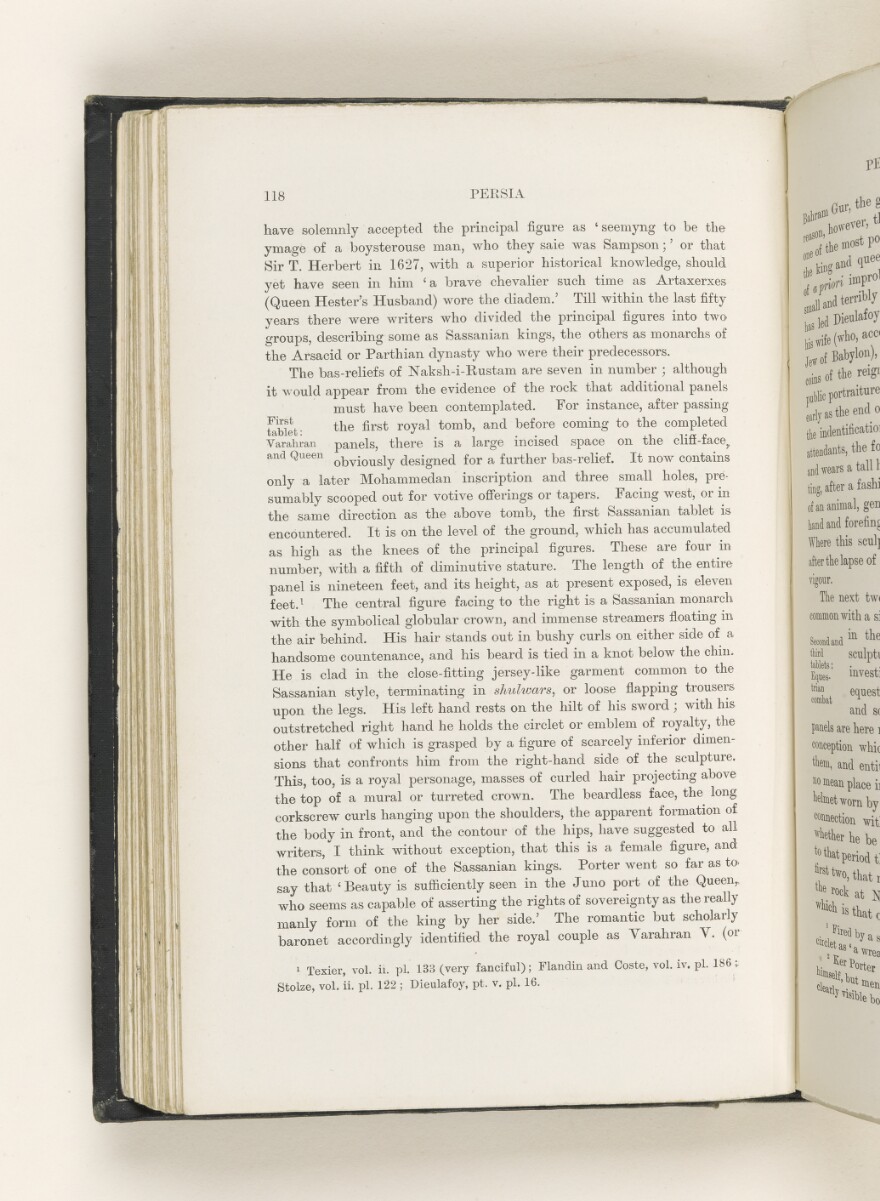
have solemnly accepted the principal figure as ‘ seemyng to be the
ymage of a hoysterouse man, who they saie was Sampson; 5 or that
Sir T. Herbert in 1627, with a superior historical knowledge, should
yet have seen in him ‘a brave chevalier such time as Artaxerxes
(Queen Hester’s Husband) wore the diadem.’ Till within the last fifty
years there were writers who divided the principal figures into two
groups, describing some as Sassanian kings, the otheis as monarchs of
the Arsacid or Parthian dynasty who were their predecessors.
The bas-reliefs of Naksh-i-Rustam are seven in number ; although
it would appear from the evidence of the rock that additional panels
must have been contemplated. For instance, after passing
Yvwn.l f.nmb a,ml before coming to the completed
First
and Queen obvious iy designed for a further bas-relief. It now contains
only a later Mohammedan inscription and three small holes, pre
sumably scooped out for votive offerings or tapers. Facing west, or in
the same direction as the above tomb, the first Sassanian tablet is
encountered. It is on the level of the ground, which has accumulated
as high as the knees of the principal figures. These are four m
number, with a fifth of diminutive stature. The length of the entire
panel is nineteen feet, and its height, as at present exposed, is ele\ en
feet. 1 The central figure facing to the right is a Sassanian monarch
with the symbolical globular crown, and immense streamers floating in
the air behind. His hair stands out in bushy curls on either side of a
handsome countenance, and his beard is tied in a knot below the chm.
He is clad in the close-fitting jersey-like garment common to the
Sassanian style, terminating in shulwars, or loose flapping trousers
upon the legs. His left hand rests on the hilt of his sword ; with his
outstretched right hand he holds the circlet or emblem of royalty, the
other half of which is grasped by a figure of scarcely inferior dimen
sions that confronts him from the right-hand side of the sculpture.
This, too, is a royal personage, masses of curled hair projecting above
the top of a mural or turreted crown. The beardless face, the long
corkscrew curls hanging upon the shoulders, the apparent formation of
the body in front, and the contour of the hips, have suggested to all
writers/1 think without exception, that this is a female figure, and
the consort of one of the Sassanian kings. Porter went so far as to.
say that ‘ Beauty is sufficiently seen in the Juno port of the Queen r
who seems as capable of asserting the rights of sovereignty as the really
manly form of the king by her side.’ The romantic but scholarly
baronet accordingly identified the royal couple as A arahian V. (oi
1 Texier, vol. ii. pi. 133 (very fanciful); Flandin and Coste, vol. iv. pi. 186 v
Stolze, vol. ii. pk 122 ; Dieulafoy, pt. v. pi. 16.
About this item
- Content
These two volumes are George Curzon's own personal annotated copies of both volumes of his book Persia and the Persian Question , which was published in 1892. Alongside the volumes are various loose papers relating to Persia [Iran], consisting of the following: received correspondence; newspaper cuttings; publishers' press releases; cuttings from various booksellers' catalogues; various journal and magazine articles; two items of printed official British correspondence; several prints of photographs and sketches; and a few handwritten notes by Curzon.
In most cases these papers, which range in date from 1892 to 1924, relate to the chapters in the book where they were originally inserted, suggesting that they were kept by Curzon with the intention of using them to inform a revised edition of the book.
Of particular note among the small amount of correspondence are two letters received by Curzon in 1914 and 1915 from retired schoolmaster and Islamic scholar Sayyid Mazhar Hasan Musawi of Saharanpur, Uttar Pradesh, India (ff 5-9 and ff 44-53). These letters, which are written in Urdu and are accompanied by English translations, discuss in detail several inaccuracies found in the Urdu version of Persia and the Persian Question .
The various prints of photographs and sketches, which were originally inserted into volume two, are of different locations in the Gulf region. Several of these appear to have been produced in preparation for the publication of the second volume of John Gordon Lorimer's Gazetteer of the Persian Gulf The historical term used to describe the body of water between the Arabian Peninsula and Iran. , Oman and Central Arabia (i.e. the 'Geographical and Statistical' section) in 1908, as they are identical to the versions found in that volume.
Also of note among the loose papers are an illustrated article from Country Life dated 5 June 1920, entitled 'The People of Persia' (ff 36-37), and a printed family tree of the Shah of Persia [Aḥmad Shah Qājār], produced in preparation of his visit to Britain in 1919 (f 233).
Volume one of Persia and the Persian Question contains a map of Persia, Afghanistan and Beluchistan [Balochistan], which is folded inside the front cover (f 1).
The German language material consists of a publisher's press release for two books authored by German archaeologist Ernst Emil Herzfeld (ff 29-30).
- Extent and format
- 2 volumes with inserts (898 folios)
- Physical characteristics
Foliation: this shelfmark consists of two physical volumes. The foliation sequence commences at the first folio of volume one (1-463), and terminates at the last folio of volume two (ff 464-898); these numbers are written in pencil, are circled, and are located in the top right corner of the recto The front of a sheet of paper or leaf, often abbreviated to 'r'. side of each folio. Each volume contains a large number of loose leaves, which have been foliated in the order that they were inserted into the volume; for conservation reasons, these loose folios have been removed from the volume and stored separately. The foliation sequence does not include the front and back covers of the two volumes.
Pagination: the file also contains an original printed pagination sequence.
- Written in
- English, Urdu and German in Latin and Arabic script View the complete information for this record
Use and share this item
- Share this item
Annotated Copy of Persia and the Persian Question by George Curzon, with Inserted Papers [550v] (1113/1814), British Library: India Office Records and Private Papers, Mss Eur F111/33, in Qatar Digital Library <https://www.qdl.qa/archive/81055/vdc_100157213847.0x000072> [accessed 6 August 2026]
https://www.qdl.qa/en/archive/81055/vdc_100157213847.0x000072
Copy and paste the code below into your web page where you would like to embed the image.
<meta charset="utf-8"><a href="https://www.qdl.qa/en/archive/81055/vdc_100157213847.0x000072">Annotated Copy of <em>Persia and the Persian Question</em> by George Curzon, with Inserted Papers [‎550v] (1113/1814)</a> <a href="https://www.qdl.qa/en/archive/81055/vdc_100157213847.0x000072"> <img src="https://iiif.qdl.qa/iiif/images/81055/vdc_100000001491.0x00033b/Mss Eur F111_33_1127.jp2/full/!280,240/0/default.jpg" alt="" /> </a>
This record has a IIIF manifest available as follows. If you have a compatible viewer you can drag the icon to load it.https://www.qdl.qa/en/iiif/81055/vdc_100000001491.0x00033b/manifestOpen in Universal viewerOpen in Mirador viewerMore options for embedding images
Copyright: How to use this content
- Reference
- Mss Eur F111/33
- Title
- Annotated Copy of Persia and the Persian Questionby George Curzon, with Inserted Papers
- Pages
- 54r:135v, 147r:149v, 158r:180v, 183r:221v, 224r:224v, 227r:246v, 248r:257v, 259r:260v, 268r:362v, 364r:364v, 367r:388v, 390r:400v, 402r:416v, 419r:432v, 434r:444v, 448r:462v, 464r:471v, 475r:481v, 483r:513v, 516r:525v, 527r:544v, 546r:563v, 566r:598v, 600r:622v, 624r:656v, 658r:665v, 667r:675v, 678r:684v, 687r:688v, 691r:691v, 693r:693v, 695r:708v, 711r:721v, 724r:726v, 728r:729v, 731r:736v, 742r:742v, 746r:757v, 759r:761v, 763r:763v, 765r:765v, 772r:777v, 780r:789v, 793r:794v, 797r:809v, 811r:821v, 825r:840v, 843r:898v
- Author
- Curzon, George Nathaniel, 1st Marquess Curzon of Kedleston
- Usage terms
- Public Domain