
![Annotated Copy of <em>Persia and the Persian Question</em> by George Curzon, with Inserted Papers [‎530v] (1073/1814)](https://iiif.qdl.qa/iiif/images/81055/vdc_100000001491.0x00033b/Mss Eur F111_33_1087.jp2/full/!1200,1200/0/default.jpg "Annotated Copy of <em>Persia and the Persian Question</em> by George Curzon, with Inserted Papers [‎530v] (1073/1814)")
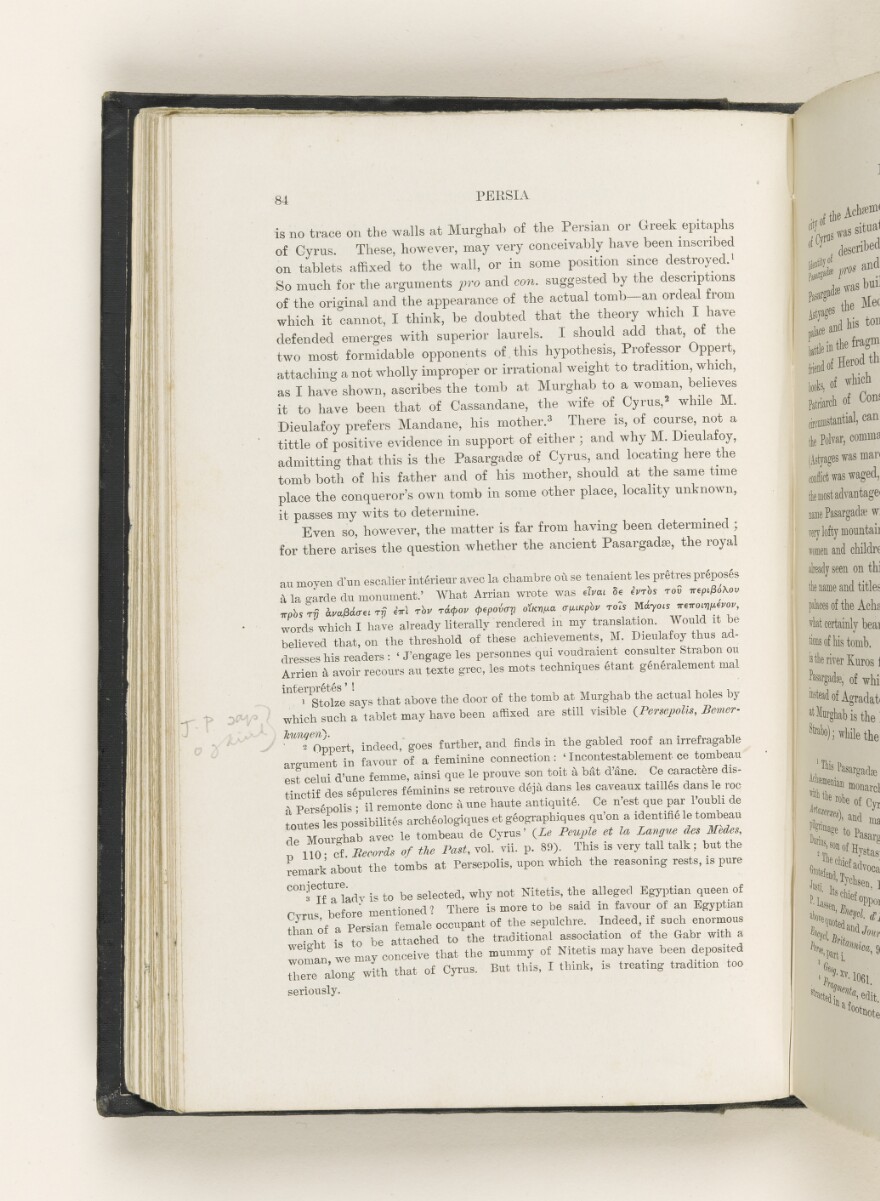
Annotated Copy of Persia and the Persian Question by George Curzon, with Inserted Papers [530v] (1073/1814)
The record is made up of 2 volumes with inserts (898 folios). It was created in 1892-1924. It was written in English, Urdu and German. The original is part of the British Library: India Office The department of the British Government to which the Government of India reported between 1858 and 1947. The successor to the Court of Directors. Records and Private Papers Documents collected in a private capacity. .
Transcription
This transcription is created automatically. It may contain errors.
84
PERSIA
is no trace on the walls at Murghab of the Persian or Greek epitaphs
of Cyrus. These, however, may very conceivably have been inscribed
on tablets affixed to the wall, or in some position since destroyed.
So much for the arguments y>ro and co7i. suggested by the descriptions
of the original and the appearance of the actual tomb—an ordeal rom
which it cannot, I think, be doubted that the theory which I have
defended emerges with superior laurels. I should add that, o tie
two most formidable opponents of this hypothesis, Professor Oppert,
attaching a not wholly improper or irrational weight to tradition, which,
as I have shown, ascribes the tomb at Murghab to a woman, believes
it to have been that of Cassandane, the wife of Cyrus, 2 while M.
Dieulafoy prefers Mandane, his mother. 3 There is, of course, not a
tittle of positive evidence in support of either ; and why M. Dieulafoy,
admitting that this is the Pasargadse of Cyrus, and locating here the
tomb both of his father and of his mother, should at the same time
place the conqueror’s own tomb in some other place, locality unknown,
it passes my wits to determine.
Even so, however, the matter is far from having been determined ,
for there arises the question whether the ancient Pasargadte, the royal
an moyen d’un escalier int&ieur avec la chambre oi'i se tenaient les pretres preposes
a la garde du monument.’ What Arrian wrote was eirc. Be ivrbs rov ir^oXov
X nb S TTj avafam TV eirl rbv T<i<t>op ohcv/m ffiwcpbp ro.s jeMi^eror,
words'which I have already literally rendered in my translation. Would it be
believed that, on the threshold of these achievements, M. Dieulafoy thus ad
dresses his readers : ‘ J’engage les personnes qui voudraient consulter Strabon on
Arrien & avoir recours an texte grec, les mots techniques etant generalement mal
“b 1 Stolze says that above the door of the tomb at Murghab the actual holes by
which such a tablet may have been affixed are still visible {Persepolu, Bemer-
ta? Op goeg and finds in the gabled roof an irrefragable
mmiment in favour of a feminine connection : < Incontestablement ce tombeau
est celui d’une femme, ainsi que le prouve son toit & bat d’ane. Ce caractere dis-
tinctif des sipulcres fgminins se retrouve deja dans les caveaux tallies dans le roc
.1 Perseoolis • il remonte done a une haute antiquity Ce n’est que par 1’oubli de
tnutes les possibilites archgologiques et geographiques qu’on a identifie le tombeau
de Mourghab avec le tombeau de Cyrus’ (Ze Peuple et U Langne des Medes,
„ ,, 0 • tf Records of the Past, vol. vii. p. 89). This is very tall talk ; but the
remark about the tombs at Persepolis, upon which the reasoning rests, is pure
C °Triadv is to be selected, why not Nitetis, the alleged Egyptian queen of
m-rns before mentioned? There is more to be said in favour of an Egyptian
Py"“: f „ p ers ian female occupant of the sepulchre. Indeed, if such enormous
h “ 1 1 is to be attached to the traditional association of the Gabr with a
woman we may conceive that the mummy of Nitetis may have been deposited
there along with that of Cyrus. But this, I think, is treating tradition too
seriously.
About this item
- Content
These two volumes are George Curzon's own personal annotated copies of both volumes of his book Persia and the Persian Question , which was published in 1892. Alongside the volumes are various loose papers relating to Persia [Iran], consisting of the following: received correspondence; newspaper cuttings; publishers' press releases; cuttings from various booksellers' catalogues; various journal and magazine articles; two items of printed official British correspondence; several prints of photographs and sketches; and a few handwritten notes by Curzon.
In most cases these papers, which range in date from 1892 to 1924, relate to the chapters in the book where they were originally inserted, suggesting that they were kept by Curzon with the intention of using them to inform a revised edition of the book.
Of particular note among the small amount of correspondence are two letters received by Curzon in 1914 and 1915 from retired schoolmaster and Islamic scholar Sayyid Mazhar Hasan Musawi of Saharanpur, Uttar Pradesh, India (ff 5-9 and ff 44-53). These letters, which are written in Urdu and are accompanied by English translations, discuss in detail several inaccuracies found in the Urdu version of Persia and the Persian Question .
The various prints of photographs and sketches, which were originally inserted into volume two, are of different locations in the Gulf region. Several of these appear to have been produced in preparation for the publication of the second volume of John Gordon Lorimer's Gazetteer of the Persian Gulf The historical term used to describe the body of water between the Arabian Peninsula and Iran. , Oman and Central Arabia (i.e. the 'Geographical and Statistical' section) in 1908, as they are identical to the versions found in that volume.
Also of note among the loose papers are an illustrated article from Country Life dated 5 June 1920, entitled 'The People of Persia' (ff 36-37), and a printed family tree of the Shah of Persia [Aḥmad Shah Qājār], produced in preparation of his visit to Britain in 1919 (f 233).
Volume one of Persia and the Persian Question contains a map of Persia, Afghanistan and Beluchistan [Balochistan], which is folded inside the front cover (f 1).
The German language material consists of a publisher's press release for two books authored by German archaeologist Ernst Emil Herzfeld (ff 29-30).
- Extent and format
- 2 volumes with inserts (898 folios)
- Physical characteristics
Foliation: this shelfmark consists of two physical volumes. The foliation sequence commences at the first folio of volume one (1-463), and terminates at the last folio of volume two (ff 464-898); these numbers are written in pencil, are circled, and are located in the top right corner of the recto The front of a sheet of paper or leaf, often abbreviated to 'r'. side of each folio. Each volume contains a large number of loose leaves, which have been foliated in the order that they were inserted into the volume; for conservation reasons, these loose folios have been removed from the volume and stored separately. The foliation sequence does not include the front and back covers of the two volumes.
Pagination: the file also contains an original printed pagination sequence.
- Written in
- English, Urdu and German in Latin and Arabic script View the complete information for this record
Use and share this item
- Share this item
Annotated Copy of Persia and the Persian Question by George Curzon, with Inserted Papers [530v] (1073/1814), British Library: India Office Records and Private Papers, Mss Eur F111/33, in Qatar Digital Library <https://www.qdl.qa/archive/81055/vdc_100157213847.0x00004a> [accessed 30 August 2026]
https://www.qdl.qa/en/archive/81055/vdc_100157213847.0x00004a
Copy and paste the code below into your web page where you would like to embed the image.
<meta charset="utf-8"><a href="https://www.qdl.qa/en/archive/81055/vdc_100157213847.0x00004a">Annotated Copy of <em>Persia and the Persian Question</em> by George Curzon, with Inserted Papers [‎530v] (1073/1814)</a> <a href="https://www.qdl.qa/en/archive/81055/vdc_100157213847.0x00004a"> <img src="https://iiif.qdl.qa/iiif/images/81055/vdc_100000001491.0x00033b/Mss Eur F111_33_1087.jp2/full/!280,240/0/default.jpg" alt="" /> </a>
This record has a IIIF manifest available as follows. If you have a compatible viewer you can drag the icon to load it.https://www.qdl.qa/en/iiif/81055/vdc_100000001491.0x00033b/manifestOpen in Universal viewerOpen in Mirador viewerMore options for embedding images
Copyright: How to use this content
- Reference
- Mss Eur F111/33
- Title
- Annotated Copy of Persia and the Persian Questionby George Curzon, with Inserted Papers
- Pages
- 54r:135v, 147r:149v, 158r:180v, 183r:221v, 224r:224v, 227r:246v, 248r:257v, 259r:260v, 268r:362v, 364r:364v, 367r:388v, 390r:400v, 402r:416v, 419r:432v, 434r:444v, 448r:462v, 464r:471v, 475r:481v, 483r:513v, 516r:525v, 527r:544v, 546r:563v, 566r:598v, 600r:622v, 624r:656v, 658r:665v, 667r:675v, 678r:684v, 687r:688v, 691r:691v, 693r:693v, 695r:708v, 711r:721v, 724r:726v, 728r:729v, 731r:736v, 742r:742v, 746r:757v, 759r:761v, 763r:763v, 765r:765v, 772r:777v, 780r:789v, 793r:794v, 797r:809v, 811r:821v, 825r:840v, 843r:898v
- Author
- Curzon, George Nathaniel, 1st Marquess Curzon of Kedleston
- Usage terms
- Public Domain