
![Annotated Copy of <em>Persia and the Persian Question</em> by George Curzon, with Inserted Papers [‎430v] (863/1814)](https://iiif.qdl.qa/iiif/images/81055/vdc_100000001491.0x00033b/Mss Eur F111_33_0875.jp2/full/!1200,1200/0/default.jpg "Annotated Copy of <em>Persia and the Persian Question</em> by George Curzon, with Inserted Papers [‎430v] (863/1814)")
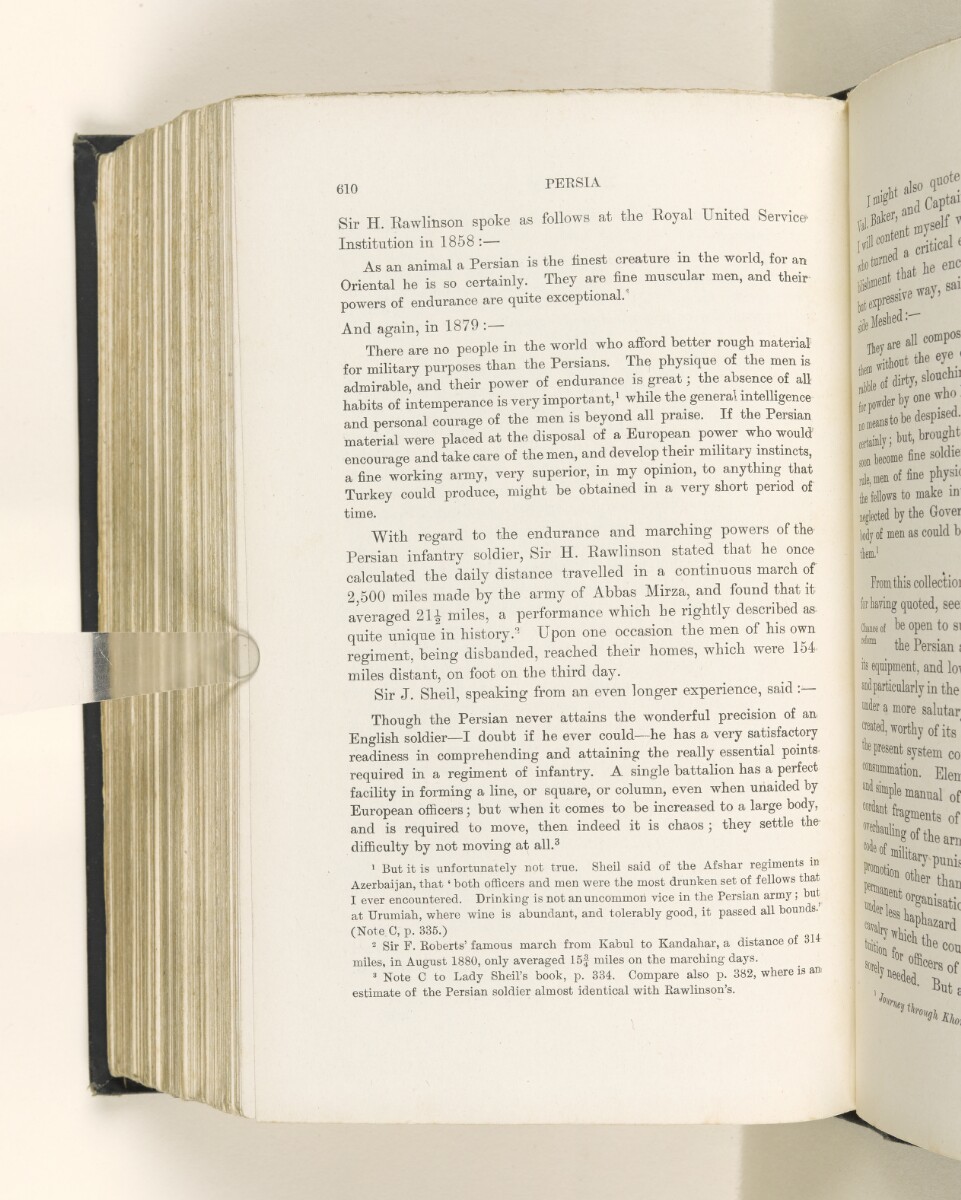
Annotated Copy of Persia and the Persian Question by George Curzon, with Inserted Papers [430v] (863/1814)
The record is made up of 2 volumes with inserts (898 folios). It was created in 1892-1924. It was written in English, Urdu and German. The original is part of the British Library: India Office The department of the British Government to which the Government of India reported between 1858 and 1947. The successor to the Court of Directors. Records and Private Papers Documents collected in a private capacity. .
Transcription
This transcription is created automatically. It may contain errors.
610
PEKSIA
Sir H. Rawlinson spoke as follows at the Royal United Service-
Institution in 1858:—
As an animal a Persian is the finest creature in the world, for an
Oriental he is so certainly. They are fine muscular men, and their
powers of endurance are quite exceptional.
And again, in 18/9 :
There are no people in the world who afford better rough material
for military purposes than the Persians. The physique of the men is
admirable, and their power of endurance is great; the absence ^ all
habits of intemperance is very important , 1 while the general intelligence
and personal courage of the men is beyond all praise. If the Persian
material were placed at the disposal of a European power who would
encourage and take care of the men, and develop their military instincts,
a fine working army, very superior, in my opinion, to anything that
Turkey could produce, might be obtained in a very short period of
time.
With regard to the endurance and marching powers of the
Persian infantry soldier, Sir H. Rawlinson stated that he once
calculated the daily distance travelled in a continuous march of
2,500 miles made by the army of Abbas Mirza, and found that it
averaged 21^ miles, a performance which he rightly described as
quite unique in history." Upon one occasion the men of his own
regiment, being disbanded, reached their homes, which were 154
miles distant, on foot on the third day.
Sir J. Sheil, speaking from an even longer experience, said
Though the Persian never attains the wonderful precision of an
English soldier— I doubt if he ever could—he has a very satisfactory
readiness in comprehending and attaining the really essential points
required in a regiment of infantry. A single battalion has a perfect
facility in forming a line, or square, or column, even when unaided by
European officers; but when it comes to be increased to a large body,
and is required to move, then indeed it is chaos ; they settle the
difficulty by not moving at all . 3
1 But it is unfortunately not true. Sheil said of the Afshar regiments in
Azerbaijan, that ‘ both officers and men were the most drunken set of fellows that
I ever encountered. Drinking is not an uncommon vice in the Persian army ; but
at Urumiah, where wine is abundant, and tolerably good, it passed all bounds.
(Note C, p. 335.) . , qU
2 Sir F. Roberts’ famous march from Kabul to Kandahar, a distance oi
miles, in August 1880, only averaged 15j miles on the marching days.
3 Note C to Lady Sheiks book, p. 334. Compare also p. 382, where is an
estimate of the Persian soldier almost identical with Rawlinson’s.
' \
a ca op tal
P
'""flint k® e ’ c
Iliey are all co®P oS '
I ;
r ponder by one who -
insto be despised-
rtaffily; but, broug
on become fine soldie.
le, men of fine phy^ (
[e fellows to make im
iglected by the Gover
)iy of men as could b
them. 1
From this colb
for having quoted
Clance of ^ Open
Kform the Pen
its equipment, ai
and particularly h
under a more sa
seated, worthy o
dre present syste
C0I1 ^mation.
simple maim
C0llait fragmen
ting of th
milit arT
Motion other
t* 0r San
- ® for office
"eeded. ■
4b.,
About this item
- Content
These two volumes are George Curzon's own personal annotated copies of both volumes of his book Persia and the Persian Question , which was published in 1892. Alongside the volumes are various loose papers relating to Persia [Iran], consisting of the following: received correspondence; newspaper cuttings; publishers' press releases; cuttings from various booksellers' catalogues; various journal and magazine articles; two items of printed official British correspondence; several prints of photographs and sketches; and a few handwritten notes by Curzon.
In most cases these papers, which range in date from 1892 to 1924, relate to the chapters in the book where they were originally inserted, suggesting that they were kept by Curzon with the intention of using them to inform a revised edition of the book.
Of particular note among the small amount of correspondence are two letters received by Curzon in 1914 and 1915 from retired schoolmaster and Islamic scholar Sayyid Mazhar Hasan Musawi of Saharanpur, Uttar Pradesh, India (ff 5-9 and ff 44-53). These letters, which are written in Urdu and are accompanied by English translations, discuss in detail several inaccuracies found in the Urdu version of Persia and the Persian Question .
The various prints of photographs and sketches, which were originally inserted into volume two, are of different locations in the Gulf region. Several of these appear to have been produced in preparation for the publication of the second volume of John Gordon Lorimer's Gazetteer of the Persian Gulf The historical term used to describe the body of water between the Arabian Peninsula and Iran. , Oman and Central Arabia (i.e. the 'Geographical and Statistical' section) in 1908, as they are identical to the versions found in that volume.
Also of note among the loose papers are an illustrated article from Country Life dated 5 June 1920, entitled 'The People of Persia' (ff 36-37), and a printed family tree of the Shah of Persia [Aḥmad Shah Qājār], produced in preparation of his visit to Britain in 1919 (f 233).
Volume one of Persia and the Persian Question contains a map of Persia, Afghanistan and Beluchistan [Balochistan], which is folded inside the front cover (f 1).
The German language material consists of a publisher's press release for two books authored by German archaeologist Ernst Emil Herzfeld (ff 29-30).
- Extent and format
- 2 volumes with inserts (898 folios)
- Physical characteristics
Foliation: this shelfmark consists of two physical volumes. The foliation sequence commences at the first folio of volume one (1-463), and terminates at the last folio of volume two (ff 464-898); these numbers are written in pencil, are circled, and are located in the top right corner of the recto The front of a sheet of paper or leaf, often abbreviated to 'r'. side of each folio. Each volume contains a large number of loose leaves, which have been foliated in the order that they were inserted into the volume; for conservation reasons, these loose folios have been removed from the volume and stored separately. The foliation sequence does not include the front and back covers of the two volumes.
Pagination: the file also contains an original printed pagination sequence.
- Written in
- English, Urdu and German in Latin and Arabic script View the complete information for this record
Use and share this item
- Share this item
Annotated Copy of Persia and the Persian Question by George Curzon, with Inserted Papers [430v] (863/1814), British Library: India Office Records and Private Papers, Mss Eur F111/33, in Qatar Digital Library <https://www.qdl.qa/archive/81055/vdc_100157213846.0x000046> [accessed 19 June 2026]
https://www.qdl.qa/en/archive/81055/vdc_100157213846.0x000046
Copy and paste the code below into your web page where you would like to embed the image.
<meta charset="utf-8"><a href="https://www.qdl.qa/en/archive/81055/vdc_100157213846.0x000046">Annotated Copy of <em>Persia and the Persian Question</em> by George Curzon, with Inserted Papers [‎430v] (863/1814)</a> <a href="https://www.qdl.qa/en/archive/81055/vdc_100157213846.0x000046"> <img src="https://iiif.qdl.qa/iiif/images/81055/vdc_100000001491.0x00033b/Mss Eur F111_33_0875.jp2/full/!280,240/0/default.jpg" alt="" /> </a>
This record has a IIIF manifest available as follows. If you have a compatible viewer you can drag the icon to load it.https://www.qdl.qa/en/iiif/81055/vdc_100000001491.0x00033b/manifestOpen in Universal viewerOpen in Mirador viewerMore options for embedding images
Copyright: How to use this content
- Reference
- Mss Eur F111/33
- Title
- Annotated Copy of Persia and the Persian Questionby George Curzon, with Inserted Papers
- Pages
- 54r:135v, 147r:149v, 158r:180v, 183r:221v, 224r:224v, 227r:246v, 248r:257v, 259r:260v, 268r:362v, 364r:364v, 367r:388v, 390r:400v, 402r:416v, 419r:432v, 434r:444v, 448r:462v, 464r:471v, 475r:481v, 483r:513v, 516r:525v, 527r:544v, 546r:563v, 566r:598v, 600r:622v, 624r:656v, 658r:665v, 667r:675v, 678r:684v, 687r:688v, 691r:691v, 693r:693v, 695r:708v, 711r:721v, 724r:726v, 728r:729v, 731r:736v, 742r:742v, 746r:757v, 759r:761v, 763r:763v, 765r:765v, 772r:777v, 780r:789v, 793r:794v, 797r:809v, 811r:821v, 825r:840v, 843r:898v
- Author
- Curzon, George Nathaniel, 1st Marquess Curzon of Kedleston
- Usage terms
- Public Domain