
![Annotated Copy of <em>Persia and the Persian Question</em> by George Curzon, with Inserted Papers [‎426r] (854/1814)](https://iiif.qdl.qa/iiif/images/81055/vdc_100000001491.0x00033b/Mss Eur F111_33_0866.jp2/full/!1200,1200/0/default.jpg "Annotated Copy of <em>Persia and the Persian Question</em> by George Curzon, with Inserted Papers [‎426r] (854/1814)")
Annotated Copy of Persia and the Persian Question by George Curzon, with Inserted Papers [426r] (854/1814)
The record is made up of 2 volumes with inserts (898 folios). It was created in 1892-1924. It was written in English, Urdu and German. The original is part of the British Library: India Office The department of the British Government to which the Government of India reported between 1858 and 1947. The successor to the Court of Directors. Records and Private Papers Documents collected in a private capacity. .
Transcription
This transcription is created automatically. It may contain errors.
603
8 ; cen% ^ e tte
frontier ,, , 0 of ).
10o tHoJ° S; ^ile'
b '* 5::s
em. Qf
" are none i
Iip ^ i. . 1 %
Serial of
inderan.
th the^old^^^
"“eanwarandirf,
^Muchas^,
. b ° 1 f 1 a P al *®icpilk
“glikelayforfei,!
J-elieran arsenal fc ^
'e Kurdish or T%
ndl rifles, for wticfls,
of ammunition, andi
1 disuse. There are si:
es (transformed mi
Germans in the Er®
hem to the SMinj
.ey and their ammiitii
.e latter is manufad®
vder
factory
An East India Company trading post.
, while si
r on to the Meidan. 1
was courteously receh
ound the premises,»
3 opening on to gaiti-
i pay his annual visits
ras in spick and f
diief products of
fatuettesfortlied#
ssion-cap factor W
an; and shof** ll1 '
Mirza Ag hass1 ’
^-p t-Up ancient A
THE AEMY
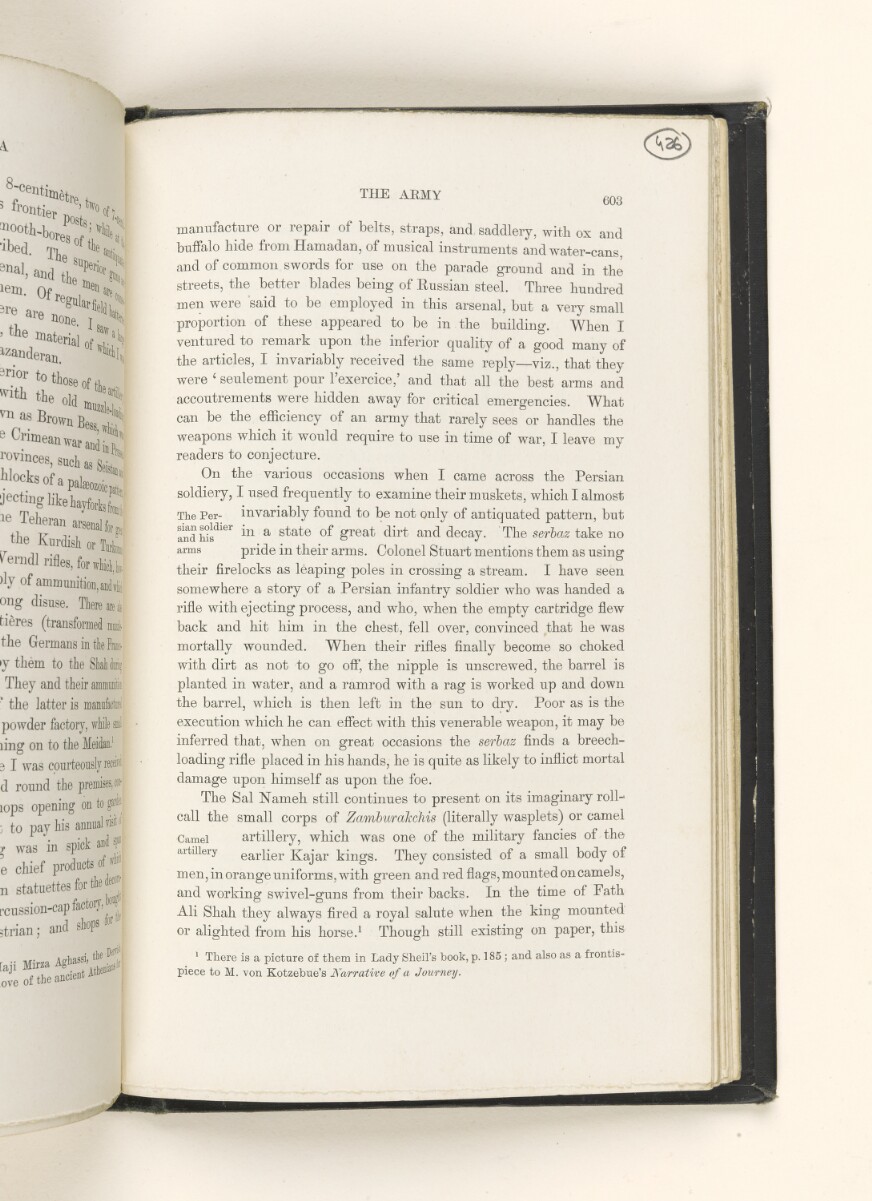
manufacture or repair of belts, straps, and saddlery, with ox and
buffalo hide from Hamadan, of musical instruments and water-cans
and of common swords for use on the parade ground and in the
streets, the better blades being of Russian steel. Three hundred
men were said to be employed in this arsenal, but a very small
proportion of these appeared to be in the building. When I
ventured to remark upon the inferior quality of a good many of
the articles, I invariably received the same reply—viz., that they
were c senlement pour Texercice,’ and that all the best arms and
accoutrements were hidden away for critical emergencies. TVTiat
can be the efficiency of an army that rarely sees or handles the
weapons which it would require to use in time of war, I leave my
readers to conjecture.
On the various occasions when I came across the Persian
soldiery, I used frequently to examine their muskets, which I almost
The Per- invariably found to be not only of antiquated pattern, but
and his dier i n a state g reat dirt and decay. The serbaz take no
arms pride in their arms. Colonel Stuart mentions them as using
their firelocks as leaping poles in crossing a stream. I have seen
somewhere a story of a Persian infantry soldier who was handed a
rifle with ejecting process, and who, when the empty cartridge flew
back and hit him in the chest, fell over, convinced that he was
mortally wounded. When their rifles finally become so choked
with dirt as not to go off, the nipple is unscrewed, the barrel is
planted in water, and a ramrod with a rag is worked up and down
the barrel, which is then left in the sun to dry. Poor as is the
execution which he can effect with this venerable weapon, it may he
inferred that, when on great occasions the serbaz finds a breech
loading rifle placed in his hands, he is quite as likely to inflict mortal
damage upon himself as upon the foe.
The Sal Nameh still continues to present on its imaginary roll-
call the small corps of Zamburakchis (literally wasplets) or camel
Camel artillery, which was one of the military fancies of the
artillery earlier Kajar kings. They consisted of a small body of
men, in orange uniforms, with green and red flags, mounted on camels,
and working swivel-guns from their backs. In the time of Path
Ali Shah they always fired a royal salute when the king mounted
or alighted from his horse. 1 Though still existing on paper, this
1 There is a picture of them in Lady Sheil’s book, p. 185 ; and also as a frontis
piece to M. von Kotzebue’s Narrative of a Journey.
About this item
- Content
These two volumes are George Curzon's own personal annotated copies of both volumes of his book Persia and the Persian Question , which was published in 1892. Alongside the volumes are various loose papers relating to Persia [Iran], consisting of the following: received correspondence; newspaper cuttings; publishers' press releases; cuttings from various booksellers' catalogues; various journal and magazine articles; two items of printed official British correspondence; several prints of photographs and sketches; and a few handwritten notes by Curzon.
In most cases these papers, which range in date from 1892 to 1924, relate to the chapters in the book where they were originally inserted, suggesting that they were kept by Curzon with the intention of using them to inform a revised edition of the book.
Of particular note among the small amount of correspondence are two letters received by Curzon in 1914 and 1915 from retired schoolmaster and Islamic scholar Sayyid Mazhar Hasan Musawi of Saharanpur, Uttar Pradesh, India (ff 5-9 and ff 44-53). These letters, which are written in Urdu and are accompanied by English translations, discuss in detail several inaccuracies found in the Urdu version of Persia and the Persian Question .
The various prints of photographs and sketches, which were originally inserted into volume two, are of different locations in the Gulf region. Several of these appear to have been produced in preparation for the publication of the second volume of John Gordon Lorimer's Gazetteer of the Persian Gulf The historical term used to describe the body of water between the Arabian Peninsula and Iran. , Oman and Central Arabia (i.e. the 'Geographical and Statistical' section) in 1908, as they are identical to the versions found in that volume.
Also of note among the loose papers are an illustrated article from Country Life dated 5 June 1920, entitled 'The People of Persia' (ff 36-37), and a printed family tree of the Shah of Persia [Aḥmad Shah Qājār], produced in preparation of his visit to Britain in 1919 (f 233).
Volume one of Persia and the Persian Question contains a map of Persia, Afghanistan and Beluchistan [Balochistan], which is folded inside the front cover (f 1).
The German language material consists of a publisher's press release for two books authored by German archaeologist Ernst Emil Herzfeld (ff 29-30).
- Extent and format
- 2 volumes with inserts (898 folios)
- Physical characteristics
Foliation: this shelfmark consists of two physical volumes. The foliation sequence commences at the first folio of volume one (1-463), and terminates at the last folio of volume two (ff 464-898); these numbers are written in pencil, are circled, and are located in the top right corner of the recto The front of a sheet of paper or leaf, often abbreviated to 'r'. side of each folio. Each volume contains a large number of loose leaves, which have been foliated in the order that they were inserted into the volume; for conservation reasons, these loose folios have been removed from the volume and stored separately. The foliation sequence does not include the front and back covers of the two volumes.
Pagination: the file also contains an original printed pagination sequence.
- Written in
- English, Urdu and German in Latin and Arabic script View the complete information for this record
Use and share this item
- Share this item
Annotated Copy of Persia and the Persian Question by George Curzon, with Inserted Papers [426r] (854/1814), British Library: India Office Records and Private Papers, Mss Eur F111/33, in Qatar Digital Library <https://www.qdl.qa/archive/81055/vdc_100157213846.0x00003d> [accessed 1 August 2026]
https://www.qdl.qa/en/archive/81055/vdc_100157213846.0x00003d
Copy and paste the code below into your web page where you would like to embed the image.
<meta charset="utf-8"><a href="https://www.qdl.qa/en/archive/81055/vdc_100157213846.0x00003d">Annotated Copy of <em>Persia and the Persian Question</em> by George Curzon, with Inserted Papers [‎426r] (854/1814)</a> <a href="https://www.qdl.qa/en/archive/81055/vdc_100157213846.0x00003d"> <img src="https://iiif.qdl.qa/iiif/images/81055/vdc_100000001491.0x00033b/Mss Eur F111_33_0866.jp2/full/!280,240/0/default.jpg" alt="" /> </a>
This record has a IIIF manifest available as follows. If you have a compatible viewer you can drag the icon to load it.https://www.qdl.qa/en/iiif/81055/vdc_100000001491.0x00033b/manifestOpen in Universal viewerOpen in Mirador viewerMore options for embedding images
Copyright: How to use this content
- Reference
- Mss Eur F111/33
- Title
- Annotated Copy of Persia and the Persian Questionby George Curzon, with Inserted Papers
- Pages
- 54r:135v, 147r:149v, 158r:180v, 183r:221v, 224r:224v, 227r:246v, 248r:257v, 259r:260v, 268r:362v, 364r:364v, 367r:388v, 390r:400v, 402r:416v, 419r:432v, 434r:444v, 448r:462v, 464r:471v, 475r:481v, 483r:513v, 516r:525v, 527r:544v, 546r:563v, 566r:598v, 600r:622v, 624r:656v, 658r:665v, 667r:675v, 678r:684v, 687r:688v, 691r:691v, 693r:693v, 695r:708v, 711r:721v, 724r:726v, 728r:729v, 731r:736v, 742r:742v, 746r:757v, 759r:761v, 763r:763v, 765r:765v, 772r:777v, 780r:789v, 793r:794v, 797r:809v, 811r:821v, 825r:840v, 843r:898v
- Author
- Curzon, George Nathaniel, 1st Marquess Curzon of Kedleston
- Usage terms
- Public Domain