
![Annotated Copy of <em>Persia and the Persian Question</em> by George Curzon, with Inserted Papers [‎415r] (832/1814)](https://iiif.qdl.qa/iiif/images/81055/vdc_100000001491.0x00033b/Mss Eur F111_33_0844.jp2/full/!1200,1200/0/default.jpg "Annotated Copy of <em>Persia and the Persian Question</em> by George Curzon, with Inserted Papers [‎415r] (832/1814)")
Annotated Copy of Persia and the Persian Question by George Curzon, with Inserted Papers [415r] (832/1814)
The record is made up of 2 volumes with inserts (898 folios). It was created in 1892-1924. It was written in English, Urdu and German. The original is part of the British Library: India Office The department of the British Government to which the Government of India reported between 1858 and 1947. The successor to the Court of Directors. Records and Private Papers Documents collected in a private capacity. .
Transcription
This transcription is created automatically. It may contain errors.
585
led V Mr
Persia,^,
lances ^
l ' eVer ’ w ere
Und ^thei>
and ?’ and <;
?Uard ’ 01 ' ghk^ "
^7 l T suece ®fci
'^p^C
be British officers'
irt, and were
‘d jealousy of their P a
nied beforehand whet
long the regiments i
they found it dlml
scality, the thieving
After three months’1
anc
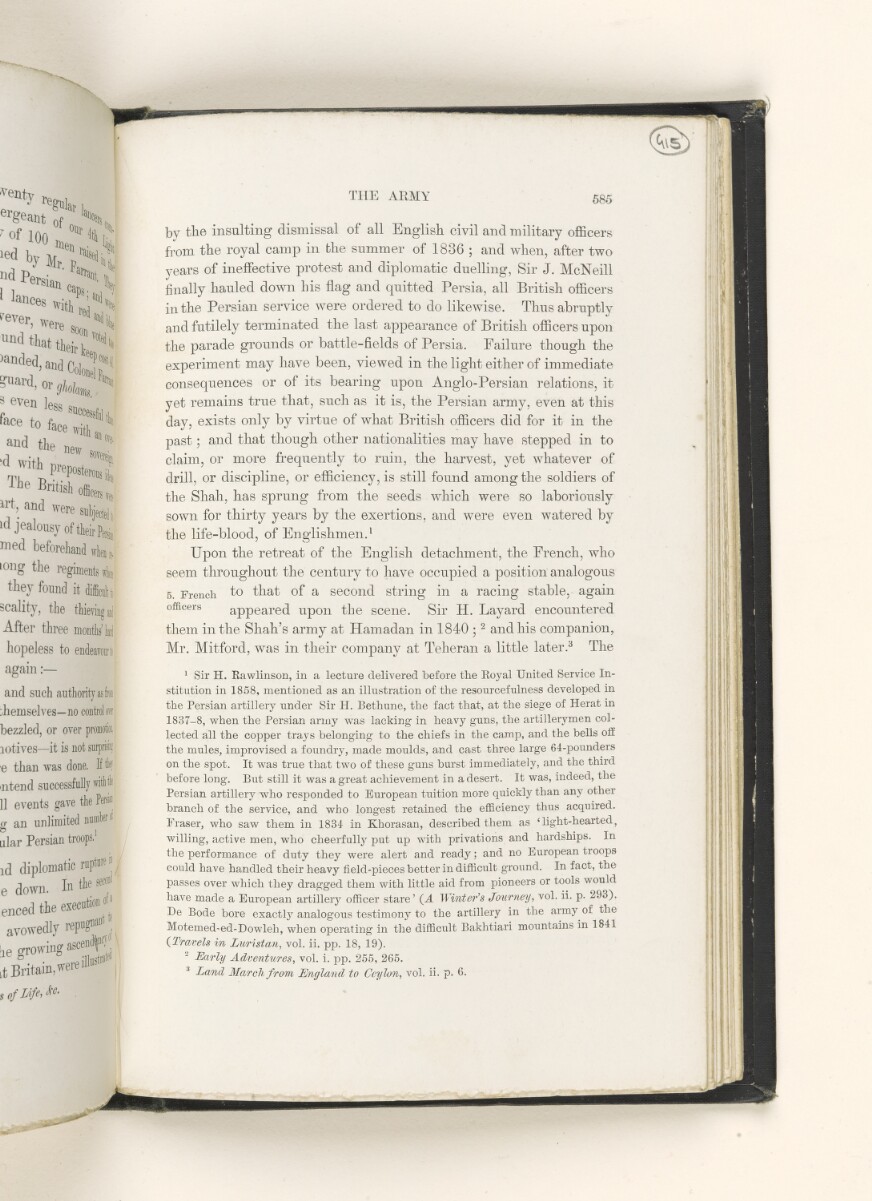
THE ARMY
by the insulting dismissal of all English civil and military officers
from the royal camp in the summer of 1836 ; and when, after two
years of ineffective protest and diplomatic duelling, Sir J. McNeill
finally hauled down his flag and quitted Persia, all British officers
in the Persian service were ordered to do likewise. Thus abruptly
and futilely terminated the last appearance of British officers upon
the parade grounds or battle-fields of Persia. Failure though the
experiment may have been, viewed in the light either of immediate
consequences or of its bearing upon Anglo-Persian relations, it
yet remains true that, such as it is, the Persian army, even at this
day, exists only by virtue of what British officers did for it in the
past; and that though other nationalities may have stepped in to
claim, or more frequently to ruin, the harvest, yet whatever of
drill, or discipline, or efficiency, is still found among the soldiers of
the Shah, has sprung from the seeds which were so laboriously
sown for thirty years by the exertions, and were even watered by
the life-blood, of Englishmen. 1
Upon the retreat of the English detachment, the French, who
seem throughout the century to have occupied a position analogous
5 French f° fbnf °f a second string in a racing stable, again
officers appeared upon the scene. Sir H. Layard encountered
them in the Shah’s army at Hamadan in 1840 ; 2 and his companion,
Mr. Mitford, was in their company at Teheran a little later. 3 The
1 Sir H. Rawlinson, in a lecture delivered before the Royal United Service In
stitution in 1858, mentioned as an illustration of the resourcefulness developed in
the Persian artillery under Sir H. Bethune, the fact that, at the siege of Herat in
1837-8, when the Persian army was lacking in heavy guns, the artillerymen col
lected all the copper trays belonging to the chiefs in the camp, and the bells off
the mules, improvised a foundry, made moulds, and cast three large 64-pounders
on the spot. It was true that two of these guns burst immediately, and the third
before long. But still it was a great achievement in a desert. It was, indeed, the
Persian artillery who responded to European tuition more quickly than any other
branch of the service, and who longest retained the efficiency thus acquired.
Eraser, who saw them in 1834 in Khorasan, described them as ‘light-hearted,
willing, active men, who cheerfully put up with privations and hardships. In
the performance of duty they were alert and ready; and no European troops
could have handled their heavy field-pieces better in difficult ground. In fact, the
passes over which they dragged them with little aid from pioneers or tools would
have made a European artillery officer stare’ (A Winter’s Journey, vol. ii. p. 293).
He Bode bore exactly analogous testimony to the artillery in the army of the
Motemed-ed-Dowleh, when operating in the difficult Bakhtiari mountains in 1841
{Travels in Luristan, vol. ii. pp. 18, 19).
2 Early Adventures, vol. i. pp. 255, 265.
3 Land March from England to Ceylon, vol. ii. p. 6.
About this item
- Content
These two volumes are George Curzon's own personal annotated copies of both volumes of his book Persia and the Persian Question , which was published in 1892. Alongside the volumes are various loose papers relating to Persia [Iran], consisting of the following: received correspondence; newspaper cuttings; publishers' press releases; cuttings from various booksellers' catalogues; various journal and magazine articles; two items of printed official British correspondence; several prints of photographs and sketches; and a few handwritten notes by Curzon.
In most cases these papers, which range in date from 1892 to 1924, relate to the chapters in the book where they were originally inserted, suggesting that they were kept by Curzon with the intention of using them to inform a revised edition of the book.
Of particular note among the small amount of correspondence are two letters received by Curzon in 1914 and 1915 from retired schoolmaster and Islamic scholar Sayyid Mazhar Hasan Musawi of Saharanpur, Uttar Pradesh, India (ff 5-9 and ff 44-53). These letters, which are written in Urdu and are accompanied by English translations, discuss in detail several inaccuracies found in the Urdu version of Persia and the Persian Question .
The various prints of photographs and sketches, which were originally inserted into volume two, are of different locations in the Gulf region. Several of these appear to have been produced in preparation for the publication of the second volume of John Gordon Lorimer's Gazetteer of the Persian Gulf The historical term used to describe the body of water between the Arabian Peninsula and Iran. , Oman and Central Arabia (i.e. the 'Geographical and Statistical' section) in 1908, as they are identical to the versions found in that volume.
Also of note among the loose papers are an illustrated article from Country Life dated 5 June 1920, entitled 'The People of Persia' (ff 36-37), and a printed family tree of the Shah of Persia [Aḥmad Shah Qājār], produced in preparation of his visit to Britain in 1919 (f 233).
Volume one of Persia and the Persian Question contains a map of Persia, Afghanistan and Beluchistan [Balochistan], which is folded inside the front cover (f 1).
The German language material consists of a publisher's press release for two books authored by German archaeologist Ernst Emil Herzfeld (ff 29-30).
- Extent and format
- 2 volumes with inserts (898 folios)
- Physical characteristics
Foliation: this shelfmark consists of two physical volumes. The foliation sequence commences at the first folio of volume one (1-463), and terminates at the last folio of volume two (ff 464-898); these numbers are written in pencil, are circled, and are located in the top right corner of the recto The front of a sheet of paper or leaf, often abbreviated to 'r'. side of each folio. Each volume contains a large number of loose leaves, which have been foliated in the order that they were inserted into the volume; for conservation reasons, these loose folios have been removed from the volume and stored separately. The foliation sequence does not include the front and back covers of the two volumes.
Pagination: the file also contains an original printed pagination sequence.
- Written in
- English, Urdu and German in Latin and Arabic script View the complete information for this record
Use and share this item
- Share this item
Annotated Copy of Persia and the Persian Question by George Curzon, with Inserted Papers [415r] (832/1814), British Library: India Office Records and Private Papers, Mss Eur F111/33, in Qatar Digital Library <https://www.qdl.qa/archive/81055/vdc_100157213846.0x000027> [accessed 4 August 2026]
https://www.qdl.qa/en/archive/81055/vdc_100157213846.0x000027
Copy and paste the code below into your web page where you would like to embed the image.
<meta charset="utf-8"><a href="https://www.qdl.qa/en/archive/81055/vdc_100157213846.0x000027">Annotated Copy of <em>Persia and the Persian Question</em> by George Curzon, with Inserted Papers [‎415r] (832/1814)</a> <a href="https://www.qdl.qa/en/archive/81055/vdc_100157213846.0x000027"> <img src="https://iiif.qdl.qa/iiif/images/81055/vdc_100000001491.0x00033b/Mss Eur F111_33_0844.jp2/full/!280,240/0/default.jpg" alt="" /> </a>
This record has a IIIF manifest available as follows. If you have a compatible viewer you can drag the icon to load it.https://www.qdl.qa/en/iiif/81055/vdc_100000001491.0x00033b/manifestOpen in Universal viewerOpen in Mirador viewerMore options for embedding images
Copyright: How to use this content
- Reference
- Mss Eur F111/33
- Title
- Annotated Copy of Persia and the Persian Questionby George Curzon, with Inserted Papers
- Pages
- 54r:135v, 147r:149v, 158r:180v, 183r:221v, 224r:224v, 227r:246v, 248r:257v, 259r:260v, 268r:362v, 364r:364v, 367r:388v, 390r:400v, 402r:416v, 419r:432v, 434r:444v, 448r:462v, 464r:471v, 475r:481v, 483r:513v, 516r:525v, 527r:544v, 546r:563v, 566r:598v, 600r:622v, 624r:656v, 658r:665v, 667r:675v, 678r:684v, 687r:688v, 691r:691v, 693r:693v, 695r:708v, 711r:721v, 724r:726v, 728r:729v, 731r:736v, 742r:742v, 746r:757v, 759r:761v, 763r:763v, 765r:765v, 772r:777v, 780r:789v, 793r:794v, 797r:809v, 811r:821v, 825r:840v, 843r:898v
- Author
- Curzon, George Nathaniel, 1st Marquess Curzon of Kedleston
- Usage terms
- Public Domain