
![Annotated Copy of <em>Persia and the Persian Question</em> by George Curzon, with Inserted Papers [‎387r] (776/1814)](https://iiif.qdl.qa/iiif/images/81055/vdc_100000001491.0x00033b/Mss Eur F111_33_0787.jp2/full/!1200,1200/0/default.jpg "Annotated Copy of <em>Persia and the Persian Question</em> by George Curzon, with Inserted Papers [‎387r] (776/1814)")
Annotated Copy of Persia and the Persian Question by George Curzon, with Inserted Papers [387r] (776/1814)
The record is made up of 2 volumes with inserts (898 folios). It was created in 1892-1924. It was written in English, Urdu and German. The original is part of the British Library: India Office The department of the British Government to which the Government of India reported between 1858 and 1947. The successor to the Court of Directors. Records and Private Papers Documents collected in a private capacity. .
Transcription
This transcription is created automatically. It may contain errors.
537
Nt,
> c Ottpa r e d
Lal t0 : tel 4
j , ke of Zurici
) wl ncli i s Sl v 41
> n tai ns ; >
hom ' )0 ^ at ‘
01B are AfeV ,
- 1 ? °f Nestori ai] r ^
scarcel y less W?
r oftke <4
en gates, and an 01 [ e
‘PQrtaneeistliejfj^
Wn ’ tte C0Ur t of wliid
■Pounders and a s i n ,] e
le tlie Kurdish terror
^eidullah in 1880 p re .
regulars, armed wi|
istian visitors the cbf
2 t that it is the had-
nglish Missions to |
d, to which interest^
rrect cal-
eTurkisl
an beinff,
previofls
the follow
ivols.
THE NORTH-WEST AND WESTERN PROVINCES
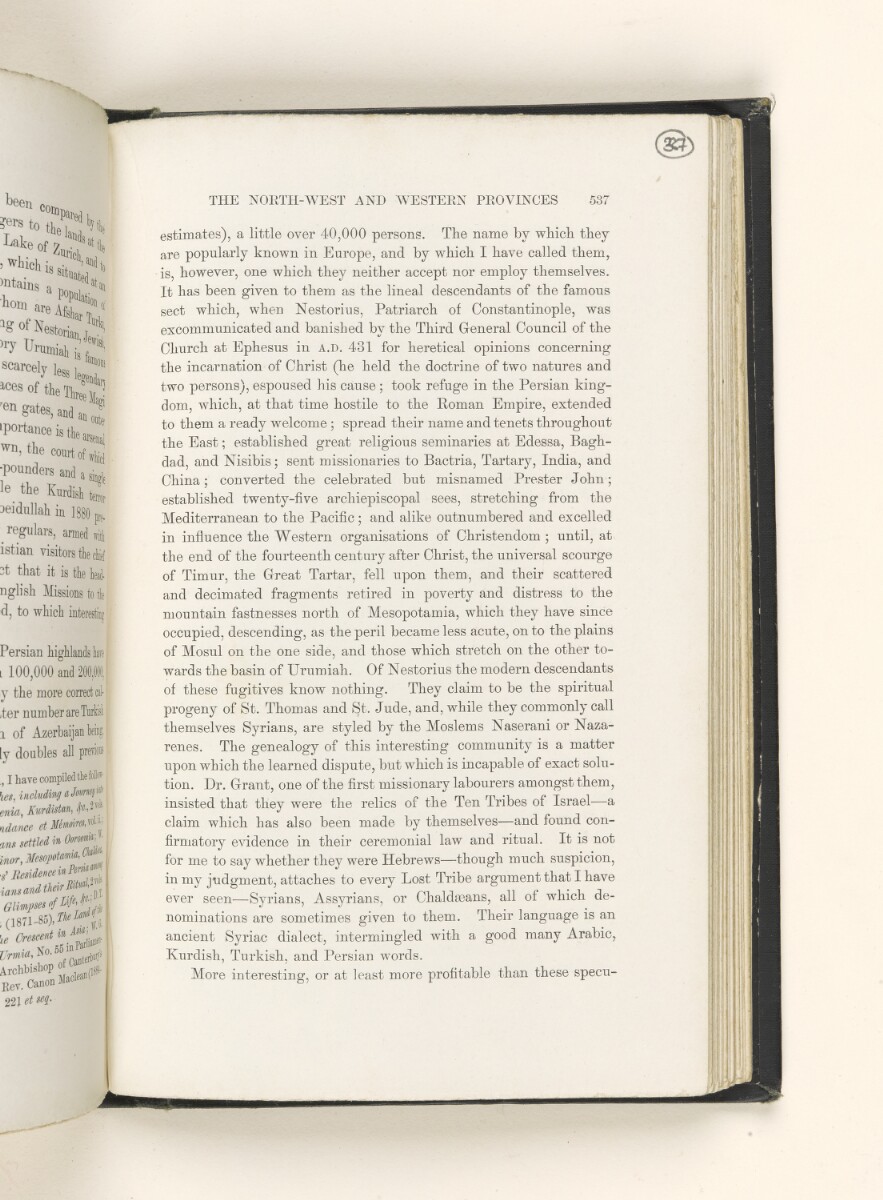
estimates), a little over 40,000 persons. The name by which they
are popularly known in Europe, and by which I have called them,
is, however, one which they neither accept nor employ themselves.
It has been given to them as the lineal descendants of the famous
sect which, when Nestorius, Patriarch of Constantinople, was
excommunicated and banished by the Third General Council of the
Church at Ephesus in a.d. 431 for heretical opinions concerning
the incarnation of Christ (he held the doctrine of two natures and
two persons), espoused his cause ; took refuge in the Persian king
dom, which, at that time hostile to the Roman Empire, extended
to them a ready welcome ; spread their name and tenets throughout
the East; established great religious seminaries at Edessa, Bagh
dad, and Nisibis; sent missionaries to Bactria, Tartary, India, and
China ; converted the celebrated but misnamed Prester John;
established twenty-five archiepiscopal sees, stretching from the
Mediterranean to the Pacific; and alike outnumbered and excelled
in influence the Western organisations of Christendom ; until, at
the end of the fourteenth century after Christ, the universal scourge
of Timur, the Great Tartar, fell upon them, and their scattered
and decimated fragments retired in poverty and distress to the
mountain fastnesses north of Mesopotamia, which they have since
occupied, descending, as the peril became less acute, on to the plains
of Mosul on the one side, and those which stretch on the other to
wards the basin of Urumiah. Of Nestorius the modern descendants
of these fugitives know nothing. They claim to be the spiritual
progeny of St. Thomas and St. Jude, and, while they commonly call
themselves Syrians, are styled by the Moslems Naserani or Naza-
renes. The genealogy of this interesting community is a matter
upon which the learned dispute, but which is incapable of exact solu
tion. Dr. Grant, one of the first missionary labourers amongst them,
insisted that they were the relics of the Ten Tribes of Israel—a
claim which has also been made by themselves—and found con
firmatory evidence in their ceremonial law and ritual. It is not
for me to say whether they were Hebrews—though much suspicion,
in my judgment, attaches to every Lost Tribe argument that I have
ever seen—Syrians, Assyrians, or Chaldseans, all of which de
nominations are sometimes given to them. Their language is an
ancient Syriac dialect, intermingled with a good many Arabic,
Kurdish, Turkish, and Persian words.
More interesting, or at least more profitable than these specu-
About this item
- Content
These two volumes are George Curzon's own personal annotated copies of both volumes of his book Persia and the Persian Question , which was published in 1892. Alongside the volumes are various loose papers relating to Persia [Iran], consisting of the following: received correspondence; newspaper cuttings; publishers' press releases; cuttings from various booksellers' catalogues; various journal and magazine articles; two items of printed official British correspondence; several prints of photographs and sketches; and a few handwritten notes by Curzon.
In most cases these papers, which range in date from 1892 to 1924, relate to the chapters in the book where they were originally inserted, suggesting that they were kept by Curzon with the intention of using them to inform a revised edition of the book.
Of particular note among the small amount of correspondence are two letters received by Curzon in 1914 and 1915 from retired schoolmaster and Islamic scholar Sayyid Mazhar Hasan Musawi of Saharanpur, Uttar Pradesh, India (ff 5-9 and ff 44-53). These letters, which are written in Urdu and are accompanied by English translations, discuss in detail several inaccuracies found in the Urdu version of Persia and the Persian Question .
The various prints of photographs and sketches, which were originally inserted into volume two, are of different locations in the Gulf region. Several of these appear to have been produced in preparation for the publication of the second volume of John Gordon Lorimer's Gazetteer of the Persian Gulf The historical term used to describe the body of water between the Arabian Peninsula and Iran. , Oman and Central Arabia (i.e. the 'Geographical and Statistical' section) in 1908, as they are identical to the versions found in that volume.
Also of note among the loose papers are an illustrated article from Country Life dated 5 June 1920, entitled 'The People of Persia' (ff 36-37), and a printed family tree of the Shah of Persia [Aḥmad Shah Qājār], produced in preparation of his visit to Britain in 1919 (f 233).
Volume one of Persia and the Persian Question contains a map of Persia, Afghanistan and Beluchistan [Balochistan], which is folded inside the front cover (f 1).
The German language material consists of a publisher's press release for two books authored by German archaeologist Ernst Emil Herzfeld (ff 29-30).
- Extent and format
- 2 volumes with inserts (898 folios)
- Physical characteristics
Foliation: this shelfmark consists of two physical volumes. The foliation sequence commences at the first folio of volume one (1-463), and terminates at the last folio of volume two (ff 464-898); these numbers are written in pencil, are circled, and are located in the top right corner of the recto The front of a sheet of paper or leaf, often abbreviated to 'r'. side of each folio. Each volume contains a large number of loose leaves, which have been foliated in the order that they were inserted into the volume; for conservation reasons, these loose folios have been removed from the volume and stored separately. The foliation sequence does not include the front and back covers of the two volumes.
Pagination: the file also contains an original printed pagination sequence.
- Written in
- English, Urdu and German in Latin and Arabic script View the complete information for this record
Use and share this item
- Share this item
Annotated Copy of Persia and the Persian Question by George Curzon, with Inserted Papers [387r] (776/1814), British Library: India Office Records and Private Papers, Mss Eur F111/33, in Qatar Digital Library <https://www.qdl.qa/archive/81055/vdc_100157213845.0x0000b7> [accessed 26 July 2026]
https://www.qdl.qa/en/archive/81055/vdc_100157213845.0x0000b7
Copy and paste the code below into your web page where you would like to embed the image.
<meta charset="utf-8"><a href="https://www.qdl.qa/en/archive/81055/vdc_100157213845.0x0000b7">Annotated Copy of <em>Persia and the Persian Question</em> by George Curzon, with Inserted Papers [‎387r] (776/1814)</a> <a href="https://www.qdl.qa/en/archive/81055/vdc_100157213845.0x0000b7"> <img src="https://iiif.qdl.qa/iiif/images/81055/vdc_100000001491.0x00033b/Mss Eur F111_33_0787.jp2/full/!280,240/0/default.jpg" alt="" /> </a>
This record has a IIIF manifest available as follows. If you have a compatible viewer you can drag the icon to load it.https://www.qdl.qa/en/iiif/81055/vdc_100000001491.0x00033b/manifestOpen in Universal viewerOpen in Mirador viewerMore options for embedding images
Copyright: How to use this content
- Reference
- Mss Eur F111/33
- Title
- Annotated Copy of Persia and the Persian Questionby George Curzon, with Inserted Papers
- Pages
- 54r:135v, 147r:149v, 158r:180v, 183r:221v, 224r:224v, 227r:246v, 248r:257v, 259r:260v, 268r:362v, 364r:364v, 367r:388v, 390r:400v, 402r:416v, 419r:432v, 434r:444v, 448r:462v, 464r:471v, 475r:481v, 483r:513v, 516r:525v, 527r:544v, 546r:563v, 566r:598v, 600r:622v, 624r:656v, 658r:665v, 667r:675v, 678r:684v, 687r:688v, 691r:691v, 693r:693v, 695r:708v, 711r:721v, 724r:726v, 728r:729v, 731r:736v, 742r:742v, 746r:757v, 759r:761v, 763r:763v, 765r:765v, 772r:777v, 780r:789v, 793r:794v, 797r:809v, 811r:821v, 825r:840v, 843r:898v
- Author
- Curzon, George Nathaniel, 1st Marquess Curzon of Kedleston
- Usage terms
- Public Domain