
![Annotated Copy of <em>Persia and the Persian Question</em> by George Curzon, with Inserted Papers [‎349v] (701/1814)](https://iiif.qdl.qa/iiif/images/81055/vdc_100000001491.0x00033b/Mss Eur F111_33_0712.jp2/full/!1200,1200/0/default.jpg "Annotated Copy of <em>Persia and the Persian Question</em> by George Curzon, with Inserted Papers [‎349v] (701/1814)")
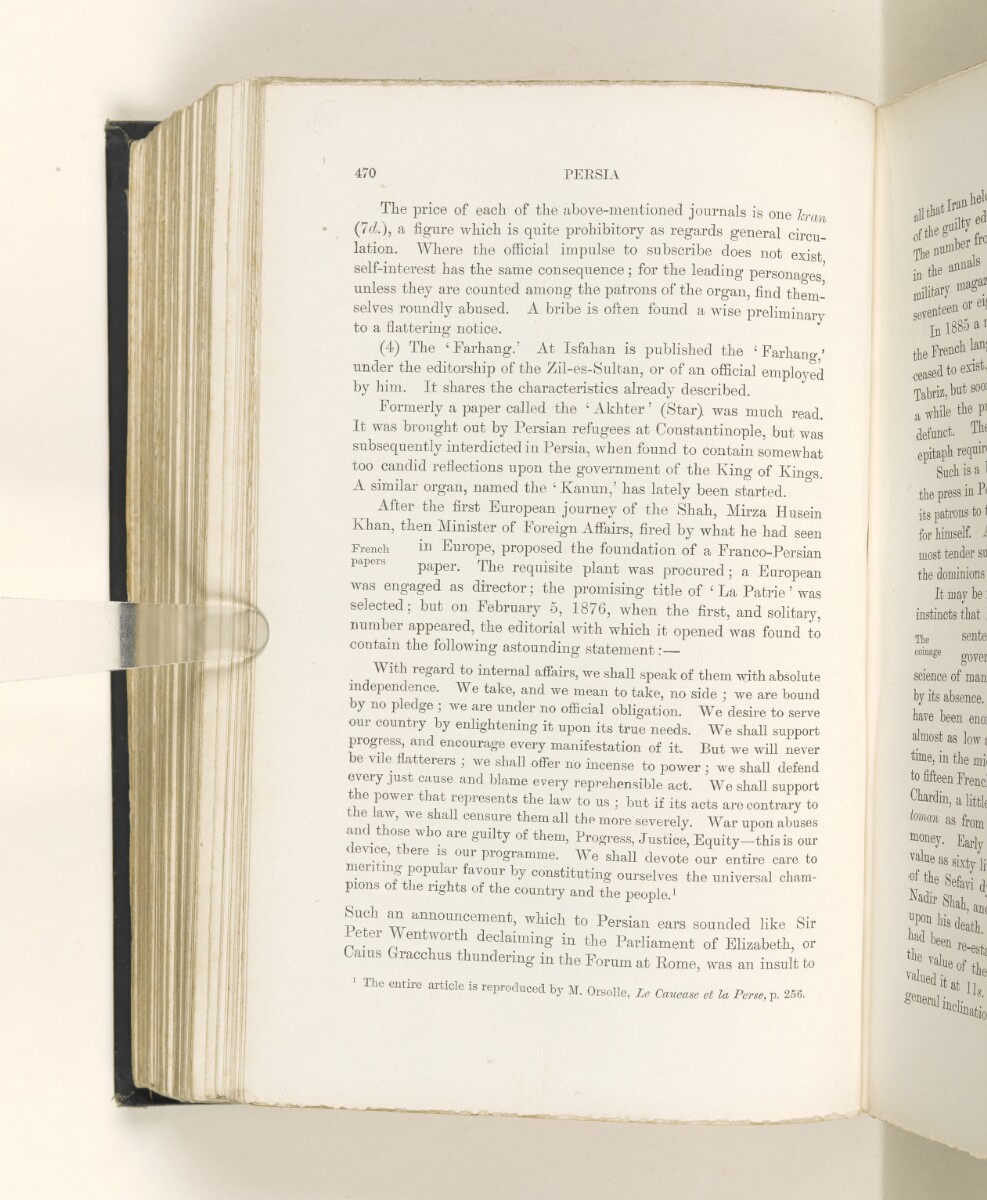
Annotated Copy of Persia and the Persian Question by George Curzon, with Inserted Papers [349v] (701/1814)
The record is made up of 2 volumes with inserts (898 folios). It was created in 1892-1924. It was written in English, Urdu and German. The original is part of the British Library: India Office The department of the British Government to which the Government of India reported between 1858 and 1947. The successor to the Court of Directors. Records and Private Papers Documents collected in a private capacity. .
Transcription
This transcription is created automatically. It may contain errors.
470
PERSIA
The price of each of the above-mentioned journals is one Iran
(7d)j a figure which is quite prohibitory as regards general circu
lation. Where the official impulse to subscribe does not exist
self-interest has the same consequence; for the leading personages 1
unless they are counted among the patrons of the organ, find them
selves roundly abused. A bribe is often found a wise preliminary
to a flattering notice.
(4) The ‘Farhang/ At Isfahan is published the ‘ Farhang ’
under the editorship of the Zil-es-Sultan, or of an official employed
by him. It shares the characteristics already described.
Formerly a paper called the ‘ Akhter ’ (Star) was much read.
It was brought out by Persian refugees at Constantinople, but was
subsequently interdicted in Persia, when found to contain somewhat
too candid reflections upon the government of the King of Kino's.
A similar organ, named the c Kanun/ has lately been started.
After the first European journey of the Shah, Mirza Husein
Khan, then Minister of Foreign Affairs, fired by what he had seen
Prench in Europe, proposed the foundation of a Franco-Persian
paper. The requisite plant was procured; a European
was engaged as director; the promising title of ‘ La Patrie 5 was
selected; but on February 5, 1876, when the first, and solitary,
number appeared, the editorial with which it opened was found to
contain the following astounding statement:
. ° c^j.j.aaj. 0 , we oiictii speaK or tiiem wim absolute
independence. We take, and we mean to take, no side ; we are bound
y no p e ge ; we are under no official obligation. We desire to serve
r countiy by enlightening it ujDon its true needs. We shall support
progress, and encourage every manifestation of it. But we will never
e vi e atterers , we shall offer no incense to power ; we shall defend
every just cause and blame every reprehensible act. We shall support
the power that represents the law to us ; but if its acts are contrary to
the law, we shall censure them all the more severely. War upon abuses
am . lose w 10 are guilty of them, Progress, Justice, Equity—this is our
device, there is our programme. We shall devote our entire care to
. ^ popu ar avour by constituting ourselves the universal cham
pions of the rights of the country and the people.*
p ° \ A announcement, which to Persian ears sounded like Sir
e. 61 ’ entworth declaiming in the Parliament of Elizabeth, or
aiUS Gracchus thundering in the Forum at Rome, was an insult to
The enme aiticle is reproduced by M. Orsolle, Ze Caucase et la Perse, p. 256.
About this item
- Content
These two volumes are George Curzon's own personal annotated copies of both volumes of his book Persia and the Persian Question , which was published in 1892. Alongside the volumes are various loose papers relating to Persia [Iran], consisting of the following: received correspondence; newspaper cuttings; publishers' press releases; cuttings from various booksellers' catalogues; various journal and magazine articles; two items of printed official British correspondence; several prints of photographs and sketches; and a few handwritten notes by Curzon.
In most cases these papers, which range in date from 1892 to 1924, relate to the chapters in the book where they were originally inserted, suggesting that they were kept by Curzon with the intention of using them to inform a revised edition of the book.
Of particular note among the small amount of correspondence are two letters received by Curzon in 1914 and 1915 from retired schoolmaster and Islamic scholar Sayyid Mazhar Hasan Musawi of Saharanpur, Uttar Pradesh, India (ff 5-9 and ff 44-53). These letters, which are written in Urdu and are accompanied by English translations, discuss in detail several inaccuracies found in the Urdu version of Persia and the Persian Question .
The various prints of photographs and sketches, which were originally inserted into volume two, are of different locations in the Gulf region. Several of these appear to have been produced in preparation for the publication of the second volume of John Gordon Lorimer's Gazetteer of the Persian Gulf The historical term used to describe the body of water between the Arabian Peninsula and Iran. , Oman and Central Arabia (i.e. the 'Geographical and Statistical' section) in 1908, as they are identical to the versions found in that volume.
Also of note among the loose papers are an illustrated article from Country Life dated 5 June 1920, entitled 'The People of Persia' (ff 36-37), and a printed family tree of the Shah of Persia [Aḥmad Shah Qājār], produced in preparation of his visit to Britain in 1919 (f 233).
Volume one of Persia and the Persian Question contains a map of Persia, Afghanistan and Beluchistan [Balochistan], which is folded inside the front cover (f 1).
The German language material consists of a publisher's press release for two books authored by German archaeologist Ernst Emil Herzfeld (ff 29-30).
- Extent and format
- 2 volumes with inserts (898 folios)
- Physical characteristics
Foliation: this shelfmark consists of two physical volumes. The foliation sequence commences at the first folio of volume one (1-463), and terminates at the last folio of volume two (ff 464-898); these numbers are written in pencil, are circled, and are located in the top right corner of the recto The front of a sheet of paper or leaf, often abbreviated to 'r'. side of each folio. Each volume contains a large number of loose leaves, which have been foliated in the order that they were inserted into the volume; for conservation reasons, these loose folios have been removed from the volume and stored separately. The foliation sequence does not include the front and back covers of the two volumes.
Pagination: the file also contains an original printed pagination sequence.
- Written in
- English, Urdu and German in Latin and Arabic script View the complete information for this record
Use and share this item
- Share this item
Annotated Copy of Persia and the Persian Question by George Curzon, with Inserted Papers [349v] (701/1814), British Library: India Office Records and Private Papers, Mss Eur F111/33, in Qatar Digital Library <https://www.qdl.qa/archive/81055/vdc_100157213845.0x00006c> [accessed 14 July 2026]
https://www.qdl.qa/en/archive/81055/vdc_100157213845.0x00006c
Copy and paste the code below into your web page where you would like to embed the image.
<meta charset="utf-8"><a href="https://www.qdl.qa/en/archive/81055/vdc_100157213845.0x00006c">Annotated Copy of <em>Persia and the Persian Question</em> by George Curzon, with Inserted Papers [‎349v] (701/1814)</a> <a href="https://www.qdl.qa/en/archive/81055/vdc_100157213845.0x00006c"> <img src="https://iiif.qdl.qa/iiif/images/81055/vdc_100000001491.0x00033b/Mss Eur F111_33_0712.jp2/full/!280,240/0/default.jpg" alt="" /> </a>
This record has a IIIF manifest available as follows. If you have a compatible viewer you can drag the icon to load it.https://www.qdl.qa/en/iiif/81055/vdc_100000001491.0x00033b/manifestOpen in Universal viewerOpen in Mirador viewerMore options for embedding images
Copyright: How to use this content
- Reference
- Mss Eur F111/33
- Title
- Annotated Copy of Persia and the Persian Questionby George Curzon, with Inserted Papers
- Pages
- 54r:135v, 147r:149v, 158r:180v, 183r:221v, 224r:224v, 227r:246v, 248r:257v, 259r:260v, 268r:362v, 364r:364v, 367r:388v, 390r:400v, 402r:416v, 419r:432v, 434r:444v, 448r:462v, 464r:471v, 475r:481v, 483r:513v, 516r:525v, 527r:544v, 546r:563v, 566r:598v, 600r:622v, 624r:656v, 658r:665v, 667r:675v, 678r:684v, 687r:688v, 691r:691v, 693r:693v, 695r:708v, 711r:721v, 724r:726v, 728r:729v, 731r:736v, 742r:742v, 746r:757v, 759r:761v, 763r:763v, 765r:765v, 772r:777v, 780r:789v, 793r:794v, 797r:809v, 811r:821v, 825r:840v, 843r:898v
- Author
- Curzon, George Nathaniel, 1st Marquess Curzon of Kedleston
- Usage terms
- Public Domain