
![Annotated Copy of <em>Persia and the Persian Question</em> by George Curzon, with Inserted Papers [‎343r] (688/1814)](https://iiif.qdl.qa/iiif/images/81055/vdc_100000001491.0x00033b/Mss Eur F111_33_0699.jp2/full/!1200,1200/0/default.jpg "Annotated Copy of <em>Persia and the Persian Question</em> by George Curzon, with Inserted Papers [‎343r] (688/1814)")
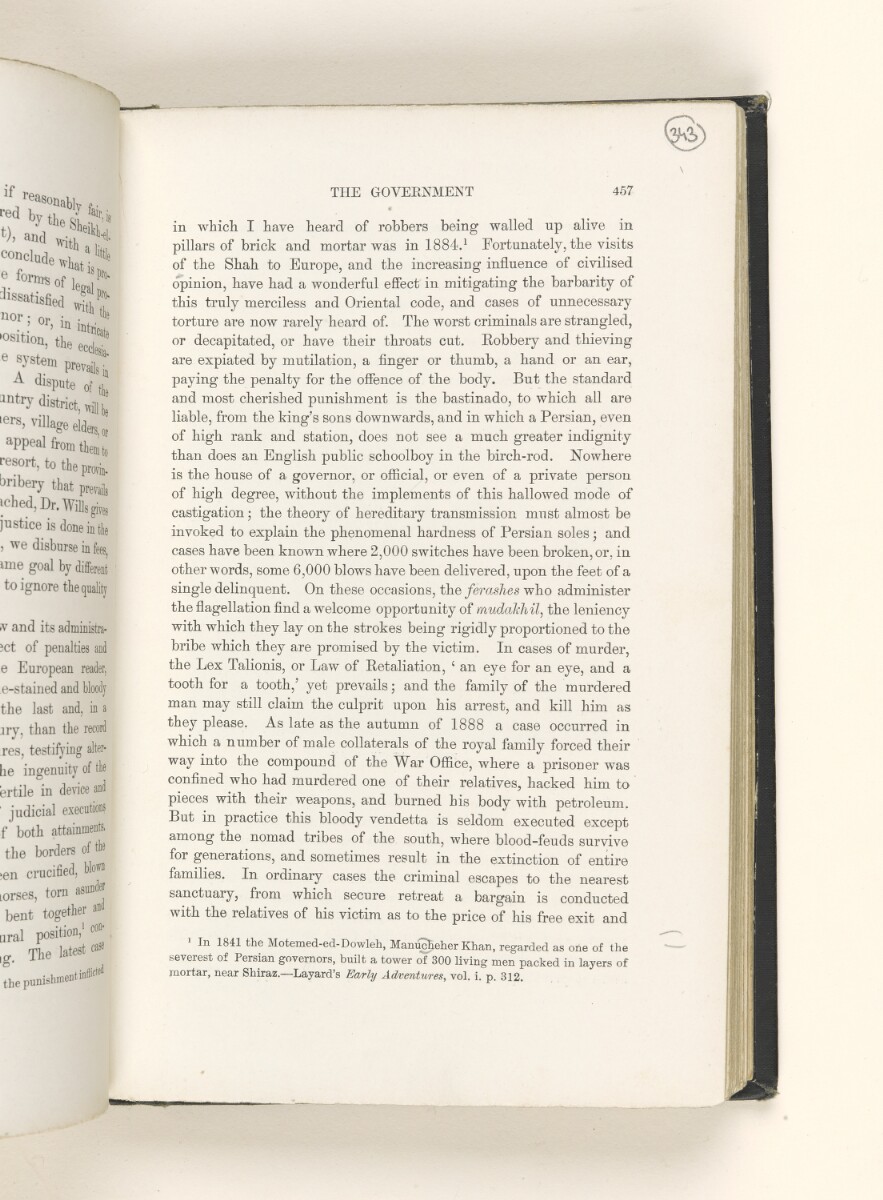
Annotated Copy of Persia and the Persian Question by George Curzon, with Inserted Papers [343r] (688/1814)
The record is made up of 2 volumes with inserts (898 folios). It was created in 1892-1924. It was written in English, Urdu and German. The original is part of the British Library: India Office The department of the British Government to which the Government of India reported between 1858 and 1947. The successor to the Court of Directors. Records and Private Papers Documents collected in a private capacity. .
Transcription
This transcription is created automatically. It may contain errors.
lf rea sonabi v p ■
le( l by th e J f ait >i!
‘). a„ J a »>*
“Mluie .u," H
^MisSei i>
nor ; or ; n tle
'osit on ’the >
’ 11116 ecckj,
e l yst ; a p-vaii s ?'
A dls P u te 0 f c
“Strict, *,,1
,ers > ^lage eld* 0f
a PPeal from them to
resort . to the provij.
bri bery that p ref4
icbed, Dr. Wills give s
justice is done in the
> w e disburse in fees,
uue goal by different
to ignore the quality
>v and its administra-
?ct of penalties and
e European reader,
e-stained and bloody
the last and, in a
ury, than the record
res, testifying alter*
lie ingenuity of the
ertile in device and
judicial executions
f both attainments,
the borders of *
■en crucified, blow
icrses, torn asur*
bent together and
oral position, r
lg . The latest cs s!
the punishment m 111 ' 1 ' 1
THE GOVERNMENT 457
in which I have heard of robbers being walled up alive in
pillars of brick and mortar was in 1884. 1 Fortunately, the visits
of the Sbab to Europe, and the increasing influence of civilised
opinion, have bad a wonderful effect in mitigating the barbarity of
this truly merciless and Oriental code, and cases of unnecessary
torture are now rarely heard of. The worst criminals are strangled,
or decapitated, or have their throats cut. Robbery and thieving
are expiated by mutilation, a finger or thumb, a band or an ear,
paying the penalty for the offence of the body. But the standard
and most cherished punishment is the bastinado, to which all are
liable, from the king’s sons downwards, and in which a Persian, even
of high rank and station, does not see a much greater indignity
than does an English public schoolboy in the birch-rod. Nowhere
is the house of a governor, or official, or even of a private person
of high degree, without the implements of this hallowed mode of
castigation; the theory of hereditary transmission must almost be
invoked to explain the phenomenal hardness of Persian soles; and
cases have been known where 2,000 switches have been broken, or, in
other words, some 6,000 blows have been delivered, upon the feet of a
single delinquent. On these occasions, the ferashes who administer
the flagellation find a welcome opportunity of mudakhil, the leniency
with which they lay on the strokes being rigidly proportioned to the
bribe which they are promised by the victim. In cases of murder,
the Lex Talionis, or Law of Retaliation, ‘ an eye for an eye, and a
tooth for a tooth, 5 yet prevails; and the family of the murdered
man may still claim the culprit upon his arrest, and kill him as
they please. As late as the autumn of 1888 a case occurred in
which a number of male collaterals of the royal family forced their
way into the compound of the War Office, where a prisoner was
confined who had murdered one of their relatives, hacked him to
pieces with their weapons, and burned his body with petroleum.
But in practice this bloody vendetta is seldom executed except
among the nomad tribes of the south, where blood-feuds survive
for generations, and sometimes result in the extinction of entire
families. In ordinary cases the criminal escapes to the nearest
sanctuary, from which secure retreat a bargain is conducted
with the relatives of his victim as to the price of his free exit and
1 In 1841 the Motemed-ed-Dowleh, Mann^heher Khan, regarded as one of the
severest of Persian governors, built a tower of 300 living men packed in layers of
mortar, near Shiraz.—Layard’s Early Adventures, vol. i. p. 312.
About this item
- Content
These two volumes are George Curzon's own personal annotated copies of both volumes of his book Persia and the Persian Question , which was published in 1892. Alongside the volumes are various loose papers relating to Persia [Iran], consisting of the following: received correspondence; newspaper cuttings; publishers' press releases; cuttings from various booksellers' catalogues; various journal and magazine articles; two items of printed official British correspondence; several prints of photographs and sketches; and a few handwritten notes by Curzon.
In most cases these papers, which range in date from 1892 to 1924, relate to the chapters in the book where they were originally inserted, suggesting that they were kept by Curzon with the intention of using them to inform a revised edition of the book.
Of particular note among the small amount of correspondence are two letters received by Curzon in 1914 and 1915 from retired schoolmaster and Islamic scholar Sayyid Mazhar Hasan Musawi of Saharanpur, Uttar Pradesh, India (ff 5-9 and ff 44-53). These letters, which are written in Urdu and are accompanied by English translations, discuss in detail several inaccuracies found in the Urdu version of Persia and the Persian Question .
The various prints of photographs and sketches, which were originally inserted into volume two, are of different locations in the Gulf region. Several of these appear to have been produced in preparation for the publication of the second volume of John Gordon Lorimer's Gazetteer of the Persian Gulf The historical term used to describe the body of water between the Arabian Peninsula and Iran. , Oman and Central Arabia (i.e. the 'Geographical and Statistical' section) in 1908, as they are identical to the versions found in that volume.
Also of note among the loose papers are an illustrated article from Country Life dated 5 June 1920, entitled 'The People of Persia' (ff 36-37), and a printed family tree of the Shah of Persia [Aḥmad Shah Qājār], produced in preparation of his visit to Britain in 1919 (f 233).
Volume one of Persia and the Persian Question contains a map of Persia, Afghanistan and Beluchistan [Balochistan], which is folded inside the front cover (f 1).
The German language material consists of a publisher's press release for two books authored by German archaeologist Ernst Emil Herzfeld (ff 29-30).
- Extent and format
- 2 volumes with inserts (898 folios)
- Physical characteristics
Foliation: this shelfmark consists of two physical volumes. The foliation sequence commences at the first folio of volume one (1-463), and terminates at the last folio of volume two (ff 464-898); these numbers are written in pencil, are circled, and are located in the top right corner of the recto The front of a sheet of paper or leaf, often abbreviated to 'r'. side of each folio. Each volume contains a large number of loose leaves, which have been foliated in the order that they were inserted into the volume; for conservation reasons, these loose folios have been removed from the volume and stored separately. The foliation sequence does not include the front and back covers of the two volumes.
Pagination: the file also contains an original printed pagination sequence.
- Written in
- English, Urdu and German in Latin and Arabic script View the complete information for this record
Use and share this item
- Share this item
Annotated Copy of Persia and the Persian Question by George Curzon, with Inserted Papers [343r] (688/1814), British Library: India Office Records and Private Papers, Mss Eur F111/33, in Qatar Digital Library <https://www.qdl.qa/archive/81055/vdc_100157213845.0x00005f> [accessed 1 August 2026]
https://www.qdl.qa/en/archive/81055/vdc_100157213845.0x00005f
Copy and paste the code below into your web page where you would like to embed the image.
<meta charset="utf-8"><a href="https://www.qdl.qa/en/archive/81055/vdc_100157213845.0x00005f">Annotated Copy of <em>Persia and the Persian Question</em> by George Curzon, with Inserted Papers [‎343r] (688/1814)</a> <a href="https://www.qdl.qa/en/archive/81055/vdc_100157213845.0x00005f"> <img src="https://iiif.qdl.qa/iiif/images/81055/vdc_100000001491.0x00033b/Mss Eur F111_33_0699.jp2/full/!280,240/0/default.jpg" alt="" /> </a>
This record has a IIIF manifest available as follows. If you have a compatible viewer you can drag the icon to load it.https://www.qdl.qa/en/iiif/81055/vdc_100000001491.0x00033b/manifestOpen in Universal viewerOpen in Mirador viewerMore options for embedding images
Copyright: How to use this content
- Reference
- Mss Eur F111/33
- Title
- Annotated Copy of Persia and the Persian Questionby George Curzon, with Inserted Papers
- Pages
- 54r:135v, 147r:149v, 158r:180v, 183r:221v, 224r:224v, 227r:246v, 248r:257v, 259r:260v, 268r:362v, 364r:364v, 367r:388v, 390r:400v, 402r:416v, 419r:432v, 434r:444v, 448r:462v, 464r:471v, 475r:481v, 483r:513v, 516r:525v, 527r:544v, 546r:563v, 566r:598v, 600r:622v, 624r:656v, 658r:665v, 667r:675v, 678r:684v, 687r:688v, 691r:691v, 693r:693v, 695r:708v, 711r:721v, 724r:726v, 728r:729v, 731r:736v, 742r:742v, 746r:757v, 759r:761v, 763r:763v, 765r:765v, 772r:777v, 780r:789v, 793r:794v, 797r:809v, 811r:821v, 825r:840v, 843r:898v
- Author
- Curzon, George Nathaniel, 1st Marquess Curzon of Kedleston
- Usage terms
- Public Domain