
![Annotated Copy of <em>Persia and the Persian Question</em> by George Curzon, with Inserted Papers [‎342r] (686/1814)](https://iiif.qdl.qa/iiif/images/81055/vdc_100000001491.0x00033b/Mss Eur F111_33_0697.jp2/full/!1200,1200/0/default.jpg "Annotated Copy of <em>Persia and the Persian Question</em> by George Curzon, with Inserted Papers [‎342r] (686/1814)")
Annotated Copy of Persia and the Persian Question by George Curzon, with Inserted Papers [342r] (686/1814)
The record is made up of 2 volumes with inserts (898 folios). It was created in 1892-1924. It was written in English, Urdu and German. The original is part of the British Library: India Office The department of the British Government to which the Government of India reported between 1858 and 1947. The successor to the Court of Directors. Records and Private Papers Documents collected in a private capacity. .
Transcription
This transcription is created automatically. It may contain errors.
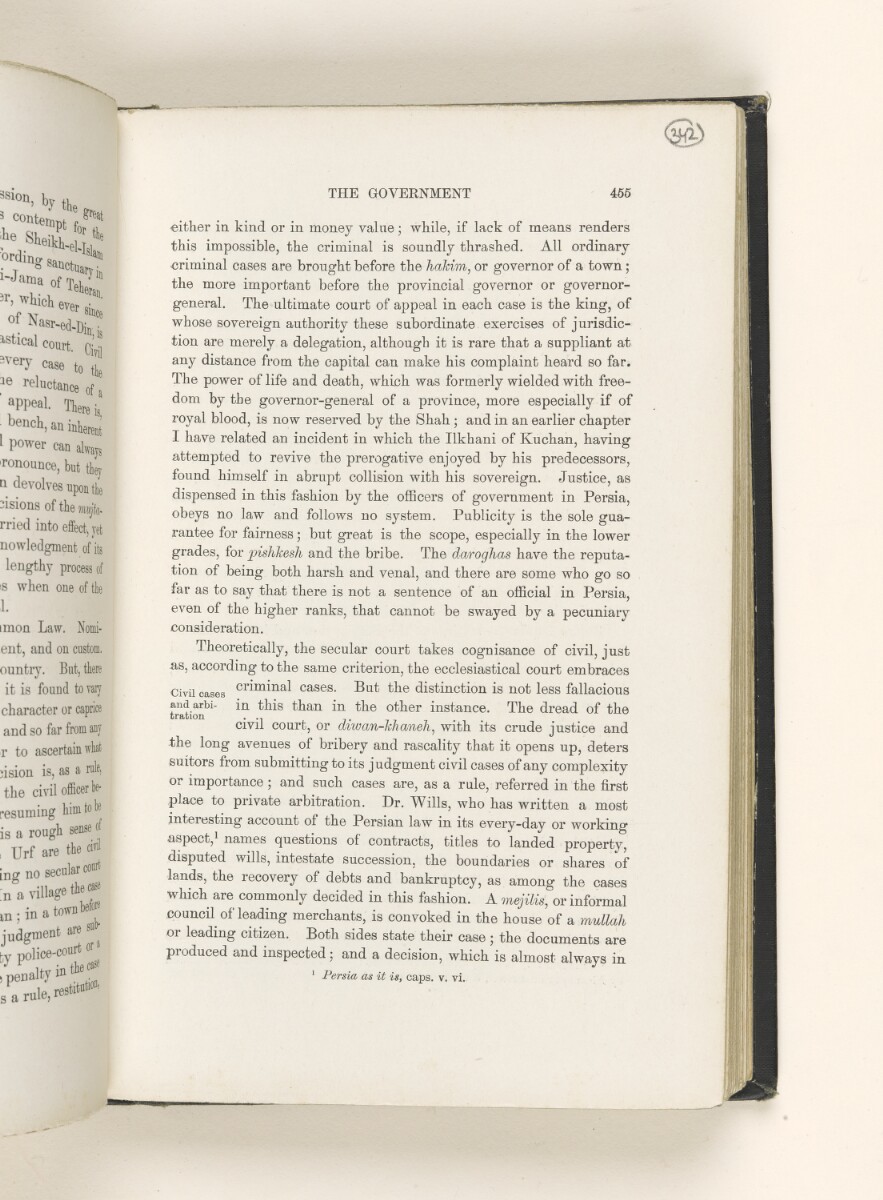
THE GOVERNMENT
455
•either in kind or in money value; while, if lack of means renders
this impossible, the criminal is soundly thrashed. All ordinary
criminal cases are brought before the hakim, or governor of a town;
the more important before the provincial governor or governor-
general. The ultimate court of appeal in each case is the king, of
whose sovereign authority these subordinate exercises of jurisdic
tion are merely a delegation, although it is rare that a suppliant at
any distance from the capital can make his complaint heard so far.
The power of life and death, which was formerly wielded with free
dom by the governor-general of a province, more especially if of
royal blood, is now reserved by the Shah ; and in an earlier chapter
I have related an incident in which the
Ilkhani
The paramount chief of certain tribes in south west Iran.
of Kuchan, having
attempted to revive the prerogative enjoyed by his predecessors,
found himself in abrupt collision with his sovereign. Justice, as
dispensed in this fashion by the officers of government in Persia,
obeys no law and follows no system. Publicity is the sole gua
rantee for fairness; but great is the scope, especially in the lower
grades, for pishkesh and the bribe. The daroghas have the reputa
tion of being both harsh and venal, and there are some who go so
far as to say that there is not a sentence of an official in Persia,
even of the higher ranks, that cannot be swayed by a pecuniary
consideration.
Theoretically, the secular court takes cognisance of civil, just
as, according to the same criterion, the ecclesiastical court embraces
Civil cases cr ™^ na l cases. But the distinction is not less fallacious
andarbi- in this than in the other instance. The dread of the
tration . .,
civil court, or diwan-khaneh, with its crude justice and
the long avenues of bribery and rascality that it opens up, deters
suitors from submitting to its judgment civil cases of any complexity
or importance ; and such cases are, as a rule, referred in the first
place to private arbitration. Dr. Wills, who has written a most
interesting account of the Persian law in its every-day or working
aspect, names questions of contracts, titles to landed property,
disputed wills, intestate succession, the boundaries or shares of
lands, the recovery of debts and bankruptcy, as among the cases
which are commonly decided in this fashion. A mejilis, or informal
council, of leading merchants, is convoked in the house of a mullah
or leading citizen. Both sides state their case; the documents are
produced and inspected; and a decision, which is almost always in
1 Persia as it is, caps. v. vi.
About this item
- Content
These two volumes are George Curzon's own personal annotated copies of both volumes of his book Persia and the Persian Question , which was published in 1892. Alongside the volumes are various loose papers relating to Persia [Iran], consisting of the following: received correspondence; newspaper cuttings; publishers' press releases; cuttings from various booksellers' catalogues; various journal and magazine articles; two items of printed official British correspondence; several prints of photographs and sketches; and a few handwritten notes by Curzon.
In most cases these papers, which range in date from 1892 to 1924, relate to the chapters in the book where they were originally inserted, suggesting that they were kept by Curzon with the intention of using them to inform a revised edition of the book.
Of particular note among the small amount of correspondence are two letters received by Curzon in 1914 and 1915 from retired schoolmaster and Islamic scholar Sayyid Mazhar Hasan Musawi of Saharanpur, Uttar Pradesh, India (ff 5-9 and ff 44-53). These letters, which are written in Urdu and are accompanied by English translations, discuss in detail several inaccuracies found in the Urdu version of Persia and the Persian Question .
The various prints of photographs and sketches, which were originally inserted into volume two, are of different locations in the Gulf region. Several of these appear to have been produced in preparation for the publication of the second volume of John Gordon Lorimer's Gazetteer of the Persian Gulf The historical term used to describe the body of water between the Arabian Peninsula and Iran. , Oman and Central Arabia (i.e. the 'Geographical and Statistical' section) in 1908, as they are identical to the versions found in that volume.
Also of note among the loose papers are an illustrated article from Country Life dated 5 June 1920, entitled 'The People of Persia' (ff 36-37), and a printed family tree of the Shah of Persia [Aḥmad Shah Qājār], produced in preparation of his visit to Britain in 1919 (f 233).
Volume one of Persia and the Persian Question contains a map of Persia, Afghanistan and Beluchistan [Balochistan], which is folded inside the front cover (f 1).
The German language material consists of a publisher's press release for two books authored by German archaeologist Ernst Emil Herzfeld (ff 29-30).
- Extent and format
- 2 volumes with inserts (898 folios)
- Physical characteristics
Foliation: this shelfmark consists of two physical volumes. The foliation sequence commences at the first folio of volume one (1-463), and terminates at the last folio of volume two (ff 464-898); these numbers are written in pencil, are circled, and are located in the top right corner of the recto The front of a sheet of paper or leaf, often abbreviated to 'r'. side of each folio. Each volume contains a large number of loose leaves, which have been foliated in the order that they were inserted into the volume; for conservation reasons, these loose folios have been removed from the volume and stored separately. The foliation sequence does not include the front and back covers of the two volumes.
Pagination: the file also contains an original printed pagination sequence.
- Written in
- English, Urdu and German in Latin and Arabic script View the complete information for this record
Use and share this item
- Share this item
Annotated Copy of Persia and the Persian Question by George Curzon, with Inserted Papers [342r] (686/1814), British Library: India Office Records and Private Papers, Mss Eur F111/33, in Qatar Digital Library <https://www.qdl.qa/archive/81055/vdc_100157213845.0x00005d> [accessed 21 July 2026]
https://www.qdl.qa/en/archive/81055/vdc_100157213845.0x00005d
Copy and paste the code below into your web page where you would like to embed the image.
<meta charset="utf-8"><a href="https://www.qdl.qa/en/archive/81055/vdc_100157213845.0x00005d">Annotated Copy of <em>Persia and the Persian Question</em> by George Curzon, with Inserted Papers [‎342r] (686/1814)</a> <a href="https://www.qdl.qa/en/archive/81055/vdc_100157213845.0x00005d"> <img src="https://iiif.qdl.qa/iiif/images/81055/vdc_100000001491.0x00033b/Mss Eur F111_33_0697.jp2/full/!280,240/0/default.jpg" alt="" /> </a>
This record has a IIIF manifest available as follows. If you have a compatible viewer you can drag the icon to load it.https://www.qdl.qa/en/iiif/81055/vdc_100000001491.0x00033b/manifestOpen in Universal viewerOpen in Mirador viewerMore options for embedding images
Copyright: How to use this content
- Reference
- Mss Eur F111/33
- Title
- Annotated Copy of Persia and the Persian Questionby George Curzon, with Inserted Papers
- Pages
- 54r:135v, 147r:149v, 158r:180v, 183r:221v, 224r:224v, 227r:246v, 248r:257v, 259r:260v, 268r:362v, 364r:364v, 367r:388v, 390r:400v, 402r:416v, 419r:432v, 434r:444v, 448r:462v, 464r:471v, 475r:481v, 483r:513v, 516r:525v, 527r:544v, 546r:563v, 566r:598v, 600r:622v, 624r:656v, 658r:665v, 667r:675v, 678r:684v, 687r:688v, 691r:691v, 693r:693v, 695r:708v, 711r:721v, 724r:726v, 728r:729v, 731r:736v, 742r:742v, 746r:757v, 759r:761v, 763r:763v, 765r:765v, 772r:777v, 780r:789v, 793r:794v, 797r:809v, 811r:821v, 825r:840v, 843r:898v
- Author
- Curzon, George Nathaniel, 1st Marquess Curzon of Kedleston
- Usage terms
- Public Domain