
![Annotated Copy of <em>Persia and the Persian Question</em> by George Curzon, with Inserted Papers [‎339r] (680/1814)](https://iiif.qdl.qa/iiif/images/81055/vdc_100000001491.0x00033b/Mss Eur F111_33_0691.jp2/full/!1200,1200/0/default.jpg "Annotated Copy of <em>Persia and the Persian Question</em> by George Curzon, with Inserted Papers [‎339r] (680/1814)")
Annotated Copy of Persia and the Persian Question by George Curzon, with Inserted Papers [339r] (680/1814)
The record is made up of 2 volumes with inserts (898 folios). It was created in 1892-1924. It was written in English, Urdu and German. The original is part of the British Library: India Office The department of the British Government to which the Government of India reported between 1858 and 1947. The successor to the Court of Directors. Records and Private Papers Documents collected in a private capacity. .
Transcription
This transcription is created automatically. It may contain errors.
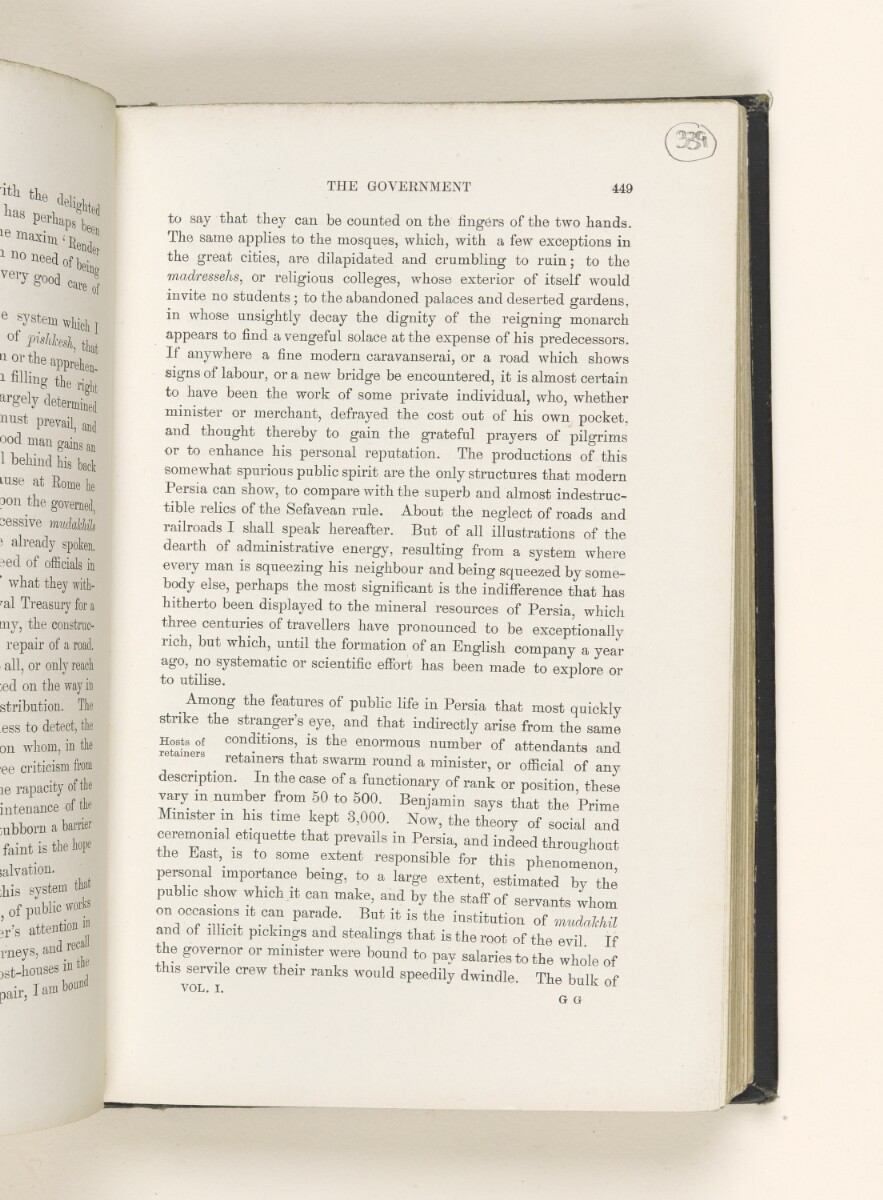
THE GOVERNMENT
449
to say that they can be counted on the fingers of the two hands.
The same applies to the mosques, which, with a few exceptions in
the great cities, are dilapidated and crumbling to ruin; to the
madressehs, or religious colleges, whose exterior of itself would
invite no students ; to the abandoned palaces and deserted gardens,
in whose unsightly decay the dignity of the reigning monarch
appears to find a vengeful solace at the expense of his predecessors.
If anywhere a fine modern
caravanserai
A roadside inn providing accommodation for caravans (groups of travellers).
, or a road which shows
signs of labour, or a new bridge be encountered, it is almost certain
to have been the work of some private individual, who, whether
minister or merchant, defrayed the cost out of his own pocket,
and thought thereby to gain the grateful prayers of pilgrims
or to enhance his personal reputation. The productions of this
somewhat spurious public spirit are the only structures that modern
Persia can show, to compare with the superb and almost indestruc
tible relics of the Sefavean rule. About the neglect of roads and
railroads I shall speak hereafter. But of all illustrations of the
dearth of administrative energy, resulting from a system where
every man is squeezing his neighbour and being squeezed by some
body else, perhaps the most significant is the indifference that has
hitherto been displayed to the mineral resources of Persia, which
three centuries of travellers have pronounced to be exceptionally
rich, but which, until the formation of an English company a year
ago, no systematic or scientific effort has been made to explore or
to utilise.
Among the features of public life in Persia that most quickly
strike the stranger’s eye, and that indirectly arise from the same
Hosts of conditions, is the enormous number of attendants and
le amers . retainers that swarm round a minister, or official of any
description. In the case of a functionary of rank or position these
vary in number from 50 to 500. Benjamin says that the Prime
Minister m his time kept 3,000, Now, the theory of social and
ceremonial etiquette that prevails in Persia, and indeed throughout
the East,, is to some extent responsible for this phenomenon
personal importance being, to a large extent, estimated by the
public show which it can make, and by the staff of servants whom
on occasions it can parade. But it is the institution of mndaJchil
and of illicit pickings and stealings that is the root of the evil If
the governor or minister were bound to pay salaries to the whole of
this servile crew their ranks would speedily dwindle. The bulk of
VOL. I.
About this item
- Content
These two volumes are George Curzon's own personal annotated copies of both volumes of his book Persia and the Persian Question , which was published in 1892. Alongside the volumes are various loose papers relating to Persia [Iran], consisting of the following: received correspondence; newspaper cuttings; publishers' press releases; cuttings from various booksellers' catalogues; various journal and magazine articles; two items of printed official British correspondence; several prints of photographs and sketches; and a few handwritten notes by Curzon.
In most cases these papers, which range in date from 1892 to 1924, relate to the chapters in the book where they were originally inserted, suggesting that they were kept by Curzon with the intention of using them to inform a revised edition of the book.
Of particular note among the small amount of correspondence are two letters received by Curzon in 1914 and 1915 from retired schoolmaster and Islamic scholar Sayyid Mazhar Hasan Musawi of Saharanpur, Uttar Pradesh, India (ff 5-9 and ff 44-53). These letters, which are written in Urdu and are accompanied by English translations, discuss in detail several inaccuracies found in the Urdu version of Persia and the Persian Question .
The various prints of photographs and sketches, which were originally inserted into volume two, are of different locations in the Gulf region. Several of these appear to have been produced in preparation for the publication of the second volume of John Gordon Lorimer's Gazetteer of the Persian Gulf The historical term used to describe the body of water between the Arabian Peninsula and Iran. , Oman and Central Arabia (i.e. the 'Geographical and Statistical' section) in 1908, as they are identical to the versions found in that volume.
Also of note among the loose papers are an illustrated article from Country Life dated 5 June 1920, entitled 'The People of Persia' (ff 36-37), and a printed family tree of the Shah of Persia [Aḥmad Shah Qājār], produced in preparation of his visit to Britain in 1919 (f 233).
Volume one of Persia and the Persian Question contains a map of Persia, Afghanistan and Beluchistan [Balochistan], which is folded inside the front cover (f 1).
The German language material consists of a publisher's press release for two books authored by German archaeologist Ernst Emil Herzfeld (ff 29-30).
- Extent and format
- 2 volumes with inserts (898 folios)
- Physical characteristics
Foliation: this shelfmark consists of two physical volumes. The foliation sequence commences at the first folio of volume one (1-463), and terminates at the last folio of volume two (ff 464-898); these numbers are written in pencil, are circled, and are located in the top right corner of the recto The front of a sheet of paper or leaf, often abbreviated to 'r'. side of each folio. Each volume contains a large number of loose leaves, which have been foliated in the order that they were inserted into the volume; for conservation reasons, these loose folios have been removed from the volume and stored separately. The foliation sequence does not include the front and back covers of the two volumes.
Pagination: the file also contains an original printed pagination sequence.
- Written in
- English, Urdu and German in Latin and Arabic script View the complete information for this record
Use and share this item
- Share this item
Annotated Copy of Persia and the Persian Question by George Curzon, with Inserted Papers [339r] (680/1814), British Library: India Office Records and Private Papers, Mss Eur F111/33, in Qatar Digital Library <https://www.qdl.qa/archive/81055/vdc_100157213845.0x000057> [accessed 23 August 2026]
https://www.qdl.qa/en/archive/81055/vdc_100157213845.0x000057
Copy and paste the code below into your web page where you would like to embed the image.
<meta charset="utf-8"><a href="https://www.qdl.qa/en/archive/81055/vdc_100157213845.0x000057">Annotated Copy of <em>Persia and the Persian Question</em> by George Curzon, with Inserted Papers [‎339r] (680/1814)</a> <a href="https://www.qdl.qa/en/archive/81055/vdc_100157213845.0x000057"> <img src="https://iiif.qdl.qa/iiif/images/81055/vdc_100000001491.0x00033b/Mss Eur F111_33_0691.jp2/full/!280,240/0/default.jpg" alt="" /> </a>
This record has a IIIF manifest available as follows. If you have a compatible viewer you can drag the icon to load it.https://www.qdl.qa/en/iiif/81055/vdc_100000001491.0x00033b/manifestOpen in Universal viewerOpen in Mirador viewerMore options for embedding images
Copyright: How to use this content
- Reference
- Mss Eur F111/33
- Title
- Annotated Copy of Persia and the Persian Questionby George Curzon, with Inserted Papers
- Pages
- 54r:135v, 147r:149v, 158r:180v, 183r:221v, 224r:224v, 227r:246v, 248r:257v, 259r:260v, 268r:362v, 364r:364v, 367r:388v, 390r:400v, 402r:416v, 419r:432v, 434r:444v, 448r:462v, 464r:471v, 475r:481v, 483r:513v, 516r:525v, 527r:544v, 546r:563v, 566r:598v, 600r:622v, 624r:656v, 658r:665v, 667r:675v, 678r:684v, 687r:688v, 691r:691v, 693r:693v, 695r:708v, 711r:721v, 724r:726v, 728r:729v, 731r:736v, 742r:742v, 746r:757v, 759r:761v, 763r:763v, 765r:765v, 772r:777v, 780r:789v, 793r:794v, 797r:809v, 811r:821v, 825r:840v, 843r:898v
- Author
- Curzon, George Nathaniel, 1st Marquess Curzon of Kedleston
- Usage terms
- Public Domain