
![Annotated Copy of <em>Persia and the Persian Question</em> by George Curzon, with Inserted Papers [‎335v] (673/1814)](https://iiif.qdl.qa/iiif/images/81055/vdc_100000001491.0x00033b/Mss Eur F111_33_0684.jp2/full/!1200,1200/0/default.jpg "Annotated Copy of <em>Persia and the Persian Question</em> by George Curzon, with Inserted Papers [‎335v] (673/1814)")
Annotated Copy of Persia and the Persian Question by George Curzon, with Inserted Papers [335v] (673/1814)
The record is made up of 2 volumes with inserts (898 folios). It was created in 1892-1924. It was written in English, Urdu and German. The original is part of the British Library: India Office The department of the British Government to which the Government of India reported between 1858 and 1947. The successor to the Court of Directors. Records and Private Papers Documents collected in a private capacity. .
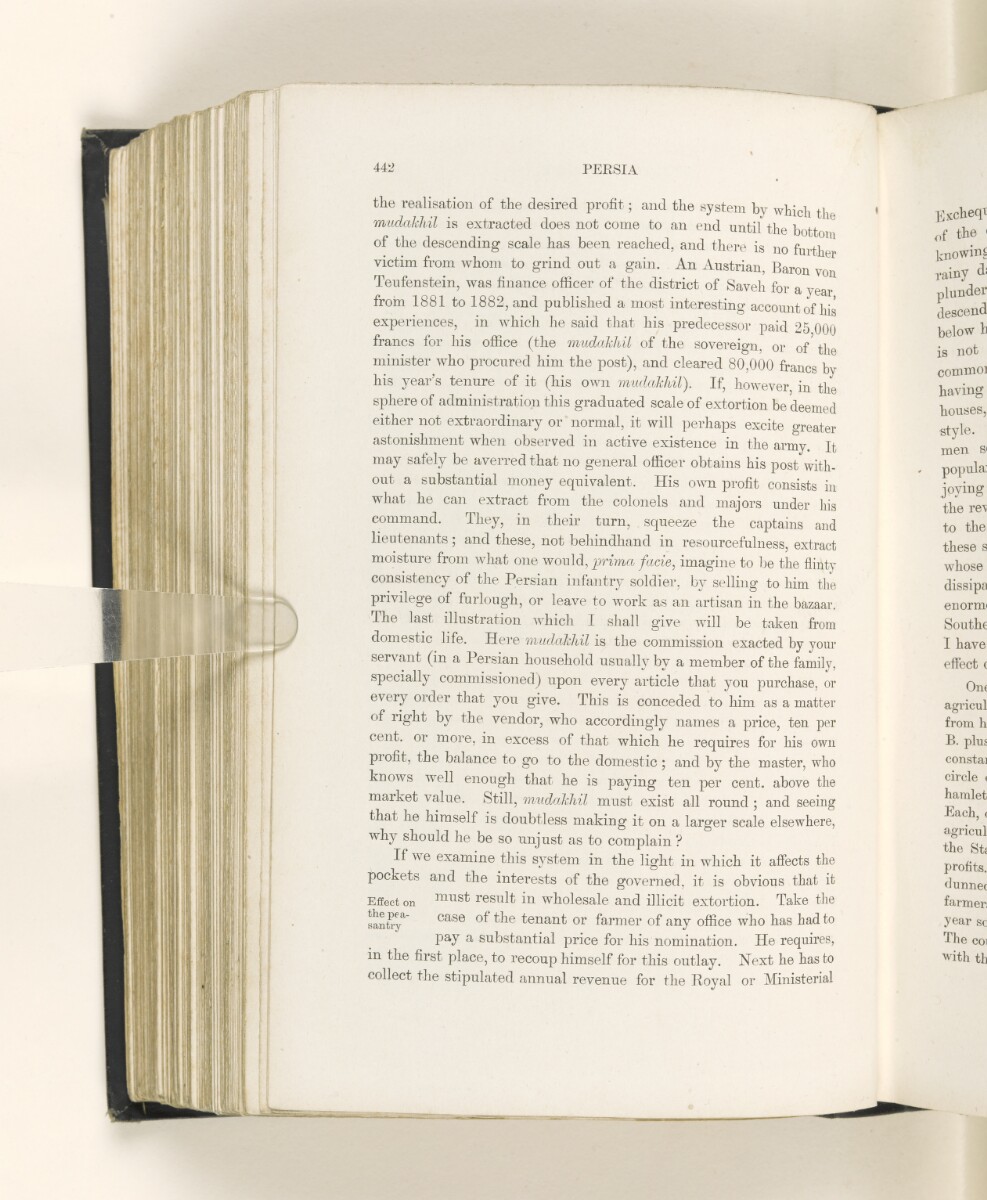
Transcription
This transcription is created automatically. It may contain errors.
442 PERSIA
the realisation of the desired profit; and the system by which the
mudakhil is extracted does not come to an end until" the bott
of the descending scale has been reached, and there is no fm tl
victim from whom to grind out a gain. An Austrian, Baron von
Teufenstein, was finance officer of the district of Saveli for a year
from 1881 to 1882, and published a most interesting account of his
experiences, in which he said that his predecessor paid 25 000
francs for his office (the mudakhil of the sovereign, or of the
minister who procured him the post), and cleared 80,000 francs by
his year’s tenure of it (his own mudakhil). If, however in the
sphere of administration this graduated scale of extortion be deemed
either not extraordinary or normal, it will perhaps excite greater
astonishment when observed in active existence in the army. It
may safely be averred that no general officer obtains his post with
out a substantial money equivalent. His own profit consists in
what he can extract from the colonels and majors under his
command. They, in their turn, squeeze the captains and
lieutenants; and these, not behindhand in resourcefulness, extract
moisture from what one would, primaj facia^ imagine to be the flinty
consistency of the Persian infantry soldier, by selling to him the
privilege of furlough, or leave to work as an artisan in the bazaar.
The last illustration which I shall give will be taken from
domestic life. Here mudakhil is the commission exacted by your
servant (in a Persian household usually by a member of the family,
specially commissioned) upon every article that you purchase, or
every order that you give. This is conceded to him as a matter
of light by the vendor, who accordingly names a price, ten per
cent, or more, in excess of that which he requires for his own
profit, the balance to go to the domestic ; and by the master, who
knows well enough that he is paying ten per cent, above the
market value. Still, mudakhil must exist all round ; and seeing
that he himself is doubtless making it on a larger scale elsewhere,
why should he be so unjust as to complain ?
If we examine this system in the light in which it affects the
pockets and the interests of the governed, it is obvious that it
Effect on must result in wholesale and illicit extortion. Take the
gantry 1 " case ^ ie f enar d or farmer of any office who has had to
pay a substantial price for his nomination. He requires,
in the first place, to recoup himself for this outlay. Next he has to
collect the stipulated annual revenue for the Royal or Ministerial
pxcheqi
of the <
knowing
rainy T
plunder
descend
below h
is not
commoi
having
houses,
stvle.
men s<
- populai
joying
the rev
to the
these s
whose
dissipa
enorm<
Southe
I have
effect c
Out
agricul
from h
B. plus
constai
circle (
hamlet
Each, (
agricul
the 8R
profits,
dunnec
farmer;
year so
The coi
with th
About this item
- Content
These two volumes are George Curzon's own personal annotated copies of both volumes of his book Persia and the Persian Question , which was published in 1892. Alongside the volumes are various loose papers relating to Persia [Iran], consisting of the following: received correspondence; newspaper cuttings; publishers' press releases; cuttings from various booksellers' catalogues; various journal and magazine articles; two items of printed official British correspondence; several prints of photographs and sketches; and a few handwritten notes by Curzon.
In most cases these papers, which range in date from 1892 to 1924, relate to the chapters in the book where they were originally inserted, suggesting that they were kept by Curzon with the intention of using them to inform a revised edition of the book.
Of particular note among the small amount of correspondence are two letters received by Curzon in 1914 and 1915 from retired schoolmaster and Islamic scholar Sayyid Mazhar Hasan Musawi of Saharanpur, Uttar Pradesh, India (ff 5-9 and ff 44-53). These letters, which are written in Urdu and are accompanied by English translations, discuss in detail several inaccuracies found in the Urdu version of Persia and the Persian Question .
The various prints of photographs and sketches, which were originally inserted into volume two, are of different locations in the Gulf region. Several of these appear to have been produced in preparation for the publication of the second volume of John Gordon Lorimer's Gazetteer of the Persian Gulf The historical term used to describe the body of water between the Arabian Peninsula and Iran. , Oman and Central Arabia (i.e. the 'Geographical and Statistical' section) in 1908, as they are identical to the versions found in that volume.
Also of note among the loose papers are an illustrated article from Country Life dated 5 June 1920, entitled 'The People of Persia' (ff 36-37), and a printed family tree of the Shah of Persia [Aḥmad Shah Qājār], produced in preparation of his visit to Britain in 1919 (f 233).
Volume one of Persia and the Persian Question contains a map of Persia, Afghanistan and Beluchistan [Balochistan], which is folded inside the front cover (f 1).
The German language material consists of a publisher's press release for two books authored by German archaeologist Ernst Emil Herzfeld (ff 29-30).
- Extent and format
- 2 volumes with inserts (898 folios)
- Physical characteristics
Foliation: this shelfmark consists of two physical volumes. The foliation sequence commences at the first folio of volume one (1-463), and terminates at the last folio of volume two (ff 464-898); these numbers are written in pencil, are circled, and are located in the top right corner of the recto The front of a sheet of paper or leaf, often abbreviated to 'r'. side of each folio. Each volume contains a large number of loose leaves, which have been foliated in the order that they were inserted into the volume; for conservation reasons, these loose folios have been removed from the volume and stored separately. The foliation sequence does not include the front and back covers of the two volumes.
Pagination: the file also contains an original printed pagination sequence.
- Written in
- English, Urdu and German in Latin and Arabic script View the complete information for this record
Use and share this item
- Share this item
Annotated Copy of Persia and the Persian Question by George Curzon, with Inserted Papers [335v] (673/1814), British Library: India Office Records and Private Papers, Mss Eur F111/33, in Qatar Digital Library <https://www.qdl.qa/archive/81055/vdc_100157213845.0x000050> [accessed 1 August 2026]
https://www.qdl.qa/en/archive/81055/vdc_100157213845.0x000050
Copy and paste the code below into your web page where you would like to embed the image.
<meta charset="utf-8"><a href="https://www.qdl.qa/en/archive/81055/vdc_100157213845.0x000050">Annotated Copy of <em>Persia and the Persian Question</em> by George Curzon, with Inserted Papers [‎335v] (673/1814)</a> <a href="https://www.qdl.qa/en/archive/81055/vdc_100157213845.0x000050"> <img src="https://iiif.qdl.qa/iiif/images/81055/vdc_100000001491.0x00033b/Mss Eur F111_33_0684.jp2/full/!280,240/0/default.jpg" alt="" /> </a>
This record has a IIIF manifest available as follows. If you have a compatible viewer you can drag the icon to load it.https://www.qdl.qa/en/iiif/81055/vdc_100000001491.0x00033b/manifestOpen in Universal viewerOpen in Mirador viewerMore options for embedding images
Copyright: How to use this content
- Reference
- Mss Eur F111/33
- Title
- Annotated Copy of Persia and the Persian Questionby George Curzon, with Inserted Papers
- Pages
- 54r:135v, 147r:149v, 158r:180v, 183r:221v, 224r:224v, 227r:246v, 248r:257v, 259r:260v, 268r:362v, 364r:364v, 367r:388v, 390r:400v, 402r:416v, 419r:432v, 434r:444v, 448r:462v, 464r:471v, 475r:481v, 483r:513v, 516r:525v, 527r:544v, 546r:563v, 566r:598v, 600r:622v, 624r:656v, 658r:665v, 667r:675v, 678r:684v, 687r:688v, 691r:691v, 693r:693v, 695r:708v, 711r:721v, 724r:726v, 728r:729v, 731r:736v, 742r:742v, 746r:757v, 759r:761v, 763r:763v, 765r:765v, 772r:777v, 780r:789v, 793r:794v, 797r:809v, 811r:821v, 825r:840v, 843r:898v
- Author
- Curzon, George Nathaniel, 1st Marquess Curzon of Kedleston
- Usage terms
- Public Domain