
![Annotated Copy of <em>Persia and the Persian Question</em> by George Curzon, with Inserted Papers [‎332r] (666/1814)](https://iiif.qdl.qa/iiif/images/81055/vdc_100000001491.0x00033b/Mss Eur F111_33_0677.jp2/full/!1200,1200/0/default.jpg "Annotated Copy of <em>Persia and the Persian Question</em> by George Curzon, with Inserted Papers [‎332r] (666/1814)")
Annotated Copy of Persia and the Persian Question by George Curzon, with Inserted Papers [332r] (666/1814)
The record is made up of 2 volumes with inserts (898 folios). It was created in 1892-1924. It was written in English, Urdu and German. The original is part of the British Library: India Office The department of the British Government to which the Government of India reported between 1858 and 1947. The successor to the Court of Directors. Records and Private Papers Documents collected in a private capacity. .
Transcription
This transcription is created automatically. It may contain errors.
spok e t ft
^ , the graven
>d ; the KibH
P lan et Satn m •
)vereign ) whose
lle Firmament;
'till would tV
£ device ap-
Pposite counsel
‘ march of time
secular council,
}lve institutions
^ written check
o means corre-
inal to what it
no longer the
m unity of the
3 sovereigns of
mceded to the
1 the Sultan of
drtue of their
, or descendant
with a semi
lie passiveness
tted to the rule
Chardin says
e Imams; and
ad washed was
re for all corn-
made, or could
st of all on be-
)n. The Shah
ims of personal
THE GOVERNMENT
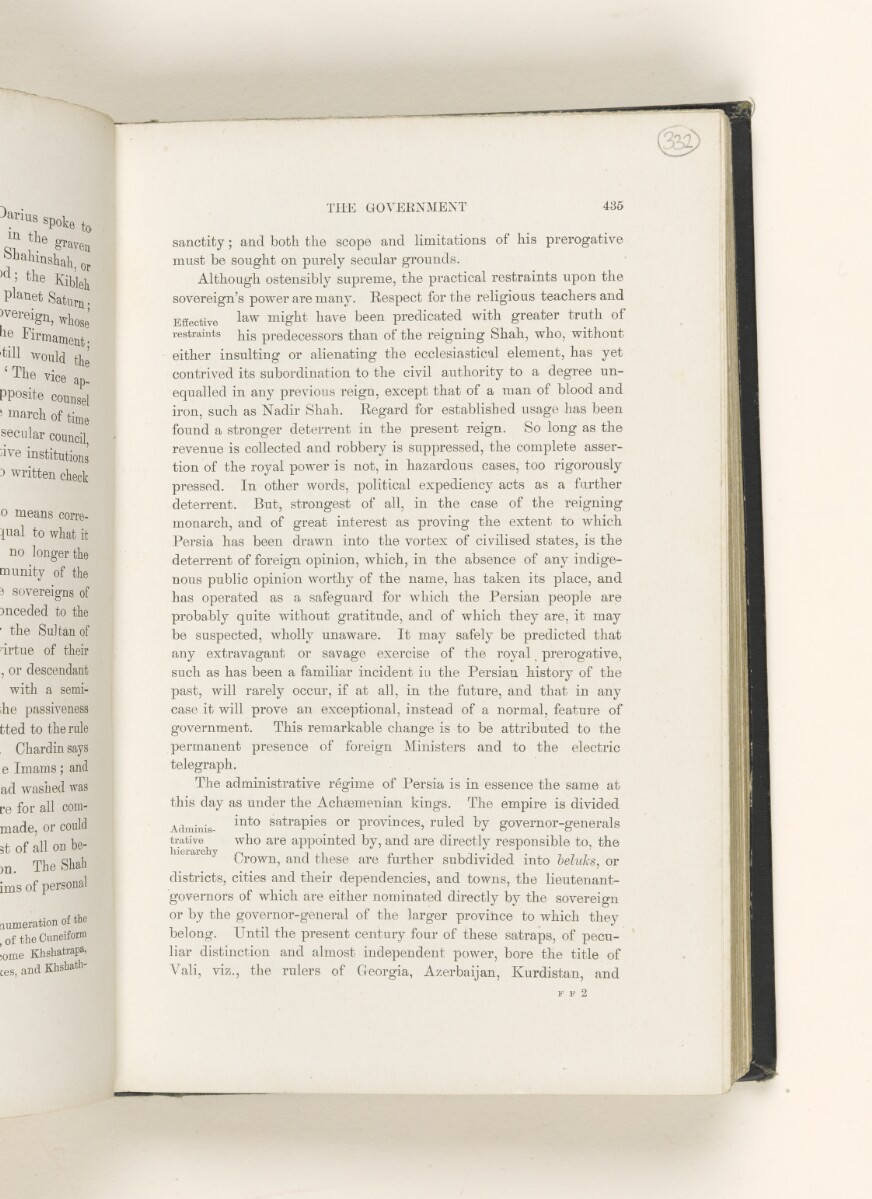
sanctity; and both the scope and limitations of his prerogative
must be sought on purely secular grounds.
Although ostensibly supreme, the practical restraints upon the
sovereign’s power are many. Respect for the religious teachers and
Effective ^ aw might have been predicated with greater truth of
restraints pi s predecessors than of the reigning Shah, who, without
either insulting or alienating the ecclesiastical element, has yet
contrived its subordination to the civil authority to a degree un
equalled in any previous reign, except that of a man of blood and
iron, such as Nadir Shah. Regard for established usage has been
found a stronger deterrent in the present reign. So long as the
revenue is collected and robbery is suppressed, the complete asser
tion of the royal powder is not, in hazardous cases, too rigorously
pressed. In other words, political expediency acts as a further
deterrent. But, strongest of all, in the case of the reigning
monarch, and of great interest as proving the extent to which
Persia has been drawn into the vortex of civilised states, is the
deterrent of foreign opinion, which, in the absence of any indige
nous public opinion worthy of the name, has taken its place, and
has operated as a safeguard for which the Persian people are
probably quite without gratitude, and of which they are, it may
be suspected, wholly unaware. It may safely be predicted that
any extravagant or savage exercise of the royal prerogative,
such as has been a familiar incident in the Persian history of the
past, will rarely occur, if at all, in the future, and that in any
case it will prove an exceptional, instead of a normal, feature of
government. This remarkable change is to be attributed to the
permanent presence of foreign Ministers and to the electric
telegraph.
The administrative regime of Persia is in essence the same at
this day as under the Acheemenian kings. The empire is divided
Adminis sa I ra pi es or provinces, ruled by governor-generals
trative who are appointed by, and are directly responsible to, the
hierarchy Q rown ^ anc ] these are further subdivided into beluks, or
districts, cities and their dependencies, and towns, the lieutenant-
governors of which are either nominated directly by the sovereign
or by the governor-general of the larger province to which they
belong. Until the present century four of these satraps, of pecu
liar distinction and almost independent power, bore the title of
V ali, viz., the rulers of Georgia, Azerbaijan, Kurdistan, and
F F 2
About this item
- Content
These two volumes are George Curzon's own personal annotated copies of both volumes of his book Persia and the Persian Question , which was published in 1892. Alongside the volumes are various loose papers relating to Persia [Iran], consisting of the following: received correspondence; newspaper cuttings; publishers' press releases; cuttings from various booksellers' catalogues; various journal and magazine articles; two items of printed official British correspondence; several prints of photographs and sketches; and a few handwritten notes by Curzon.
In most cases these papers, which range in date from 1892 to 1924, relate to the chapters in the book where they were originally inserted, suggesting that they were kept by Curzon with the intention of using them to inform a revised edition of the book.
Of particular note among the small amount of correspondence are two letters received by Curzon in 1914 and 1915 from retired schoolmaster and Islamic scholar Sayyid Mazhar Hasan Musawi of Saharanpur, Uttar Pradesh, India (ff 5-9 and ff 44-53). These letters, which are written in Urdu and are accompanied by English translations, discuss in detail several inaccuracies found in the Urdu version of Persia and the Persian Question .
The various prints of photographs and sketches, which were originally inserted into volume two, are of different locations in the Gulf region. Several of these appear to have been produced in preparation for the publication of the second volume of John Gordon Lorimer's Gazetteer of the Persian Gulf The historical term used to describe the body of water between the Arabian Peninsula and Iran. , Oman and Central Arabia (i.e. the 'Geographical and Statistical' section) in 1908, as they are identical to the versions found in that volume.
Also of note among the loose papers are an illustrated article from Country Life dated 5 June 1920, entitled 'The People of Persia' (ff 36-37), and a printed family tree of the Shah of Persia [Aḥmad Shah Qājār], produced in preparation of his visit to Britain in 1919 (f 233).
Volume one of Persia and the Persian Question contains a map of Persia, Afghanistan and Beluchistan [Balochistan], which is folded inside the front cover (f 1).
The German language material consists of a publisher's press release for two books authored by German archaeologist Ernst Emil Herzfeld (ff 29-30).
- Extent and format
- 2 volumes with inserts (898 folios)
- Physical characteristics
Foliation: this shelfmark consists of two physical volumes. The foliation sequence commences at the first folio of volume one (1-463), and terminates at the last folio of volume two (ff 464-898); these numbers are written in pencil, are circled, and are located in the top right corner of the recto The front of a sheet of paper or leaf, often abbreviated to 'r'. side of each folio. Each volume contains a large number of loose leaves, which have been foliated in the order that they were inserted into the volume; for conservation reasons, these loose folios have been removed from the volume and stored separately. The foliation sequence does not include the front and back covers of the two volumes.
Pagination: the file also contains an original printed pagination sequence.
- Written in
- English, Urdu and German in Latin and Arabic script View the complete information for this record
Use and share this item
- Share this item
Annotated Copy of Persia and the Persian Question by George Curzon, with Inserted Papers [332r] (666/1814), British Library: India Office Records and Private Papers, Mss Eur F111/33, in Qatar Digital Library <https://www.qdl.qa/archive/81055/vdc_100157213845.0x000049> [accessed 5 June 2026]
https://www.qdl.qa/en/archive/81055/vdc_100157213845.0x000049
Copy and paste the code below into your web page where you would like to embed the image.
<meta charset="utf-8"><a href="https://www.qdl.qa/en/archive/81055/vdc_100157213845.0x000049">Annotated Copy of <em>Persia and the Persian Question</em> by George Curzon, with Inserted Papers [‎332r] (666/1814)</a> <a href="https://www.qdl.qa/en/archive/81055/vdc_100157213845.0x000049"> <img src="https://iiif.qdl.qa/iiif/images/81055/vdc_100000001491.0x00033b/Mss Eur F111_33_0677.jp2/full/!280,240/0/default.jpg" alt="" /> </a>
This record has a IIIF manifest available as follows. If you have a compatible viewer you can drag the icon to load it.https://www.qdl.qa/en/iiif/81055/vdc_100000001491.0x00033b/manifestOpen in Universal viewerOpen in Mirador viewerMore options for embedding images
Copyright: How to use this content
- Reference
- Mss Eur F111/33
- Title
- Annotated Copy of Persia and the Persian Questionby George Curzon, with Inserted Papers
- Pages
- 54r:135v, 147r:149v, 158r:180v, 183r:221v, 224r:224v, 227r:246v, 248r:257v, 259r:260v, 268r:362v, 364r:364v, 367r:388v, 390r:400v, 402r:416v, 419r:432v, 434r:444v, 448r:462v, 464r:471v, 475r:481v, 483r:513v, 516r:525v, 527r:544v, 546r:563v, 566r:598v, 600r:622v, 624r:656v, 658r:665v, 667r:675v, 678r:684v, 687r:688v, 691r:691v, 693r:693v, 695r:708v, 711r:721v, 724r:726v, 728r:729v, 731r:736v, 742r:742v, 746r:757v, 759r:761v, 763r:763v, 765r:765v, 772r:777v, 780r:789v, 793r:794v, 797r:809v, 811r:821v, 825r:840v, 843r:898v
- Author
- Curzon, George Nathaniel, 1st Marquess Curzon of Kedleston
- Usage terms
- Public Domain