
![Annotated Copy of <em>Persia and the Persian Question</em> by George Curzon, with Inserted Papers [‎311r] (624/1814)](https://iiif.qdl.qa/iiif/images/81055/vdc_100000001491.0x00033b/Mss Eur F111_33_0635.jp2/full/!1200,1200/0/default.jpg "Annotated Copy of <em>Persia and the Persian Question</em> by George Curzon, with Inserted Papers [‎311r] (624/1814)")
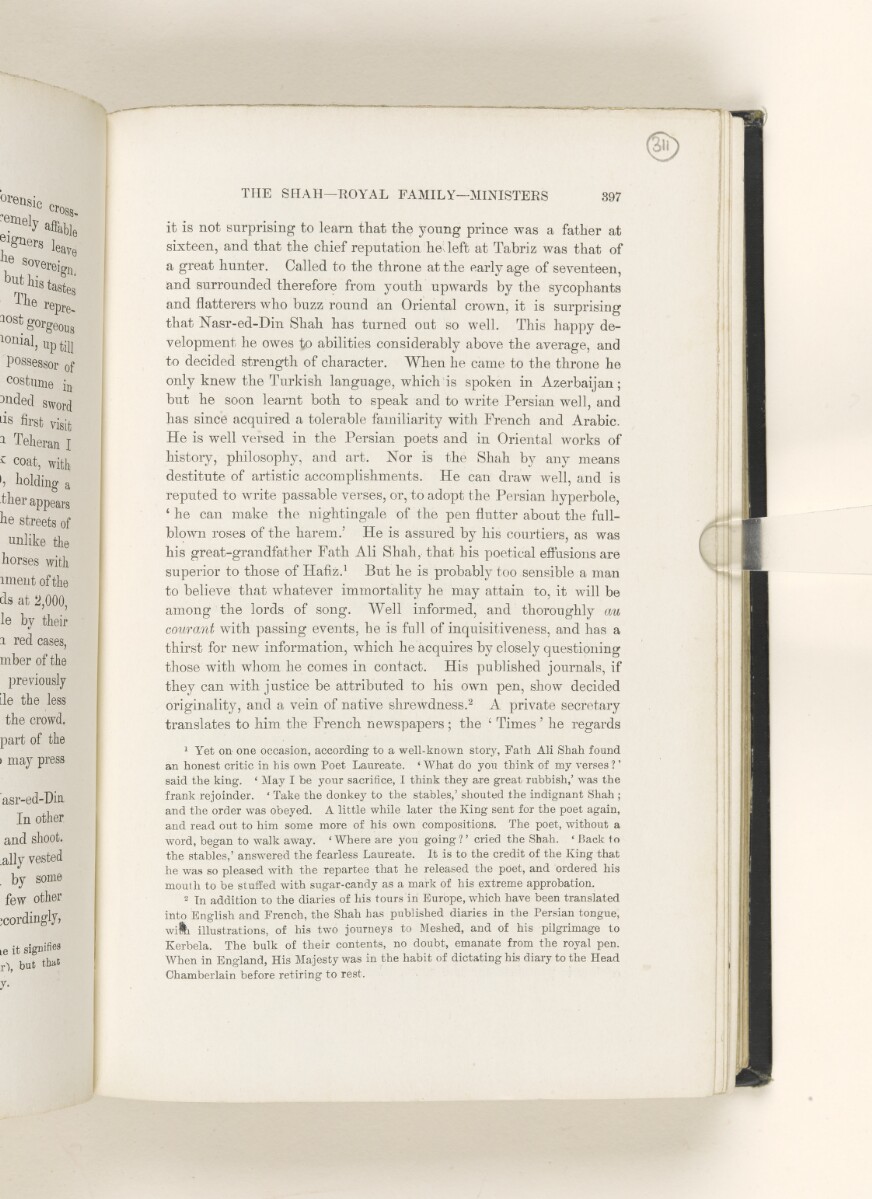
Annotated Copy of Persia and the Persian Question by George Curzon, with Inserted Papers [311r] (624/1814)
The record is made up of 2 volumes with inserts (898 folios). It was created in 1892-1924. It was written in English, Urdu and German. The original is part of the British Library: India Office The department of the British Government to which the Government of India reported between 1858 and 1947. The successor to the Court of Directors. Records and Private Papers Documents collected in a private capacity. .
Transcription
This transcription is created automatically. It may contain errors.
THE SHAH—ROYAL FAMILY—MINISTERS 897
it is not surprising to learn that the young prince was a father at
sixteen, and that the chief reputation he.left at Tabriz was that of
a great hunter. Called to the throne at the early age of seventeen,
and surrounded therefore from youth upwards by the sycophants
and flatterers who buzz round an Oriental crown, it is surprising
that Nasr-ed-Din Shah has turned out so well. This happy de
velopment he owes to abilities considerably above the average, and
to decided strength of character. When he came to the throne he
only knew the Turkish language, which is spoken in Azerbaijan;
but he soon learnt both to speak and to write Persian well, and
has since acquired a tolerable familiarity with French and Arabic.
He is well versed in the Persian poets and in Oriental works of
history, philosophy, and art. Nor is the Shah by any means
destitute of artistic accomplishments. He can draw well, and is
reputed to write passable verses, or, to adopt the Persian hyperbole,
‘ he can make the nightingale of the pen flutter about the full
blown roses of the harem/ He is assured by his courtiers, as was
his great-grandfather Fath Ali Shah, that his poetical effusions are
superior to those of Hafiz . 1 But he is probably too sensible a man
to believe that whatever immortality he may attain to, it will be
among the lords of song. Well informed, and thoroughly au
courant with passing events, he is full of inquisitiveness, and has a
thirst for new information, which he acquires by closely questioning
those with whom he comes in contact. His published journals, if
they can with justice be attributed to his own pen, show decided
originality, and a vein of native shrewdness . 2 A private secretary
translates to him the French newspapers; the c Times 5 he regards
1 Yet on one occasion, according to a well-known story, Fath All Shah found
an honest critic in his own Poet Laureate. ‘ What do you think of my verses ? ’
said the king. ‘ May I be your sacrifice, I think they are great rubbish,’ was the
frank rejoinder. ‘ Take the donkey to the stables , 7 shouted the indignant Shah ;
and the order was obeyed. A little while later the King sent for the poet again,
and read out to him some more of his own compositions. The poet, without a
word, began to walk away. ‘Where are you going? ’ cried the Shah. ‘ Back to
the stables,’ answered the fearless Laureate. It is to the credit of the King that
he was so pleased with the repartee that he released the poet, and ordered his
mouth to be stuffed with sugar-candy as a mark of his extreme approbation.
2 In addition to the diaries of his tours in Europe, which have been translated
into English and French, the Shah has published diaries in the Persian tongue,
will illustrations, of his two journeys to Meshed, and of his pilgrimage to
Kerbela. The bulk of their contents, no doubt, emanate from the royal pen.
When in England, His Majesty was in the habit of dictating his diary to the Head
Chamberlain before retiring to rest.
About this item
- Content
These two volumes are George Curzon's own personal annotated copies of both volumes of his book Persia and the Persian Question , which was published in 1892. Alongside the volumes are various loose papers relating to Persia [Iran], consisting of the following: received correspondence; newspaper cuttings; publishers' press releases; cuttings from various booksellers' catalogues; various journal and magazine articles; two items of printed official British correspondence; several prints of photographs and sketches; and a few handwritten notes by Curzon.
In most cases these papers, which range in date from 1892 to 1924, relate to the chapters in the book where they were originally inserted, suggesting that they were kept by Curzon with the intention of using them to inform a revised edition of the book.
Of particular note among the small amount of correspondence are two letters received by Curzon in 1914 and 1915 from retired schoolmaster and Islamic scholar Sayyid Mazhar Hasan Musawi of Saharanpur, Uttar Pradesh, India (ff 5-9 and ff 44-53). These letters, which are written in Urdu and are accompanied by English translations, discuss in detail several inaccuracies found in the Urdu version of Persia and the Persian Question .
The various prints of photographs and sketches, which were originally inserted into volume two, are of different locations in the Gulf region. Several of these appear to have been produced in preparation for the publication of the second volume of John Gordon Lorimer's Gazetteer of the Persian Gulf The historical term used to describe the body of water between the Arabian Peninsula and Iran. , Oman and Central Arabia (i.e. the 'Geographical and Statistical' section) in 1908, as they are identical to the versions found in that volume.
Also of note among the loose papers are an illustrated article from Country Life dated 5 June 1920, entitled 'The People of Persia' (ff 36-37), and a printed family tree of the Shah of Persia [Aḥmad Shah Qājār], produced in preparation of his visit to Britain in 1919 (f 233).
Volume one of Persia and the Persian Question contains a map of Persia, Afghanistan and Beluchistan [Balochistan], which is folded inside the front cover (f 1).
The German language material consists of a publisher's press release for two books authored by German archaeologist Ernst Emil Herzfeld (ff 29-30).
- Extent and format
- 2 volumes with inserts (898 folios)
- Physical characteristics
Foliation: this shelfmark consists of two physical volumes. The foliation sequence commences at the first folio of volume one (1-463), and terminates at the last folio of volume two (ff 464-898); these numbers are written in pencil, are circled, and are located in the top right corner of the recto The front of a sheet of paper or leaf, often abbreviated to 'r'. side of each folio. Each volume contains a large number of loose leaves, which have been foliated in the order that they were inserted into the volume; for conservation reasons, these loose folios have been removed from the volume and stored separately. The foliation sequence does not include the front and back covers of the two volumes.
Pagination: the file also contains an original printed pagination sequence.
- Written in
- English, Urdu and German in Latin and Arabic script View the complete information for this record
Use and share this item
- Share this item
Annotated Copy of Persia and the Persian Question by George Curzon, with Inserted Papers [311r] (624/1814), British Library: India Office Records and Private Papers, Mss Eur F111/33, in Qatar Digital Library <https://www.qdl.qa/archive/81055/vdc_100157213845.0x00001f> [accessed 4 July 2026]
https://www.qdl.qa/en/archive/81055/vdc_100157213845.0x00001f
Copy and paste the code below into your web page where you would like to embed the image.
<meta charset="utf-8"><a href="https://www.qdl.qa/en/archive/81055/vdc_100157213845.0x00001f">Annotated Copy of <em>Persia and the Persian Question</em> by George Curzon, with Inserted Papers [‎311r] (624/1814)</a> <a href="https://www.qdl.qa/en/archive/81055/vdc_100157213845.0x00001f"> <img src="https://iiif.qdl.qa/iiif/images/81055/vdc_100000001491.0x00033b/Mss Eur F111_33_0635.jp2/full/!280,240/0/default.jpg" alt="" /> </a>
This record has a IIIF manifest available as follows. If you have a compatible viewer you can drag the icon to load it.https://www.qdl.qa/en/iiif/81055/vdc_100000001491.0x00033b/manifestOpen in Universal viewerOpen in Mirador viewerMore options for embedding images
Copyright: How to use this content
- Reference
- Mss Eur F111/33
- Title
- Annotated Copy of Persia and the Persian Questionby George Curzon, with Inserted Papers
- Pages
- 54r:135v, 147r:149v, 158r:180v, 183r:221v, 224r:224v, 227r:246v, 248r:257v, 259r:260v, 268r:362v, 364r:364v, 367r:388v, 390r:400v, 402r:416v, 419r:432v, 434r:444v, 448r:462v, 464r:471v, 475r:481v, 483r:513v, 516r:525v, 527r:544v, 546r:563v, 566r:598v, 600r:622v, 624r:656v, 658r:665v, 667r:675v, 678r:684v, 687r:688v, 691r:691v, 693r:693v, 695r:708v, 711r:721v, 724r:726v, 728r:729v, 731r:736v, 742r:742v, 746r:757v, 759r:761v, 763r:763v, 765r:765v, 772r:777v, 780r:789v, 793r:794v, 797r:809v, 811r:821v, 825r:840v, 843r:898v
- Author
- Curzon, George Nathaniel, 1st Marquess Curzon of Kedleston
- Usage terms
- Public Domain