
![Annotated Copy of <em>Persia and the Persian Question</em> by George Curzon, with Inserted Papers [‎300r] (602/1814)](https://iiif.qdl.qa/iiif/images/81055/vdc_100000001491.0x00033b/Mss Eur F111_33_0613.jp2/full/!1200,1200/0/default.jpg "Annotated Copy of <em>Persia and the Persian Question</em> by George Curzon, with Inserted Papers [‎300r] (602/1814)")
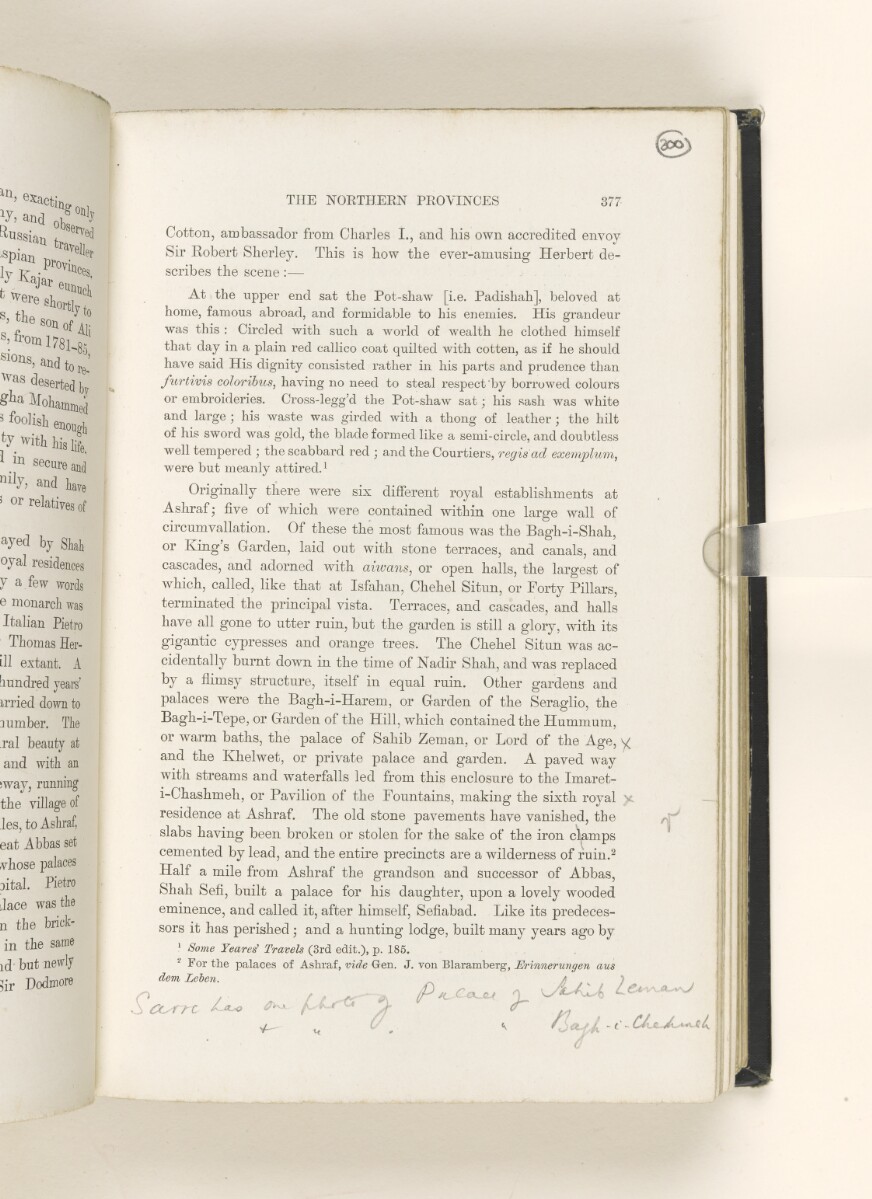
Annotated Copy of Persia and the Persian Question by George Curzon, with Inserted Papers [300r] (602/1814)
The record is made up of 2 volumes with inserts (898 folios). It was created in 1892-1924. It was written in English, Urdu and German. The original is part of the British Library: India Office The department of the British Government to which the Government of India reported between 1858 and 1947. The successor to the Court of Directors. Records and Private Papers Documents collected in a private capacity. .
Transcription
This transcription is created automatically. It may contain errors.
-*r—
x.
: Jva J ar eimt, i
b Wer e short, “
s tu Ol %to
;f 0ll0f Ali
S10ns > and to re .’
g . ^^ammed
5 00 ^ 8 t enouffl]
fy with his lif,
_in secure and
n %> a nd have
! or relatives of
ayed by Shah
ojal residences
y a few words
e monarch was
Italian Pietro
Thomas Her-
ill extant. A
hundred years’
irried down to
a umber. The
ral beauty at
and with an
way, running
the village of
les, to Ashraf,
eat Abbas set
whose palaces
oital. Pietro
lace was the
n the brick-
in the same
id but newly
}ir Dodmore
THE NORTHERN PROVINCES
377
r>
Cotton, ambassador from Charles I., and liis own accredited envoy
Sir Robert Sherley. This is bow the ever-amusing Herbert de
scribes the scene:—
At the upper end sat the Pot-shaw [i.e. Padishah], beloved at
home, famous abroad, and formidable to his enemies. His grandeur
was this : Circled with such a world of wealth he clothed himself
that day in a plain red callico coat quilted with cotten, as if he should
have said His dignity consisted rather in his parts and prudence than
furtivis coloribus, having no need to steal respect by borrowed colours
or embroideries. Cross-legg’d the Pot-shaw sat; his sash was white
and large ; his waste was girded with a thong of leather ; the hilt
of his sword was gold, the blade formed like a semi-circle, and doubtless
well tempered ‘ the scabbard red ‘ and the Courtiers, regis ad exemplum,
were but meanly attired . 1
Originally there were six different royal establishments at
Ashraf; five of which were contained within one large wall of
circumvallation. Of these the most famous was the Bagh-i-Shah,
or Ring s Garden, laid out with stone terraces, and canals, and
cascades, and adorned with aiwans, or open halls, the largest of
which, called, like that at Isfahan, Chehel Situn, or Forty Pillars,
terminated the principal vista. Terraces, and cascades, and halls
have all gone to utter ruin, but the garden is still a glory, with its
gigantic cypresses and orange trees. The Chehel Sitnn was ac
cidentally burnt down in the time of Hadir Shah, and was replaced
by a flimsy structure, itself in equal ruin. Other gardens and
palaces were the Bagh-i-Harem, or Garden of the Seraglio, the
Bagh-i-Tepe, or Garden of the Hill, which contained the Hummum,
or warm baths, the palace of Sahib Zeman, or Lord of the Age,
and the Khelwet, or private palace and garden. A paved wmy
with streams and waterfalls led from this enclosure to the Imaret-
i-Chashmeh, or Pavilion of the Fountains, making the sixth royal
residence at Ashraf. The old stone pavements have vanished, the
slabs having been broken or stolen for the sake of the iron clamps
cemented by lead, and the entire precincts are a wilderness of ruin . 2
Half a mile from Ashraf the grandson and successor of Abbas,
fehah Sefi, built a palace for his daughter, upon a lovely wooded
eminence, and called it, after himself, Sefiabad. Like its predeces
sors it has perished ; and a hunting lodge, built many years ago by
1 Some Yeares' Travels (3rd edit.), p. 185.
* For the palaces of Ashraf, vide Gen. J. von Blaramberg, JErinnerungen aus
dem Leben.
/ . / / f .f., ' * P c ^> X A-AU L e*
/
Corrc P-z-o
ri
i
A
\J0^J
About this item
- Content
These two volumes are George Curzon's own personal annotated copies of both volumes of his book Persia and the Persian Question , which was published in 1892. Alongside the volumes are various loose papers relating to Persia [Iran], consisting of the following: received correspondence; newspaper cuttings; publishers' press releases; cuttings from various booksellers' catalogues; various journal and magazine articles; two items of printed official British correspondence; several prints of photographs and sketches; and a few handwritten notes by Curzon.
In most cases these papers, which range in date from 1892 to 1924, relate to the chapters in the book where they were originally inserted, suggesting that they were kept by Curzon with the intention of using them to inform a revised edition of the book.
Of particular note among the small amount of correspondence are two letters received by Curzon in 1914 and 1915 from retired schoolmaster and Islamic scholar Sayyid Mazhar Hasan Musawi of Saharanpur, Uttar Pradesh, India (ff 5-9 and ff 44-53). These letters, which are written in Urdu and are accompanied by English translations, discuss in detail several inaccuracies found in the Urdu version of Persia and the Persian Question .
The various prints of photographs and sketches, which were originally inserted into volume two, are of different locations in the Gulf region. Several of these appear to have been produced in preparation for the publication of the second volume of John Gordon Lorimer's Gazetteer of the Persian Gulf The historical term used to describe the body of water between the Arabian Peninsula and Iran. , Oman and Central Arabia (i.e. the 'Geographical and Statistical' section) in 1908, as they are identical to the versions found in that volume.
Also of note among the loose papers are an illustrated article from Country Life dated 5 June 1920, entitled 'The People of Persia' (ff 36-37), and a printed family tree of the Shah of Persia [Aḥmad Shah Qājār], produced in preparation of his visit to Britain in 1919 (f 233).
Volume one of Persia and the Persian Question contains a map of Persia, Afghanistan and Beluchistan [Balochistan], which is folded inside the front cover (f 1).
The German language material consists of a publisher's press release for two books authored by German archaeologist Ernst Emil Herzfeld (ff 29-30).
- Extent and format
- 2 volumes with inserts (898 folios)
- Physical characteristics
Foliation: this shelfmark consists of two physical volumes. The foliation sequence commences at the first folio of volume one (1-463), and terminates at the last folio of volume two (ff 464-898); these numbers are written in pencil, are circled, and are located in the top right corner of the recto The front of a sheet of paper or leaf, often abbreviated to 'r'. side of each folio. Each volume contains a large number of loose leaves, which have been foliated in the order that they were inserted into the volume; for conservation reasons, these loose folios have been removed from the volume and stored separately. The foliation sequence does not include the front and back covers of the two volumes.
Pagination: the file also contains an original printed pagination sequence.
- Written in
- English, Urdu and German in Latin and Arabic script View the complete information for this record
Use and share this item
- Share this item
Annotated Copy of Persia and the Persian Question by George Curzon, with Inserted Papers [300r] (602/1814), British Library: India Office Records and Private Papers, Mss Eur F111/33, in Qatar Digital Library <https://www.qdl.qa/archive/81055/vdc_100157213845.0x000009> [accessed 27 July 2026]
https://www.qdl.qa/en/archive/81055/vdc_100157213845.0x000009
Copy and paste the code below into your web page where you would like to embed the image.
<meta charset="utf-8"><a href="https://www.qdl.qa/en/archive/81055/vdc_100157213845.0x000009">Annotated Copy of <em>Persia and the Persian Question</em> by George Curzon, with Inserted Papers [‎300r] (602/1814)</a> <a href="https://www.qdl.qa/en/archive/81055/vdc_100157213845.0x000009"> <img src="https://iiif.qdl.qa/iiif/images/81055/vdc_100000001491.0x00033b/Mss Eur F111_33_0613.jp2/full/!280,240/0/default.jpg" alt="" /> </a>
This record has a IIIF manifest available as follows. If you have a compatible viewer you can drag the icon to load it.https://www.qdl.qa/en/iiif/81055/vdc_100000001491.0x00033b/manifestOpen in Universal viewerOpen in Mirador viewerMore options for embedding images
Copyright: How to use this content
- Reference
- Mss Eur F111/33
- Title
- Annotated Copy of Persia and the Persian Questionby George Curzon, with Inserted Papers
- Pages
- 54r:135v, 147r:149v, 158r:180v, 183r:221v, 224r:224v, 227r:246v, 248r:257v, 259r:260v, 268r:362v, 364r:364v, 367r:388v, 390r:400v, 402r:416v, 419r:432v, 434r:444v, 448r:462v, 464r:471v, 475r:481v, 483r:513v, 516r:525v, 527r:544v, 546r:563v, 566r:598v, 600r:622v, 624r:656v, 658r:665v, 667r:675v, 678r:684v, 687r:688v, 691r:691v, 693r:693v, 695r:708v, 711r:721v, 724r:726v, 728r:729v, 731r:736v, 742r:742v, 746r:757v, 759r:761v, 763r:763v, 765r:765v, 772r:777v, 780r:789v, 793r:794v, 797r:809v, 811r:821v, 825r:840v, 843r:898v
- Author
- Curzon, George Nathaniel, 1st Marquess Curzon of Kedleston
- Usage terms
- Public Domain