
![Annotated Copy of <em>Persia and the Persian Question</em> by George Curzon, with Inserted Papers [‎273r] (548/1814)](https://iiif.qdl.qa/iiif/images/81055/vdc_100000001491.0x00033b/Mss Eur F111_33_0559.jp2/full/!1200,1200/0/default.jpg "Annotated Copy of <em>Persia and the Persian Question</em> by George Curzon, with Inserted Papers [‎273r] (548/1814)")
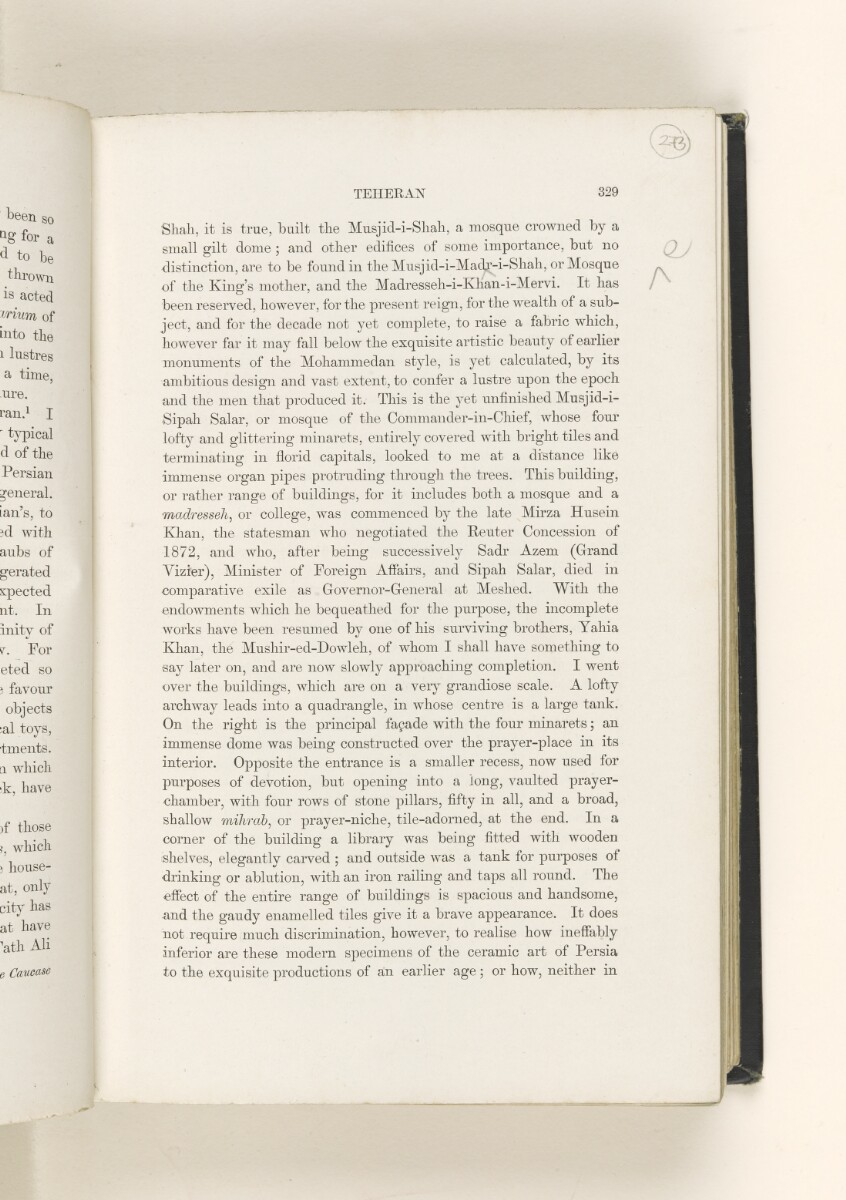
Annotated Copy of Persia and the Persian Question by George Curzon, with Inserted Papers [273r] (548/1814)
The record is made up of 2 volumes with inserts (898 folios). It was created in 1892-1924. It was written in English, Urdu and German. The original is part of the British Library: India Office The department of the British Government to which the Government of India reported between 1858 and 1947. The successor to the Court of Directors. Records and Private Papers Documents collected in a private capacity. .
Transcription
This transcription is created automatically. It may contain errors.
TEHERAN
329
Shall, it is true, built the Musjid-i-Shah, a mosque crowned by a
small gilt dome ; and other edifices of some importance, but no
distinction, are to be found in the Musjid-i-Madr-i-Shah, or Mosque
of the King’s mother, and the Madresseh-i-Khan-i-Mervi. It has
been reserved, however, for the present reign, for the wealth of a sub
ject, and for the decade not yet complete, to raise a fabric which,
however far it may fall below the exquisite artistic beauty of earlier
monuments of the Mohammedan style, is yet calculated, by its
ambitious design and vast extent, to confer a lustre upon the epoch
and the men that produced it. This is the yet unfinished Musjid-i-
Sipah Salar, or mosque of the Commander-in-Chief, whose four
lofty and glittering minarets, entirely covered with bright tiles and
terminating in florid capitals, looked to me at a distance like
immense organ pipes protruding through the trees. This building,
or rather range of buildings, for it includes both a mosque and a
madresseh) or college, was commenced by the late Mirza Husein
Khan, the statesman who negotiated the Reuter Concession of
1872, and who, after being successively Sadr Azem (Grand
Vizier), Minister of Foreign Affairs, and Sipah Salar, died in
comparative exile as Governor-General at Meshed. With the
endowments which he bequeathed for the purpose, the incomplete
works have been resumed by one of his surviving brothers, Yahia
Khan, the Mushir-ed-Dowleh, of whom I shall have something to
say later on, and are now slowly approaching completion. I went
over the buildings, which are on a very grandiose scale. A lofty
archway leads into a quadrangle, in whose centre is a large tank.
On the right is the principal facade with the four minarets; an
immense dome was being constructed over the prayer-place in its
interior. Opposite the entrance is a smaller recess, now used for
purposes of devotion, but opening into a long, vaulted prayer-
chamber, with four rows of stone pillars, fifty in all, and a broad,
shallow mihrab, or prayer-niche, tile-adorned, at the end. In a
corner of the building a library was being fitted with wooden
shelves, elegantly carved ; and outside was a tank for purposes ot
drinking or ablution, with an iron railing and taps all round. The
effect of the entire range of buildings is spacious and handsome,
and the gaudy enamelled tiles give it a brave appearance. It does
not require much discrimination, however, to realise how ineffably
inferior are these modern specimens of the ceramic art of Persia
to the exquisite productions of an earlier age; or how, neither in
About this item
- Content
These two volumes are George Curzon's own personal annotated copies of both volumes of his book Persia and the Persian Question , which was published in 1892. Alongside the volumes are various loose papers relating to Persia [Iran], consisting of the following: received correspondence; newspaper cuttings; publishers' press releases; cuttings from various booksellers' catalogues; various journal and magazine articles; two items of printed official British correspondence; several prints of photographs and sketches; and a few handwritten notes by Curzon.
In most cases these papers, which range in date from 1892 to 1924, relate to the chapters in the book where they were originally inserted, suggesting that they were kept by Curzon with the intention of using them to inform a revised edition of the book.
Of particular note among the small amount of correspondence are two letters received by Curzon in 1914 and 1915 from retired schoolmaster and Islamic scholar Sayyid Mazhar Hasan Musawi of Saharanpur, Uttar Pradesh, India (ff 5-9 and ff 44-53). These letters, which are written in Urdu and are accompanied by English translations, discuss in detail several inaccuracies found in the Urdu version of Persia and the Persian Question .
The various prints of photographs and sketches, which were originally inserted into volume two, are of different locations in the Gulf region. Several of these appear to have been produced in preparation for the publication of the second volume of John Gordon Lorimer's Gazetteer of the Persian Gulf The historical term used to describe the body of water between the Arabian Peninsula and Iran. , Oman and Central Arabia (i.e. the 'Geographical and Statistical' section) in 1908, as they are identical to the versions found in that volume.
Also of note among the loose papers are an illustrated article from Country Life dated 5 June 1920, entitled 'The People of Persia' (ff 36-37), and a printed family tree of the Shah of Persia [Aḥmad Shah Qājār], produced in preparation of his visit to Britain in 1919 (f 233).
Volume one of Persia and the Persian Question contains a map of Persia, Afghanistan and Beluchistan [Balochistan], which is folded inside the front cover (f 1).
The German language material consists of a publisher's press release for two books authored by German archaeologist Ernst Emil Herzfeld (ff 29-30).
- Extent and format
- 2 volumes with inserts (898 folios)
- Physical characteristics
Foliation: this shelfmark consists of two physical volumes. The foliation sequence commences at the first folio of volume one (1-463), and terminates at the last folio of volume two (ff 464-898); these numbers are written in pencil, are circled, and are located in the top right corner of the recto The front of a sheet of paper or leaf, often abbreviated to 'r'. side of each folio. Each volume contains a large number of loose leaves, which have been foliated in the order that they were inserted into the volume; for conservation reasons, these loose folios have been removed from the volume and stored separately. The foliation sequence does not include the front and back covers of the two volumes.
Pagination: the file also contains an original printed pagination sequence.
- Written in
- English, Urdu and German in Latin and Arabic script View the complete information for this record
Use and share this item
- Share this item
Annotated Copy of Persia and the Persian Question by George Curzon, with Inserted Papers [273r] (548/1814), British Library: India Office Records and Private Papers, Mss Eur F111/33, in Qatar Digital Library <https://www.qdl.qa/archive/81055/vdc_100157213844.0x00009b> [accessed 5 August 2026]
https://www.qdl.qa/en/archive/81055/vdc_100157213844.0x00009b
Copy and paste the code below into your web page where you would like to embed the image.
<meta charset="utf-8"><a href="https://www.qdl.qa/en/archive/81055/vdc_100157213844.0x00009b">Annotated Copy of <em>Persia and the Persian Question</em> by George Curzon, with Inserted Papers [‎273r] (548/1814)</a> <a href="https://www.qdl.qa/en/archive/81055/vdc_100157213844.0x00009b"> <img src="https://iiif.qdl.qa/iiif/images/81055/vdc_100000001491.0x00033b/Mss Eur F111_33_0559.jp2/full/!280,240/0/default.jpg" alt="" /> </a>
This record has a IIIF manifest available as follows. If you have a compatible viewer you can drag the icon to load it.https://www.qdl.qa/en/iiif/81055/vdc_100000001491.0x00033b/manifestOpen in Universal viewerOpen in Mirador viewerMore options for embedding images
Copyright: How to use this content
- Reference
- Mss Eur F111/33
- Title
- Annotated Copy of Persia and the Persian Questionby George Curzon, with Inserted Papers
- Pages
- 54r:135v, 147r:149v, 158r:180v, 183r:221v, 224r:224v, 227r:246v, 248r:257v, 259r:260v, 268r:362v, 364r:364v, 367r:388v, 390r:400v, 402r:416v, 419r:432v, 434r:444v, 448r:462v, 464r:471v, 475r:481v, 483r:513v, 516r:525v, 527r:544v, 546r:563v, 566r:598v, 600r:622v, 624r:656v, 658r:665v, 667r:675v, 678r:684v, 687r:688v, 691r:691v, 693r:693v, 695r:708v, 711r:721v, 724r:726v, 728r:729v, 731r:736v, 742r:742v, 746r:757v, 759r:761v, 763r:763v, 765r:765v, 772r:777v, 780r:789v, 793r:794v, 797r:809v, 811r:821v, 825r:840v, 843r:898v
- Author
- Curzon, George Nathaniel, 1st Marquess Curzon of Kedleston
- Usage terms
- Public Domain