
![Annotated Copy of <em>Persia and the Persian Question</em> by George Curzon, with Inserted Papers [‎257r] (516/1814)](https://iiif.qdl.qa/iiif/images/81055/vdc_100000001491.0x00033b/Mss Eur F111_33_0527.jp2/full/!1200,1200/0/default.jpg "Annotated Copy of <em>Persia and the Persian Question</em> by George Curzon, with Inserted Papers [‎257r] (516/1814)")
Annotated Copy of Persia and the Persian Question by George Curzon, with Inserted Papers [257r] (516/1814)
The record is made up of 2 volumes with inserts (898 folios). It was created in 1892-1924. It was written in English, Urdu and German. The original is part of the British Library: India Office The department of the British Government to which the Government of India reported between 1858 and 1947. The successor to the Court of Directors. Records and Private Papers Documents collected in a private capacity. .
Transcription
This transcription is created automatically. It may contain errors.
TEHERAN
315
?lasi
is
oks.
do
•ors.
in
, ^ is
1 allle - TTt,
iluseum a ° llt e H
Shal1 fro m Sr v Hal1
' the Roy al 18
ri osities ’ ^5
^ w him 8) ^
Tort y years, u
euts alt ernately, S
5 > * i;
a lon g parallel,,
plaster decoratio B!
er ° f dee P recesses,
le the partition ij.
1* of the room, are
l yed, side by side,
inalterable rubbish,
in part, tile-paved,
vases, mostly from
with a thin plating
glass cases are dis
it, but in ludicrous
tiquities and speci-
esents, and heads of
)n that most attract
3 ut, or set in every
id the glass panels,
d arms of the great
Ismail and Agb
coat of mail. A
5j four or five in*
I spill them in cas-
L ppears the g* ot
ded by himse 11 !
.rtistic chef
(75 lbs o f P l
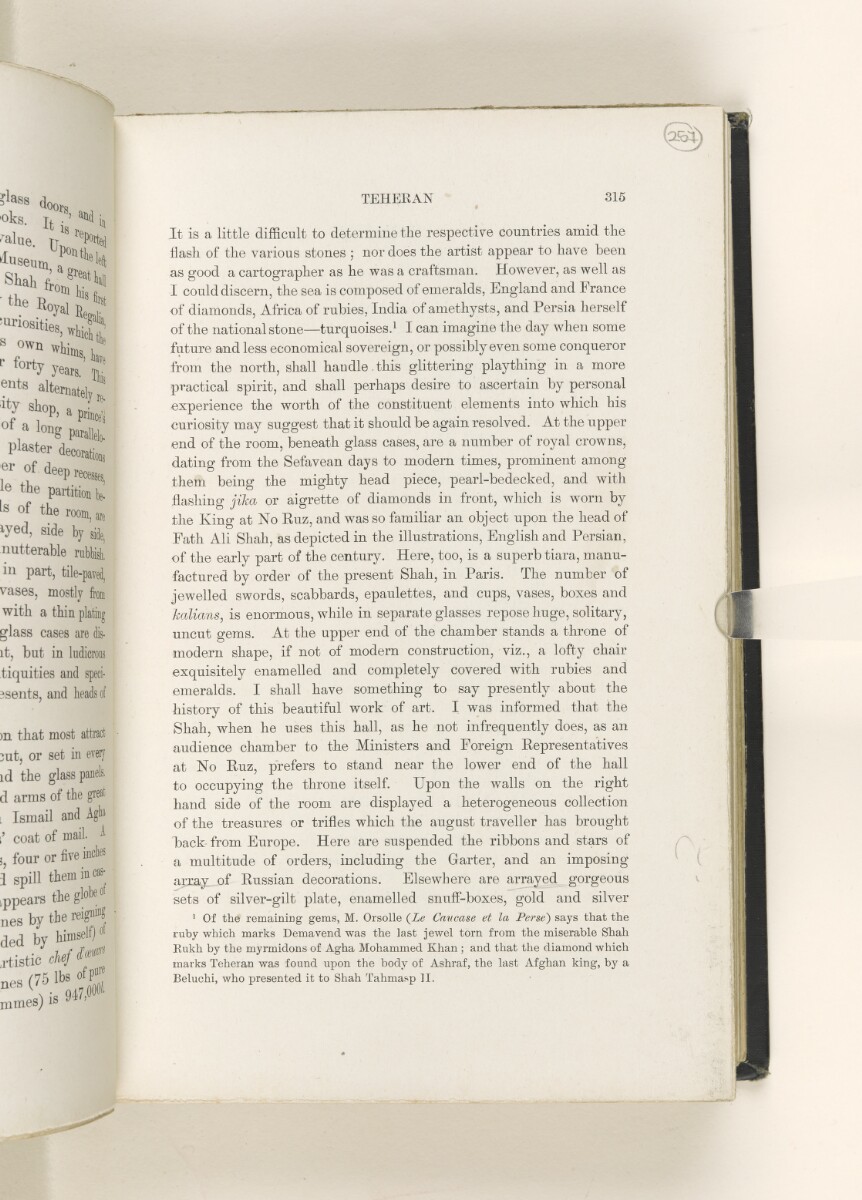
It is a little difficult to determine the respective countries amid the
flash of the various stones ; nor does the artist appear to have been
as good a cartographer as he was a craftsman. However, as well as
I could discern, the sea is composed ot emeralds, England and France
of diamonds, Africa of rubies, India of amethysts, and Persia herself
of the national stone—turquoises. 1 I can imagine the day when some
future and less economical sovereign, or possibly even some conqueror
from the north, shall handle , this glittering plaything in a more
practical spirit, and shall perhaps desire to ascertain by personal
experience the worth of the constituent elements into which his
curiosity may suggest that it should be again resolved. At the upper
end of the room, beneath glass cases, are a number of royal crowns,
dating from the Sefavean days to modern times, prominent among
them being the mighty head piece, pearl-bedecked, and with
flashing jika or aigrette of diamonds in front, which is worn by
the King at No Ruz, and was so familiar an object upon the head of
Path All Shah, as depicted in the illustrations, English and Persian,
of the early part of the century. Here, too, is a superb tiara, manu
factured by order of the present Shah, in Paris. The number of
jewelled swords, scabbards, epaulettes, and cups, Versos* ctud
kalians, is enormous, while in separate glasses repose huge, solitary,
uncut gems. At the upper end of the chamber stands a throne of
modern shape, if not of modern construction, viz., a lofty chair
exquisitely enamelled and completely covered with rubies and
emeralds. I shall have something to say presently about the
history of this beautiful work of art. I was informed that the
Shah, when he uses this hall, as he not infrequently does, as an
audience chamber to the Ministers and Foreign Representatives
at No Ruz, prefers to stand near the lower end of the hall
to occupying the throne itself. Upon the walls on the right
hand side of the room are displayed a heterogeneous collection
of the treasures or trifles which the august traveller has brought
back from Europe. Here are suspended the ribbons and stars of
a multitude of orders, including the Garter, and an imposing
array of Russian decorations. Elsewhere are arrayed gorgeous
sets of silver-gilt plate, enamelled snuff-boxes, gold and silver
1 Of the remaining gems, M. Orsolle {Le Can case et la Perse) says that the
ruby which marks Demavend was the last jewel torn from the miserable Shah
Rukh by the myrmidons of Agha Mohammed Khan ; and that the diamond which
marks Teheran was found upon the body of Ashraf, the last Afghan king, by a
Beluchi, who presented it to Shah Tahmasp II.
About this item
- Content
These two volumes are George Curzon's own personal annotated copies of both volumes of his book Persia and the Persian Question , which was published in 1892. Alongside the volumes are various loose papers relating to Persia [Iran], consisting of the following: received correspondence; newspaper cuttings; publishers' press releases; cuttings from various booksellers' catalogues; various journal and magazine articles; two items of printed official British correspondence; several prints of photographs and sketches; and a few handwritten notes by Curzon.
In most cases these papers, which range in date from 1892 to 1924, relate to the chapters in the book where they were originally inserted, suggesting that they were kept by Curzon with the intention of using them to inform a revised edition of the book.
Of particular note among the small amount of correspondence are two letters received by Curzon in 1914 and 1915 from retired schoolmaster and Islamic scholar Sayyid Mazhar Hasan Musawi of Saharanpur, Uttar Pradesh, India (ff 5-9 and ff 44-53). These letters, which are written in Urdu and are accompanied by English translations, discuss in detail several inaccuracies found in the Urdu version of Persia and the Persian Question .
The various prints of photographs and sketches, which were originally inserted into volume two, are of different locations in the Gulf region. Several of these appear to have been produced in preparation for the publication of the second volume of John Gordon Lorimer's Gazetteer of the Persian Gulf The historical term used to describe the body of water between the Arabian Peninsula and Iran. , Oman and Central Arabia (i.e. the 'Geographical and Statistical' section) in 1908, as they are identical to the versions found in that volume.
Also of note among the loose papers are an illustrated article from Country Life dated 5 June 1920, entitled 'The People of Persia' (ff 36-37), and a printed family tree of the Shah of Persia [Aḥmad Shah Qājār], produced in preparation of his visit to Britain in 1919 (f 233).
Volume one of Persia and the Persian Question contains a map of Persia, Afghanistan and Beluchistan [Balochistan], which is folded inside the front cover (f 1).
The German language material consists of a publisher's press release for two books authored by German archaeologist Ernst Emil Herzfeld (ff 29-30).
- Extent and format
- 2 volumes with inserts (898 folios)
- Physical characteristics
Foliation: this shelfmark consists of two physical volumes. The foliation sequence commences at the first folio of volume one (1-463), and terminates at the last folio of volume two (ff 464-898); these numbers are written in pencil, are circled, and are located in the top right corner of the recto The front of a sheet of paper or leaf, often abbreviated to 'r'. side of each folio. Each volume contains a large number of loose leaves, which have been foliated in the order that they were inserted into the volume; for conservation reasons, these loose folios have been removed from the volume and stored separately. The foliation sequence does not include the front and back covers of the two volumes.
Pagination: the file also contains an original printed pagination sequence.
- Written in
- English, Urdu and German in Latin and Arabic script View the complete information for this record
Use and share this item
- Share this item
Annotated Copy of Persia and the Persian Question by George Curzon, with Inserted Papers [257r] (516/1814), British Library: India Office Records and Private Papers, Mss Eur F111/33, in Qatar Digital Library <https://www.qdl.qa/archive/81055/vdc_100157213844.0x00007b> [accessed 27 August 2026]
https://www.qdl.qa/en/archive/81055/vdc_100157213844.0x00007b
Copy and paste the code below into your web page where you would like to embed the image.
<meta charset="utf-8"><a href="https://www.qdl.qa/en/archive/81055/vdc_100157213844.0x00007b">Annotated Copy of <em>Persia and the Persian Question</em> by George Curzon, with Inserted Papers [‎257r] (516/1814)</a> <a href="https://www.qdl.qa/en/archive/81055/vdc_100157213844.0x00007b"> <img src="https://iiif.qdl.qa/iiif/images/81055/vdc_100000001491.0x00033b/Mss Eur F111_33_0527.jp2/full/!280,240/0/default.jpg" alt="" /> </a>
This record has a IIIF manifest available as follows. If you have a compatible viewer you can drag the icon to load it.https://www.qdl.qa/en/iiif/81055/vdc_100000001491.0x00033b/manifestOpen in Universal viewerOpen in Mirador viewerMore options for embedding images
Copyright: How to use this content
- Reference
- Mss Eur F111/33
- Title
- Annotated Copy of Persia and the Persian Questionby George Curzon, with Inserted Papers
- Pages
- 54r:135v, 147r:149v, 158r:180v, 183r:221v, 224r:224v, 227r:246v, 248r:257v, 259r:260v, 268r:362v, 364r:364v, 367r:388v, 390r:400v, 402r:416v, 419r:432v, 434r:444v, 448r:462v, 464r:471v, 475r:481v, 483r:513v, 516r:525v, 527r:544v, 546r:563v, 566r:598v, 600r:622v, 624r:656v, 658r:665v, 667r:675v, 678r:684v, 687r:688v, 691r:691v, 693r:693v, 695r:708v, 711r:721v, 724r:726v, 728r:729v, 731r:736v, 742r:742v, 746r:757v, 759r:761v, 763r:763v, 765r:765v, 772r:777v, 780r:789v, 793r:794v, 797r:809v, 811r:821v, 825r:840v, 843r:898v
- Author
- Curzon, George Nathaniel, 1st Marquess Curzon of Kedleston
- Usage terms
- Public Domain