
![Annotated Copy of <em>Persia and the Persian Question</em> by George Curzon, with Inserted Papers [‎251v] (505/1814)](https://iiif.qdl.qa/iiif/images/81055/vdc_100000001491.0x00033b/Mss Eur F111_33_0516.jp2/full/!1200,1200/0/default.jpg "Annotated Copy of <em>Persia and the Persian Question</em> by George Curzon, with Inserted Papers [‎251v] (505/1814)")
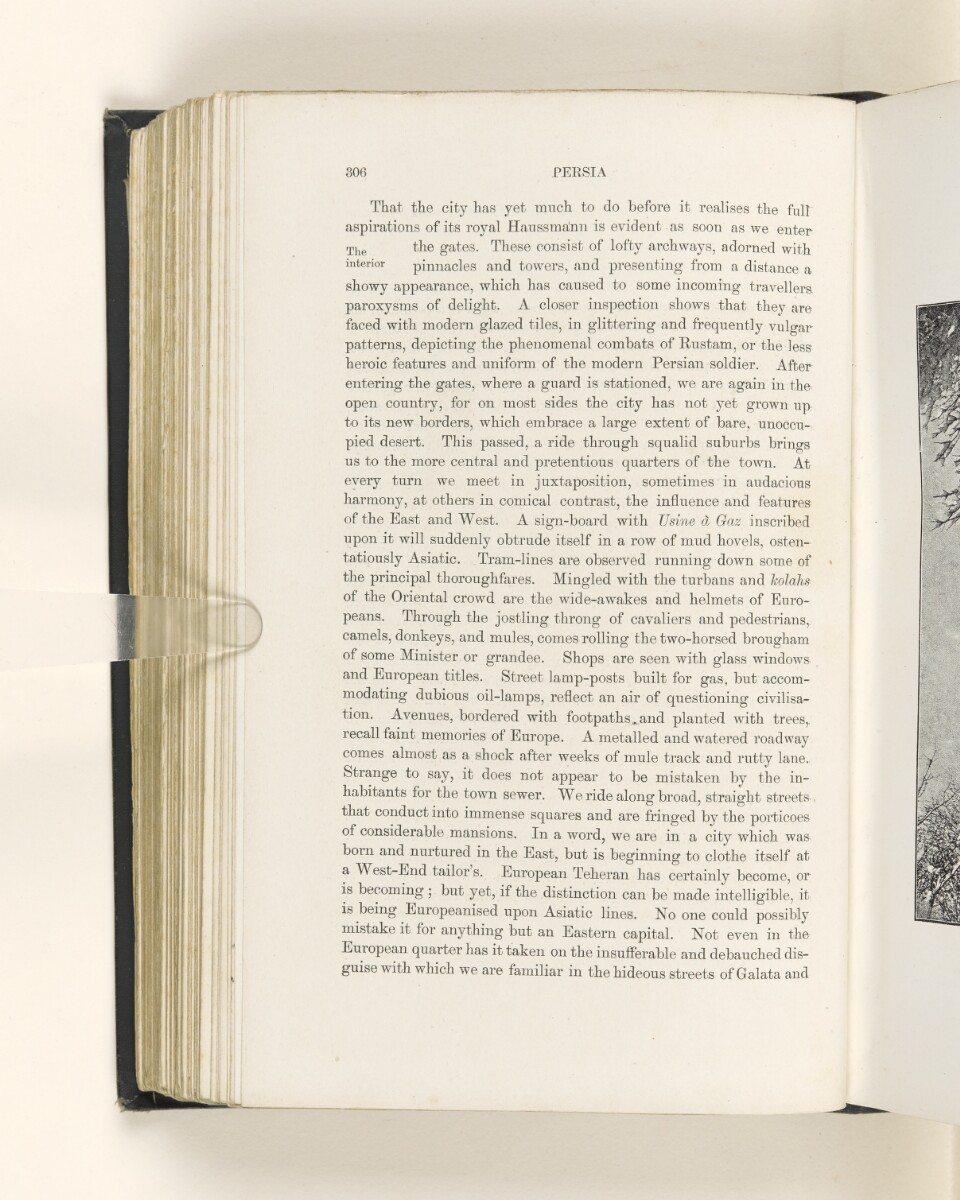
Annotated Copy of Persia and the Persian Question by George Curzon, with Inserted Papers [251v] (505/1814)
The record is made up of 2 volumes with inserts (898 folios). It was created in 1892-1924. It was written in English, Urdu and German. The original is part of the British Library: India Office The department of the British Government to which the Government of India reported between 1858 and 1947. The successor to the Court of Directors. Records and Private Papers Documents collected in a private capacity. .
Transcription
This transcription is created automatically. It may contain errors.
PERSIA
306
That the city has yet much to do before it realises the full
aspirations of its royal Haussmalnn is evident as soon as we enter
The the gates. These consist of lofty archways, adorned with
interior pinnacles and towers, and presenting from a distance a
showy appearance, which has caused to some incoming travellers
paroxysms of delight. A closer inspection shows that they are
faced with modern glazed tiles, in glittering and frequently vulgar
patterns, depicting the phenomenal combats of Rustam, or the less
heroic features and uniform of the modern Persian soldier. After
entering the gates, where a guard is stationed, we are again in the
open country, for on most sides the city has not yet grown up
to its new borders, which embrace a large extent of bare, unoccu
pied desert. This passed, a ride through squalid suburbs brings
us to the more central and pretentious quarters of the town. At
every turn we meet in juxtaposition, sometimes in audacious
harmony, at others in comical contrast, the influence and features
of the East and West. A sign-board with TJsine d Gaz inscribed
upon it will suddenly obtrude itself in a row of mud hovels, osten
tatiously Asiatic. Tram-lines are observed running down some of
the principal thoroughfares. Mingled with the turbans and holahs
of the Oriental crowd are the wide-awmkes and helmets of Euro
peans. Through the jostling throng of cavaliers and pedestrians,
camels, donkeys, and mules, comes rolling the two-horsed brougham
of some Minister or grandee. Shops are seen with glass windows
and European titles. Street lamp-posts built for gas, but accom
modating dubious oil-lamps, reflect an air of questioning civilisa
tion. Avenues, bordered with footpaths^and planted with trees,
recall faint memories of Europe. A metalled and watered roadway
comes almost as a shock after weeks of mule track and rutty lane.
Strange to say, it does not appear to be mistaken by the in
habitants for the town sewer. We ride along broad, straight streets
that conduct into immense squares and are fringed by the porticoes
of considerable mansions. In a word, we are in a city which was
bom and nurtured in the East, but is beginning to clothe itself at
a West-End tailor s. European Teheran has certainly become, or
is becoming; but yet, if the distinction can be made intelligible, it
is being Europeanised upon Asiatic lines. No one could possibly
mistake it for anything but an Eastern capital. Not even in the
European quarter has it taken on the insufferable and debauched dis
guise with which we are familiar in the hideous streets of Galata and
About this item
- Content
These two volumes are George Curzon's own personal annotated copies of both volumes of his book Persia and the Persian Question , which was published in 1892. Alongside the volumes are various loose papers relating to Persia [Iran], consisting of the following: received correspondence; newspaper cuttings; publishers' press releases; cuttings from various booksellers' catalogues; various journal and magazine articles; two items of printed official British correspondence; several prints of photographs and sketches; and a few handwritten notes by Curzon.
In most cases these papers, which range in date from 1892 to 1924, relate to the chapters in the book where they were originally inserted, suggesting that they were kept by Curzon with the intention of using them to inform a revised edition of the book.
Of particular note among the small amount of correspondence are two letters received by Curzon in 1914 and 1915 from retired schoolmaster and Islamic scholar Sayyid Mazhar Hasan Musawi of Saharanpur, Uttar Pradesh, India (ff 5-9 and ff 44-53). These letters, which are written in Urdu and are accompanied by English translations, discuss in detail several inaccuracies found in the Urdu version of Persia and the Persian Question .
The various prints of photographs and sketches, which were originally inserted into volume two, are of different locations in the Gulf region. Several of these appear to have been produced in preparation for the publication of the second volume of John Gordon Lorimer's Gazetteer of the Persian Gulf The historical term used to describe the body of water between the Arabian Peninsula and Iran. , Oman and Central Arabia (i.e. the 'Geographical and Statistical' section) in 1908, as they are identical to the versions found in that volume.
Also of note among the loose papers are an illustrated article from Country Life dated 5 June 1920, entitled 'The People of Persia' (ff 36-37), and a printed family tree of the Shah of Persia [Aḥmad Shah Qājār], produced in preparation of his visit to Britain in 1919 (f 233).
Volume one of Persia and the Persian Question contains a map of Persia, Afghanistan and Beluchistan [Balochistan], which is folded inside the front cover (f 1).
The German language material consists of a publisher's press release for two books authored by German archaeologist Ernst Emil Herzfeld (ff 29-30).
- Extent and format
- 2 volumes with inserts (898 folios)
- Physical characteristics
Foliation: this shelfmark consists of two physical volumes. The foliation sequence commences at the first folio of volume one (1-463), and terminates at the last folio of volume two (ff 464-898); these numbers are written in pencil, are circled, and are located in the top right corner of the recto The front of a sheet of paper or leaf, often abbreviated to 'r'. side of each folio. Each volume contains a large number of loose leaves, which have been foliated in the order that they were inserted into the volume; for conservation reasons, these loose folios have been removed from the volume and stored separately. The foliation sequence does not include the front and back covers of the two volumes.
Pagination: the file also contains an original printed pagination sequence.
- Written in
- English, Urdu and German in Latin and Arabic script View the complete information for this record
Use and share this item
- Share this item
Annotated Copy of Persia and the Persian Question by George Curzon, with Inserted Papers [251v] (505/1814), British Library: India Office Records and Private Papers, Mss Eur F111/33, in Qatar Digital Library <https://www.qdl.qa/archive/81055/vdc_100157213844.0x000070> [accessed 25 July 2026]
https://www.qdl.qa/en/archive/81055/vdc_100157213844.0x000070
Copy and paste the code below into your web page where you would like to embed the image.
<meta charset="utf-8"><a href="https://www.qdl.qa/en/archive/81055/vdc_100157213844.0x000070">Annotated Copy of <em>Persia and the Persian Question</em> by George Curzon, with Inserted Papers [‎251v] (505/1814)</a> <a href="https://www.qdl.qa/en/archive/81055/vdc_100157213844.0x000070"> <img src="https://iiif.qdl.qa/iiif/images/81055/vdc_100000001491.0x00033b/Mss Eur F111_33_0516.jp2/full/!280,240/0/default.jpg" alt="" /> </a>
This record has a IIIF manifest available as follows. If you have a compatible viewer you can drag the icon to load it.https://www.qdl.qa/en/iiif/81055/vdc_100000001491.0x00033b/manifestOpen in Universal viewerOpen in Mirador viewerMore options for embedding images
Copyright: How to use this content
- Reference
- Mss Eur F111/33
- Title
- Annotated Copy of Persia and the Persian Questionby George Curzon, with Inserted Papers
- Pages
- 54r:135v, 147r:149v, 158r:180v, 183r:221v, 224r:224v, 227r:246v, 248r:257v, 259r:260v, 268r:362v, 364r:364v, 367r:388v, 390r:400v, 402r:416v, 419r:432v, 434r:444v, 448r:462v, 464r:471v, 475r:481v, 483r:513v, 516r:525v, 527r:544v, 546r:563v, 566r:598v, 600r:622v, 624r:656v, 658r:665v, 667r:675v, 678r:684v, 687r:688v, 691r:691v, 693r:693v, 695r:708v, 711r:721v, 724r:726v, 728r:729v, 731r:736v, 742r:742v, 746r:757v, 759r:761v, 763r:763v, 765r:765v, 772r:777v, 780r:789v, 793r:794v, 797r:809v, 811r:821v, 825r:840v, 843r:898v
- Author
- Curzon, George Nathaniel, 1st Marquess Curzon of Kedleston
- Usage terms
- Public Domain