
![Annotated Copy of <em>Persia and the Persian Question</em> by George Curzon, with Inserted Papers [‎235v] (473/1814)](https://iiif.qdl.qa/iiif/images/81055/vdc_100000001491.0x00033b/Mss Eur F111_33_0484.jp2/full/!1200,1200/0/default.jpg "Annotated Copy of <em>Persia and the Persian Question</em> by George Curzon, with Inserted Papers [‎235v] (473/1814)")
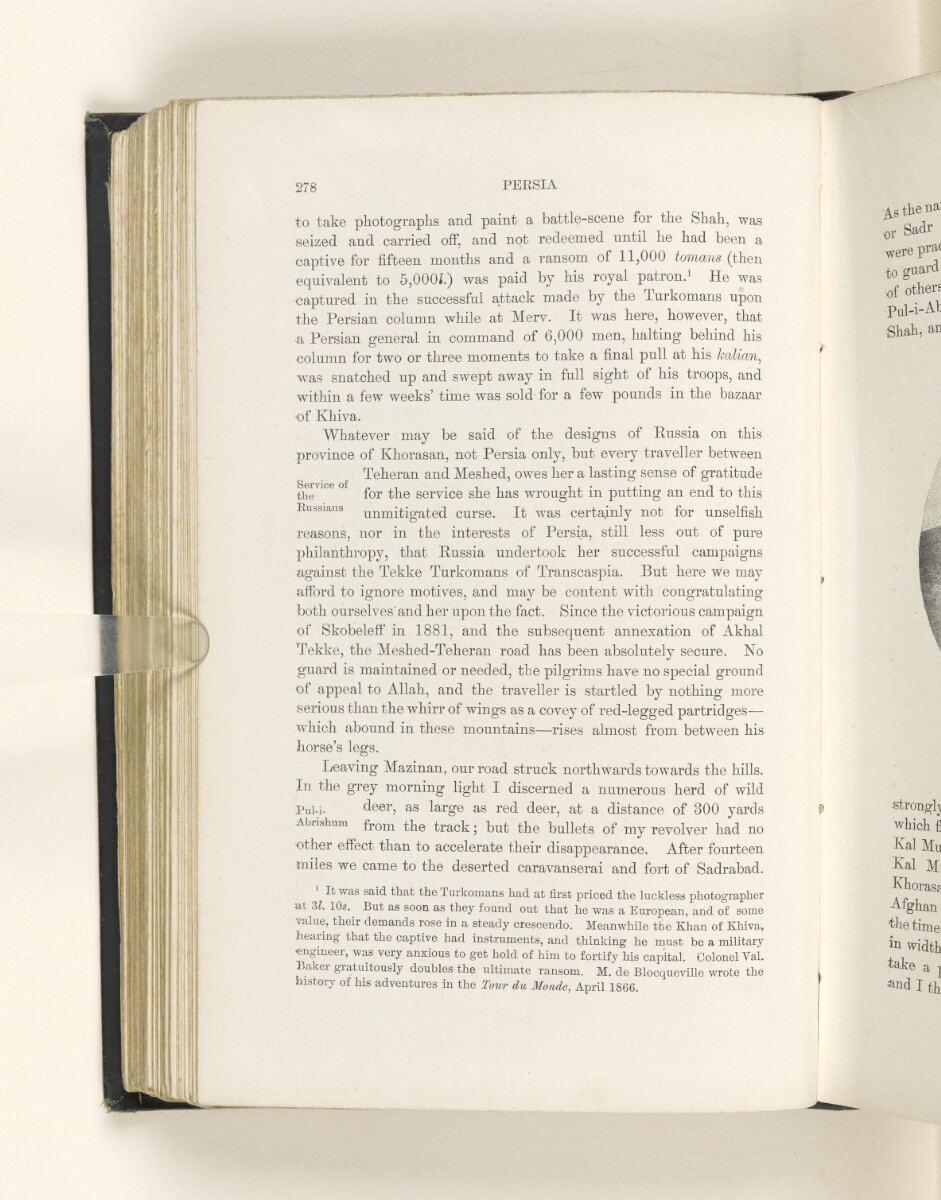
Annotated Copy of Persia and the Persian Question by George Curzon, with Inserted Papers [235v] (473/1814)
The record is made up of 2 volumes with inserts (898 folios). It was created in 1892-1924. It was written in English, Urdu and German. The original is part of the British Library: India Office The department of the British Government to which the Government of India reported between 1858 and 1947. The successor to the Court of Directors. Records and Private Papers Documents collected in a private capacity. .
Transcription
This transcription is created automatically. It may contain errors.
278
PERSIA
to take photographs and paint a battle-scene for the Shah, was
seized and carried off, and not redeemed nntil he had been a
captive for fifteen months and a ransom of 11,000
tomans
10,000 Persian dinars, or a gold coin of that value.
(then
equivalent to 5,000k) was paid by his royal patron. 1 He was
captured in the successful attack made by the Turkomans upon
the Persian column while at Merv. It was here, however, that
a Persian general in command of 6,000 men, halting behind his
column for two or three moments to take a final pull at his kalian^
was snatched up and swept away in full sight of his troops, and
within a few weeks’ time was sold for a few pounds in the bazaar
•of Khiva.
Whatever may be said of the designs of Russia on this
province of Khorasan, not Persia only, but every traveller between
Teheran and Meshed, owes her a lasting sense of gratitude
the V1C for the service she has wrought in putting an end to this
Russians unm itigated curse. It was certainly not for unselfish
reasons, nor in the interests of Persia, still less out of pure
philanthropy, that Russia undertook her successful campaigns
against the Tekke Turkomans of Transcaspia. But here we may
afford to ignore motives, and may be content with congratulating
both ourselves'and her upon the fact. Since the victorious campaign
of Skobeleff in 1881, and the subsequent annexation of Akhal
Tekke, the Meshed-Teheran road has been absolutely secure. Ho
guard is maintained or needed, the pilgrims have no special ground
of appeal to Allah, and the traveller is startled by nothing more
serious than the whirr of wings as a covey of red-legged partridges—
which abound in these mountains—rises almost from between his
horse’s legs.
Leaving Mazinan, our road struck northwards towards the hills.
In the grey morning light I discerned a numerous herd of wild
Pui-i- deer, as large as red deer, at a distance of 300 yards
Abribhmn from the track; but the bullets of my revolver had no
other effect than to accelerate their disappearance. After fourteen
miles we came to the deserted
caravanserai
A roadside inn providing accommodation for caravans (groups of travellers).
and fort of Sadrabad.
It was said that the Turkomans had at first priced the luckless photographer
at 31. 10s. But as soon as they found out that he was a European, and of some
v alue> their demands rose in a steady crescendo. Meanwhile the Khan of Khiva,
hearing that the captive had instruments, and thinking he must be a military
•engineer, was very anxious to get hold of him to fortify his capital. Colonel Yah
Baker gratuitously doubles the ultimate ransom. M. de Blocqueville wrote the
history of his adventures in the Tour du Monde, April 1866.
About this item
- Content
These two volumes are George Curzon's own personal annotated copies of both volumes of his book Persia and the Persian Question , which was published in 1892. Alongside the volumes are various loose papers relating to Persia [Iran], consisting of the following: received correspondence; newspaper cuttings; publishers' press releases; cuttings from various booksellers' catalogues; various journal and magazine articles; two items of printed official British correspondence; several prints of photographs and sketches; and a few handwritten notes by Curzon.
In most cases these papers, which range in date from 1892 to 1924, relate to the chapters in the book where they were originally inserted, suggesting that they were kept by Curzon with the intention of using them to inform a revised edition of the book.
Of particular note among the small amount of correspondence are two letters received by Curzon in 1914 and 1915 from retired schoolmaster and Islamic scholar Sayyid Mazhar Hasan Musawi of Saharanpur, Uttar Pradesh, India (ff 5-9 and ff 44-53). These letters, which are written in Urdu and are accompanied by English translations, discuss in detail several inaccuracies found in the Urdu version of Persia and the Persian Question .
The various prints of photographs and sketches, which were originally inserted into volume two, are of different locations in the Gulf region. Several of these appear to have been produced in preparation for the publication of the second volume of John Gordon Lorimer's Gazetteer of the Persian Gulf The historical term used to describe the body of water between the Arabian Peninsula and Iran. , Oman and Central Arabia (i.e. the 'Geographical and Statistical' section) in 1908, as they are identical to the versions found in that volume.
Also of note among the loose papers are an illustrated article from Country Life dated 5 June 1920, entitled 'The People of Persia' (ff 36-37), and a printed family tree of the Shah of Persia [Aḥmad Shah Qājār], produced in preparation of his visit to Britain in 1919 (f 233).
Volume one of Persia and the Persian Question contains a map of Persia, Afghanistan and Beluchistan [Balochistan], which is folded inside the front cover (f 1).
The German language material consists of a publisher's press release for two books authored by German archaeologist Ernst Emil Herzfeld (ff 29-30).
- Extent and format
- 2 volumes with inserts (898 folios)
- Physical characteristics
Foliation: this shelfmark consists of two physical volumes. The foliation sequence commences at the first folio of volume one (1-463), and terminates at the last folio of volume two (ff 464-898); these numbers are written in pencil, are circled, and are located in the top right corner of the recto The front of a sheet of paper or leaf, often abbreviated to 'r'. side of each folio. Each volume contains a large number of loose leaves, which have been foliated in the order that they were inserted into the volume; for conservation reasons, these loose folios have been removed from the volume and stored separately. The foliation sequence does not include the front and back covers of the two volumes.
Pagination: the file also contains an original printed pagination sequence.
- Written in
- English, Urdu and German in Latin and Arabic script View the complete information for this record
Use and share this item
- Share this item
Annotated Copy of Persia and the Persian Question by George Curzon, with Inserted Papers [235v] (473/1814), British Library: India Office Records and Private Papers, Mss Eur F111/33, in Qatar Digital Library <https://www.qdl.qa/archive/81055/vdc_100157213844.0x000050> [accessed 21 July 2026]
https://www.qdl.qa/en/archive/81055/vdc_100157213844.0x000050
Copy and paste the code below into your web page where you would like to embed the image.
<meta charset="utf-8"><a href="https://www.qdl.qa/en/archive/81055/vdc_100157213844.0x000050">Annotated Copy of <em>Persia and the Persian Question</em> by George Curzon, with Inserted Papers [‎235v] (473/1814)</a> <a href="https://www.qdl.qa/en/archive/81055/vdc_100157213844.0x000050"> <img src="https://iiif.qdl.qa/iiif/images/81055/vdc_100000001491.0x00033b/Mss Eur F111_33_0484.jp2/full/!280,240/0/default.jpg" alt="" /> </a>
This record has a IIIF manifest available as follows. If you have a compatible viewer you can drag the icon to load it.https://www.qdl.qa/en/iiif/81055/vdc_100000001491.0x00033b/manifestOpen in Universal viewerOpen in Mirador viewerMore options for embedding images
Copyright: How to use this content
- Reference
- Mss Eur F111/33
- Title
- Annotated Copy of Persia and the Persian Questionby George Curzon, with Inserted Papers
- Pages
- 54r:135v, 147r:149v, 158r:180v, 183r:221v, 224r:224v, 227r:246v, 248r:257v, 259r:260v, 268r:362v, 364r:364v, 367r:388v, 390r:400v, 402r:416v, 419r:432v, 434r:444v, 448r:462v, 464r:471v, 475r:481v, 483r:513v, 516r:525v, 527r:544v, 546r:563v, 566r:598v, 600r:622v, 624r:656v, 658r:665v, 667r:675v, 678r:684v, 687r:688v, 691r:691v, 693r:693v, 695r:708v, 711r:721v, 724r:726v, 728r:729v, 731r:736v, 742r:742v, 746r:757v, 759r:761v, 763r:763v, 765r:765v, 772r:777v, 780r:789v, 793r:794v, 797r:809v, 811r:821v, 825r:840v, 843r:898v
- Author
- Curzon, George Nathaniel, 1st Marquess Curzon of Kedleston
- Usage terms
- Public Domain