
![Annotated Copy of <em>Persia and the Persian Question</em> by George Curzon, with Inserted Papers [‎170r] (342/1814)](https://iiif.qdl.qa/iiif/images/81055/vdc_100000001491.0x00033b/Mss Eur F111_33_0353.jp2/full/!1200,1200/0/default.jpg "Annotated Copy of <em>Persia and the Persian Question</em> by George Curzon, with Inserted Papers [‎170r] (342/1814)")
Annotated Copy of Persia and the Persian Question by George Curzon, with Inserted Papers [170r] (342/1814)
The record is made up of 2 volumes with inserts (898 folios). It was created in 1892-1924. It was written in English, Urdu and German. The original is part of the British Library: India Office The department of the British Government to which the Government of India reported between 1858 and 1947. The successor to the Court of Directors. Records and Private Papers Documents collected in a private capacity. .
Transcription
This transcription is created automatically. It may contain errors.
16 first ti me
dividual,
' cc lesiagtic a }
( ie temporal
•ashi in ( ] f>
hierarchy q|*
Rce-bearers,
rfmujtaheds,
udence, and
' in some
who preach,
extract from
ded as very
>ray, crowds
i they spend
id weeping,
onic spasms
tyrdom both
imemorated.
places were
loured invo-
oise that he
;onage living
freely did I
night listen-
s.
iarallelogram
i mile. The
■/«, or band-
eats of royal
fanfaronade
d life, before
the provision
.after during
[ 0 ng journeys
ve sustained,
] family and
ecdesiastica 1
during tlieir
%
MESHED 205
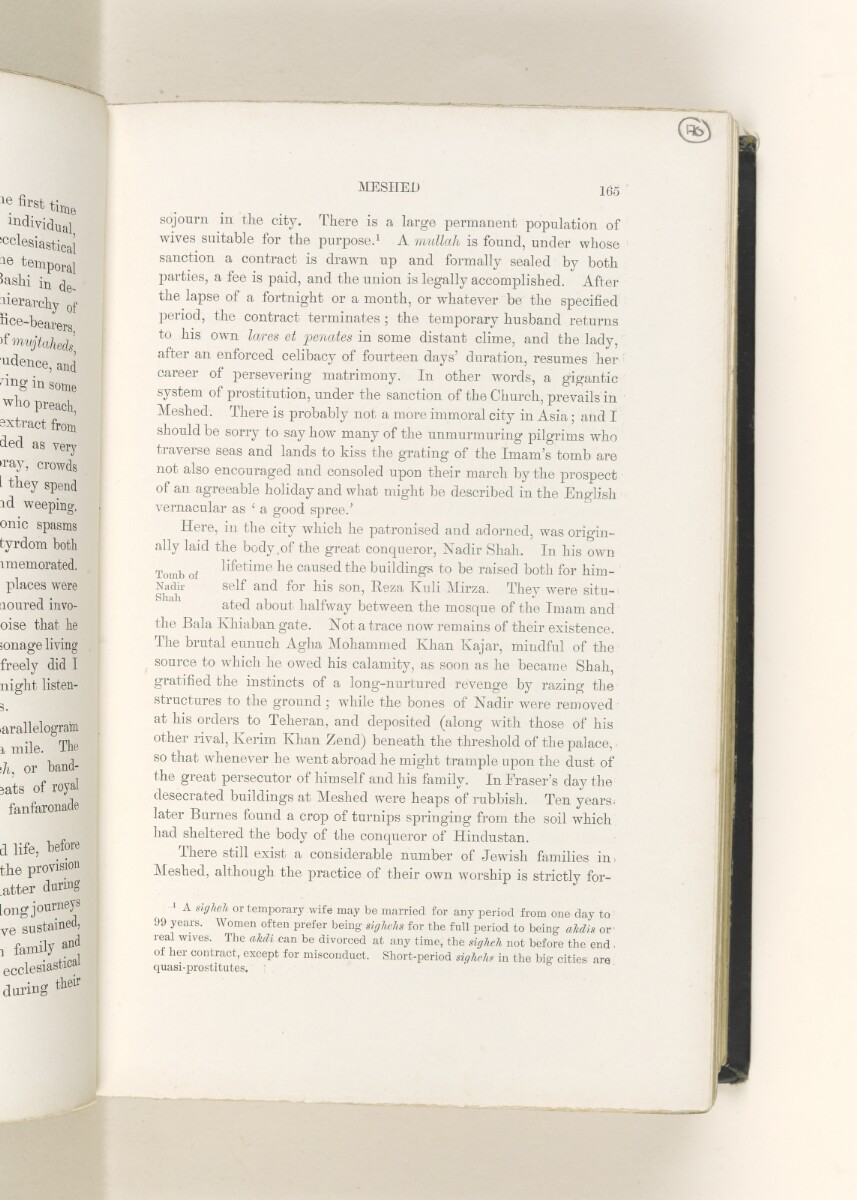
sojourn in the city. There is a large permanent population of
wives suitable for the purpose. 1 A mullah is found, under whose
sanction a contract is drawn up and formally sealed by both
parties, a fee is paid, and the union is legally accomplished. After
the lapse of a fortnight or a month, or whatever be the specified
period, the contract terminates ; the temporary husband returns
to his own lares et jpenates in some distant clime, and the lady,
after an enforced celibacy of fourteen days’ duration, resumes her
career of persevering matrimony. In other words, a gigantic
system of prostitution, under the sanction of the Church, prevails in
Meshed. There is probably not a more immoral city in Asia; and I
should be sorry to say how many of the unmurmuring pilgrims who
traverse seas and lands to kiss the grating of the Imam’s tomb are
not also encouraged and consoled upon their march by the prospect
of an agieeable holiday and what might be described m the English
vernacular as ‘ a good spree/
Here, in the city which he patronised and adorned, was origin
ally laid the body .of the great conqueror, Nadir Shah. In his own
Tomb of 116 caused the buildings to be raised both for him-
Nadir seif and for his son, Heza Ivuli Mirza. They were situ-
Sllctll ^
ated about halfway between the mosque of the Imam and
the Bala Ivhiaban gate. Not a trace now remains of their existence.
The brutal eunuch Agha Mohammed Khan Kajar, mindful of the
source to which he owed his calamity, as soon as he became Shah,
gratified the instincts of a long-nurtured revenge by razing the
structures to the ground * while the bones of Nadir were removed
at his orders to Teheran, and deposited (along with those of his
other rival, Kerim Khan Zend) beneath the threshold of the palace,
so that whenever he went abroad he might trample upon the dust of
the great persecutor of himself and his family. In Fraser’s clay the
desecrated buildings at Meshed were heaps of rubbish. Ten years.
later Burnes found a crop of turnips springing from the soil which
had sheltered the body of the conqueror of Hindustan.
There still exist a considerable number of Jewish families in>
Meshed, although the practice of their own worship is strictly for-
1 A sigheh or temporary wife may be married for any period from one day to
99 years. Women often prefer being sighehs for the full period to being aUis or'
real wives. The ahdi can be divorced at any time, the sigheh not before the end .
of her contract, except for misconduct. Short-period sighehs in the big cities are
quasi-prostitutes.
About this item
- Content
These two volumes are George Curzon's own personal annotated copies of both volumes of his book Persia and the Persian Question , which was published in 1892. Alongside the volumes are various loose papers relating to Persia [Iran], consisting of the following: received correspondence; newspaper cuttings; publishers' press releases; cuttings from various booksellers' catalogues; various journal and magazine articles; two items of printed official British correspondence; several prints of photographs and sketches; and a few handwritten notes by Curzon.
In most cases these papers, which range in date from 1892 to 1924, relate to the chapters in the book where they were originally inserted, suggesting that they were kept by Curzon with the intention of using them to inform a revised edition of the book.
Of particular note among the small amount of correspondence are two letters received by Curzon in 1914 and 1915 from retired schoolmaster and Islamic scholar Sayyid Mazhar Hasan Musawi of Saharanpur, Uttar Pradesh, India (ff 5-9 and ff 44-53). These letters, which are written in Urdu and are accompanied by English translations, discuss in detail several inaccuracies found in the Urdu version of Persia and the Persian Question .
The various prints of photographs and sketches, which were originally inserted into volume two, are of different locations in the Gulf region. Several of these appear to have been produced in preparation for the publication of the second volume of John Gordon Lorimer's Gazetteer of the Persian Gulf The historical term used to describe the body of water between the Arabian Peninsula and Iran. , Oman and Central Arabia (i.e. the 'Geographical and Statistical' section) in 1908, as they are identical to the versions found in that volume.
Also of note among the loose papers are an illustrated article from Country Life dated 5 June 1920, entitled 'The People of Persia' (ff 36-37), and a printed family tree of the Shah of Persia [Aḥmad Shah Qājār], produced in preparation of his visit to Britain in 1919 (f 233).
Volume one of Persia and the Persian Question contains a map of Persia, Afghanistan and Beluchistan [Balochistan], which is folded inside the front cover (f 1).
The German language material consists of a publisher's press release for two books authored by German archaeologist Ernst Emil Herzfeld (ff 29-30).
- Extent and format
- 2 volumes with inserts (898 folios)
- Physical characteristics
Foliation: this shelfmark consists of two physical volumes. The foliation sequence commences at the first folio of volume one (1-463), and terminates at the last folio of volume two (ff 464-898); these numbers are written in pencil, are circled, and are located in the top right corner of the recto The front of a sheet of paper or leaf, often abbreviated to 'r'. side of each folio. Each volume contains a large number of loose leaves, which have been foliated in the order that they were inserted into the volume; for conservation reasons, these loose folios have been removed from the volume and stored separately. The foliation sequence does not include the front and back covers of the two volumes.
Pagination: the file also contains an original printed pagination sequence.
- Written in
- English, Urdu and German in Latin and Arabic script View the complete information for this record
Use and share this item
- Share this item
Annotated Copy of Persia and the Persian Question by George Curzon, with Inserted Papers [170r] (342/1814), British Library: India Office Records and Private Papers, Mss Eur F111/33, in Qatar Digital Library <https://www.qdl.qa/archive/81055/vdc_100157213843.0x000095> [accessed 8 July 2026]
https://www.qdl.qa/en/archive/81055/vdc_100157213843.0x000095
Copy and paste the code below into your web page where you would like to embed the image.
<meta charset="utf-8"><a href="https://www.qdl.qa/en/archive/81055/vdc_100157213843.0x000095">Annotated Copy of <em>Persia and the Persian Question</em> by George Curzon, with Inserted Papers [‎170r] (342/1814)</a> <a href="https://www.qdl.qa/en/archive/81055/vdc_100157213843.0x000095"> <img src="https://iiif.qdl.qa/iiif/images/81055/vdc_100000001491.0x00033b/Mss Eur F111_33_0353.jp2/full/!280,240/0/default.jpg" alt="" /> </a>
This record has a IIIF manifest available as follows. If you have a compatible viewer you can drag the icon to load it.https://www.qdl.qa/en/iiif/81055/vdc_100000001491.0x00033b/manifestOpen in Universal viewerOpen in Mirador viewerMore options for embedding images
Copyright: How to use this content
- Reference
- Mss Eur F111/33
- Title
- Annotated Copy of Persia and the Persian Questionby George Curzon, with Inserted Papers
- Pages
- 54r:135v, 147r:149v, 158r:180v, 183r:221v, 224r:224v, 227r:246v, 248r:257v, 259r:260v, 268r:362v, 364r:364v, 367r:388v, 390r:400v, 402r:416v, 419r:432v, 434r:444v, 448r:462v, 464r:471v, 475r:481v, 483r:513v, 516r:525v, 527r:544v, 546r:563v, 566r:598v, 600r:622v, 624r:656v, 658r:665v, 667r:675v, 678r:684v, 687r:688v, 691r:691v, 693r:693v, 695r:708v, 711r:721v, 724r:726v, 728r:729v, 731r:736v, 742r:742v, 746r:757v, 759r:761v, 763r:763v, 765r:765v, 772r:777v, 780r:789v, 793r:794v, 797r:809v, 811r:821v, 825r:840v, 843r:898v
- Author
- Curzon, George Nathaniel, 1st Marquess Curzon of Kedleston
- Usage terms
- Public Domain