
![Annotated Copy of <em>Persia and the Persian Question</em> by George Curzon, with Inserted Papers [‎155v] (313/1814)](https://iiif.qdl.qa/iiif/images/81055/vdc_100000001491.0x00033b/Mss Eur F111_33_0324.jp2/full/!1200,1200/0/default.jpg "Annotated Copy of <em>Persia and the Persian Question</em> by George Curzon, with Inserted Papers [‎155v] (313/1814)")
Annotated Copy of Persia and the Persian Question by George Curzon, with Inserted Papers [155v] (313/1814)
The record is made up of 2 volumes with inserts (898 folios). It was created in 1892-1924. It was written in English, Urdu and German. The original is part of the British Library: India Office The department of the British Government to which the Government of India reported between 1858 and 1947. The successor to the Court of Directors. Records and Private Papers Documents collected in a private capacity. .
Transcription
This transcription is created automatically. It may contain errors.
164
KALAT-I-NADTBI
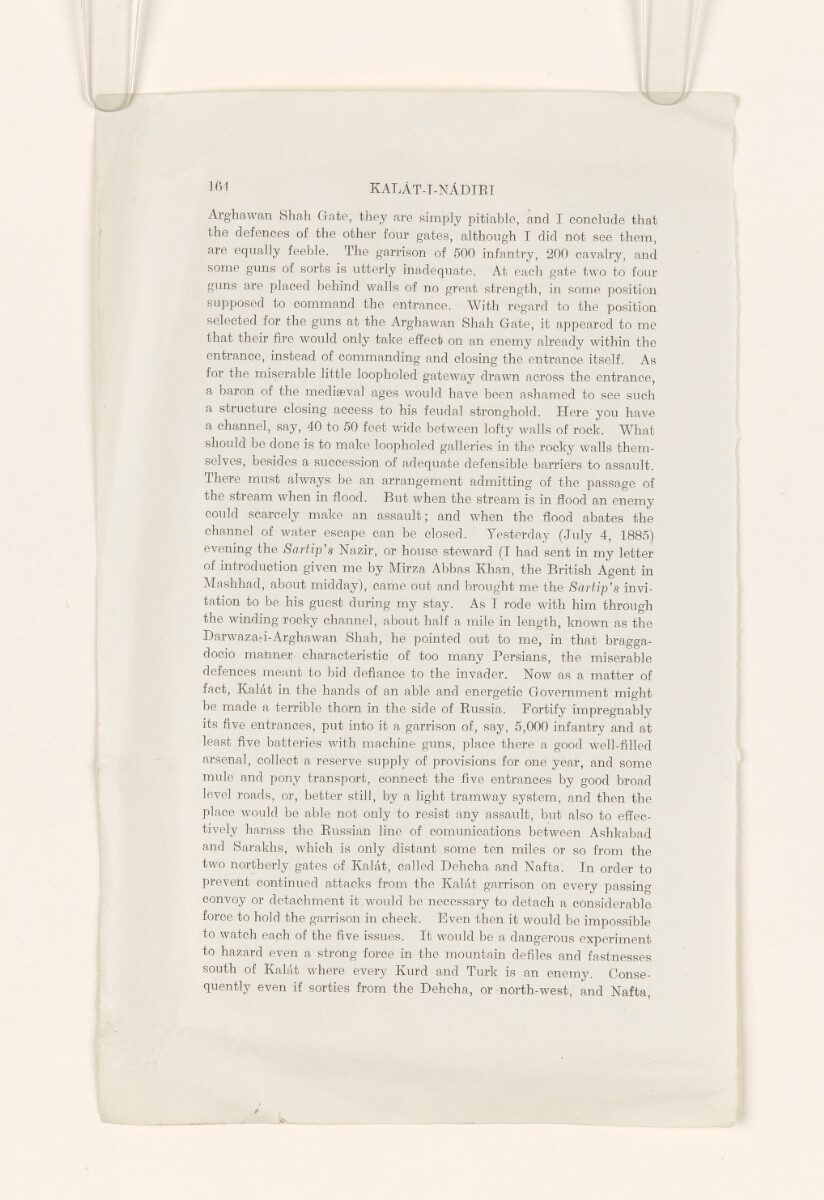
Arghawan Shah Gate, they are simply pitiable, and I conclude that
the defences of the other four gates, although I did not see them,
are equally feeble. The garrison of 500 infantry, 200 cavalry, and
some guns of sorts is utterly inadequate. At each gate two to four
guns are placed behind walls of no great strength, in some position
supposed to command the entrance. With regard to the position
selected for the guns at the Arghawan Shah Gate, it appeared to me
that their fire would only take effect on an enemy already within the
entrance, instead of commanding and closing the entrance itself. As
for the miserable little loopholed gateway drawn across the entrance,
a baron of the mediaeval ages would have been ashamed to see such
a structure closing access to his feudal stronghold. Here you have
a channel, say, 40 to 50 feet wide between lofty walls of rock. What
should be done is to make loopholed galleries in the rocky walls them
selves, besides a succession of adequate defensible barriers to assault.
There must always be an arrangement admitting of the passage of
the stream when in flood. But when the stream is in flood an enemy
could scarcely make an assault; and when the flood abates the
channel of water escape can be closed. Yesterday (July 4, 1885)
evening the Sartip’s Nazir, or house steward (I had sent in my letter
of introduction given me by Mirza Abbas Khan, the British Agent in
Mashhad, about midday), came out and brought me the Sartip’s invi
tation to be his guest during my stay. As I rode with him through
the winding rocky channel, about half a mile in length, known as the
Darwaza-i-Arghawan Shah, he pointed out to me, in that bragga
docio manner characteristic of too many Persians, the miserable
defences meant to bid defiance to the invader. Now as a matter of
fact, Kalat in the hands of an able and energetic Government might
he made a terrible thorn in the side of Russia. Fortify impregnably
its five entrances, put into it a garrison of, say, 5,000 infantry and at
least five batteries with machine guns, place there a good well-filled
arsenal, collect a reserve supply of provisions for one year, and some
mule and pony transport, connect the five entrances by good broad
level roads, or, better still, by a light tramway system, and then the
place would be able not only to resist any assault, but also to effec
tively harass the Russian line of comunications between Ashkabad
and Sarakhs, which is only distant some ten miles or so from the
two northerly gates of Kalat, called Behcha and Nafta. In order to
prevent continued attacks from the Kalat garrison on every passing
convoy or detachment it would be necessary to detach a considerable
force to hold the garrison in check. Even then it would be impossible
to watch each of the five issues. It would be a dangerous experiment
to hazard even a strong force in the mountain defiles and fastnesses
south of Kalat where every Kurd and Turk is an enemy. Conse
quently even if sorties from the Dehcha, or north-west, and Nafta,
About this item
- Content
These two volumes are George Curzon's own personal annotated copies of both volumes of his book Persia and the Persian Question , which was published in 1892. Alongside the volumes are various loose papers relating to Persia [Iran], consisting of the following: received correspondence; newspaper cuttings; publishers' press releases; cuttings from various booksellers' catalogues; various journal and magazine articles; two items of printed official British correspondence; several prints of photographs and sketches; and a few handwritten notes by Curzon.
In most cases these papers, which range in date from 1892 to 1924, relate to the chapters in the book where they were originally inserted, suggesting that they were kept by Curzon with the intention of using them to inform a revised edition of the book.
Of particular note among the small amount of correspondence are two letters received by Curzon in 1914 and 1915 from retired schoolmaster and Islamic scholar Sayyid Mazhar Hasan Musawi of Saharanpur, Uttar Pradesh, India (ff 5-9 and ff 44-53). These letters, which are written in Urdu and are accompanied by English translations, discuss in detail several inaccuracies found in the Urdu version of Persia and the Persian Question .
The various prints of photographs and sketches, which were originally inserted into volume two, are of different locations in the Gulf region. Several of these appear to have been produced in preparation for the publication of the second volume of John Gordon Lorimer's Gazetteer of the Persian Gulf The historical term used to describe the body of water between the Arabian Peninsula and Iran. , Oman and Central Arabia (i.e. the 'Geographical and Statistical' section) in 1908, as they are identical to the versions found in that volume.
Also of note among the loose papers are an illustrated article from Country Life dated 5 June 1920, entitled 'The People of Persia' (ff 36-37), and a printed family tree of the Shah of Persia [Aḥmad Shah Qājār], produced in preparation of his visit to Britain in 1919 (f 233).
Volume one of Persia and the Persian Question contains a map of Persia, Afghanistan and Beluchistan [Balochistan], which is folded inside the front cover (f 1).
The German language material consists of a publisher's press release for two books authored by German archaeologist Ernst Emil Herzfeld (ff 29-30).
- Extent and format
- 2 volumes with inserts (898 folios)
- Physical characteristics
Foliation: this shelfmark consists of two physical volumes. The foliation sequence commences at the first folio of volume one (1-463), and terminates at the last folio of volume two (ff 464-898); these numbers are written in pencil, are circled, and are located in the top right corner of the recto The front of a sheet of paper or leaf, often abbreviated to 'r'. side of each folio. Each volume contains a large number of loose leaves, which have been foliated in the order that they were inserted into the volume; for conservation reasons, these loose folios have been removed from the volume and stored separately. The foliation sequence does not include the front and back covers of the two volumes.
Pagination: the file also contains an original printed pagination sequence.
- Written in
- English, Urdu and German in Latin and Arabic script View the complete information for this record
Use and share this item
- Share this item
Annotated Copy of Persia and the Persian Question by George Curzon, with Inserted Papers [155v] (313/1814), British Library: India Office Records and Private Papers, Mss Eur F111/33, in Qatar Digital Library <https://www.qdl.qa/archive/81055/vdc_100157213843.0x000078> [accessed 30 June 2026]
https://www.qdl.qa/en/archive/81055/vdc_100157213843.0x000078
Copy and paste the code below into your web page where you would like to embed the image.
<meta charset="utf-8"><a href="https://www.qdl.qa/en/archive/81055/vdc_100157213843.0x000078">Annotated Copy of <em>Persia and the Persian Question</em> by George Curzon, with Inserted Papers [‎155v] (313/1814)</a> <a href="https://www.qdl.qa/en/archive/81055/vdc_100157213843.0x000078"> <img src="https://iiif.qdl.qa/iiif/images/81055/vdc_100000001491.0x00033b/Mss Eur F111_33_0324.jp2/full/!280,240/0/default.jpg" alt="" /> </a>
This record has a IIIF manifest available as follows. If you have a compatible viewer you can drag the icon to load it.https://www.qdl.qa/en/iiif/81055/vdc_100000001491.0x00033b/manifestOpen in Universal viewerOpen in Mirador viewerMore options for embedding images
Copyright: How to use this content
- Reference
- Mss Eur F111/33
- Title
- Annotated Copy of Persia and the Persian Questionby George Curzon, with Inserted Papers
- Pages
- 151r:157v
- Author
- Yate, Arthur Campbell
- Usage terms
- Public Domain