
![Annotated Copy of <em>Persia and the Persian Question</em> by George Curzon, with Inserted Papers [‎149v] (301/1814)](https://iiif.qdl.qa/iiif/images/81055/vdc_100000001491.0x00033b/Mss Eur F111_33_0312.jp2/full/!1200,1200/0/default.jpg "Annotated Copy of <em>Persia and the Persian Question</em> by George Curzon, with Inserted Papers [‎149v] (301/1814)")
Annotated Copy of Persia and the Persian Question by George Curzon, with Inserted Papers [149v] (301/1814)
The record is made up of 2 volumes with inserts (898 folios). It was created in 1892-1924. It was written in English, Urdu and German. The original is part of the British Library: India Office The department of the British Government to which the Government of India reported between 1858 and 1947. The successor to the Court of Directors. Records and Private Papers Documents collected in a private capacity. .
Transcription
This transcription is created automatically. It may contain errors.
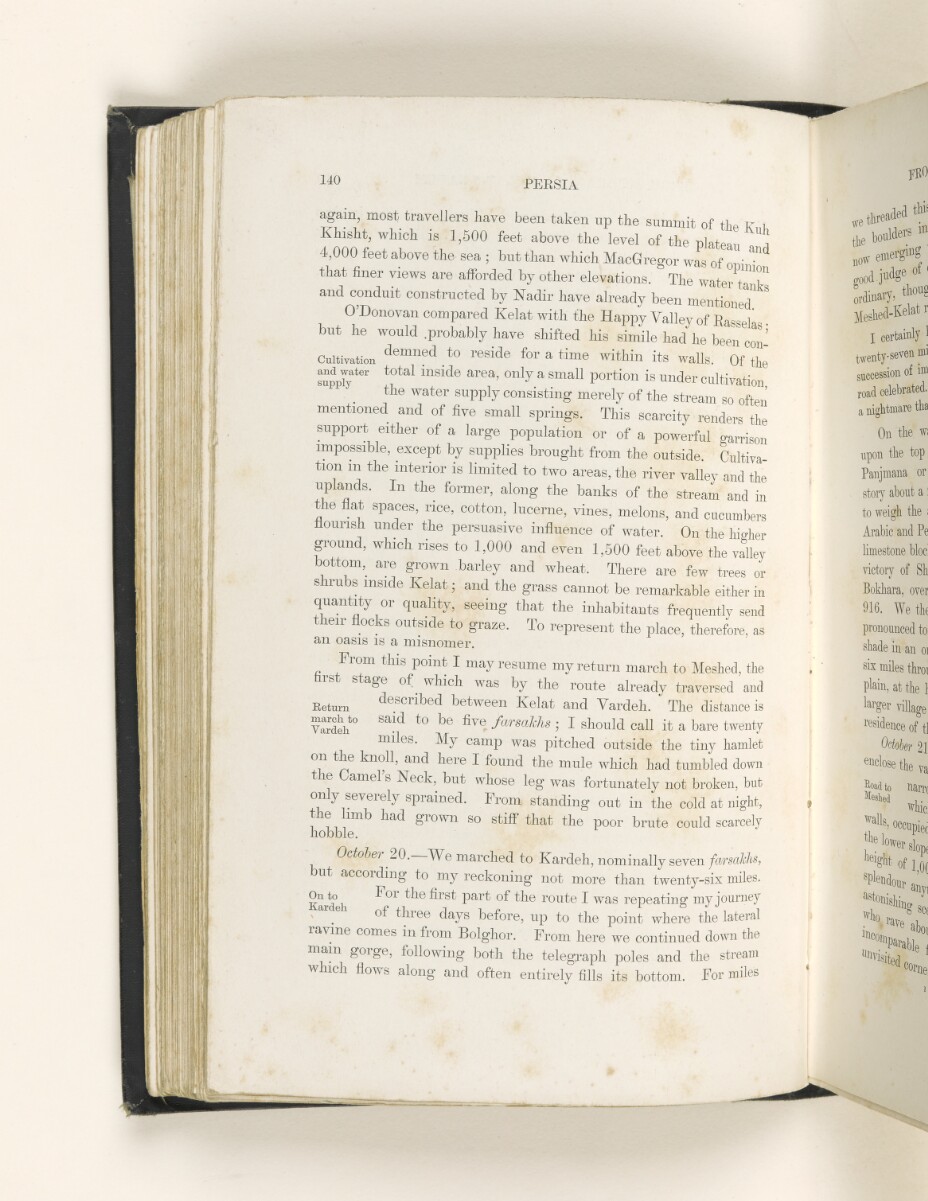
140
PERSIA
again, most travellers have been taken up the summit of the K
Khisht, which is 1,500 feet above the level of the nlntenn " !
4,000 feet above the sea ; but than which MacGregor was of oni
that finer views are afforded by other elevations. The water ta T
and conduit constructed by Nadir have already been mentioned'^
O’Donovan compared Kelat with the Happy Valley of Rasselv
but he would .probably have shifted his simile had he been con-
Cuitivation demned to resl( 3 e for a time within its walls. Of the
"upp 7 y ater t0tal mside area ’ onl y a sma11 P or tion is under cultivation
. the water consisting merely of the stream so often
mentioned and of five small springs. This scarcity renders the
support either of a large population or of a powerful garrison
impossible, except by supplies brought from the outside. Cultiva
tion m the interior is limited to two areas, the river valley and the
uplands. In the former, along the banks of the stream and in
the flat spaces, rice, cotton lucerne, vines, melons, and cucumbers
ounsh under the persuasive influence of water. On the higher
ground, which rises to 1,000 and even 1,500 feet above the valley
bottom, are grown barley and wheat. There are few trees or
shrubs inside Kelat; and the grass cannot be remarkable either in
quantity or quality, seeing that the inhabitants frequently send
their flocks outside to graze. To represent the place, therefore, as
an oasis is a misnomer.
From this point I may resume my return march to Meshed, the
stage of which was by the route already traversed and
Return <“ibed between Kelat and Vardeh. The distance is
Vardeh* 0 SMd t0 be five f arsah ^ ; I should call it a bare twenty
miles. My camp was pitched outside the tiny hamlet
on the knoll, and here I found the mule which had tumbled down
the Gamers Neck, but whose leg was fortunately not broken, but
on y severely sprained. From standing out in the cold at night,
t e imb had giown so stiff that the poor brute could scarcely
hobble.
October 20. 4 Ve marched to Kardeh, nominally seven farsakhs,
but according to my reckoning not more than twenty-six miles.
Kardei ^' 01 the first part of the route I was repeating my journey
of three days before, up to the point where the lateral
ravine comes in from Bolghor. From here we continued down the
main goige, following both the telegraph pules and the stream
which flows along and often entirely fills its bottom. For miles
About this item
- Content
These two volumes are George Curzon's own personal annotated copies of both volumes of his book Persia and the Persian Question , which was published in 1892. Alongside the volumes are various loose papers relating to Persia [Iran], consisting of the following: received correspondence; newspaper cuttings; publishers' press releases; cuttings from various booksellers' catalogues; various journal and magazine articles; two items of printed official British correspondence; several prints of photographs and sketches; and a few handwritten notes by Curzon.
In most cases these papers, which range in date from 1892 to 1924, relate to the chapters in the book where they were originally inserted, suggesting that they were kept by Curzon with the intention of using them to inform a revised edition of the book.
Of particular note among the small amount of correspondence are two letters received by Curzon in 1914 and 1915 from retired schoolmaster and Islamic scholar Sayyid Mazhar Hasan Musawi of Saharanpur, Uttar Pradesh, India (ff 5-9 and ff 44-53). These letters, which are written in Urdu and are accompanied by English translations, discuss in detail several inaccuracies found in the Urdu version of Persia and the Persian Question .
The various prints of photographs and sketches, which were originally inserted into volume two, are of different locations in the Gulf region. Several of these appear to have been produced in preparation for the publication of the second volume of John Gordon Lorimer's Gazetteer of the Persian Gulf The historical term used to describe the body of water between the Arabian Peninsula and Iran. , Oman and Central Arabia (i.e. the 'Geographical and Statistical' section) in 1908, as they are identical to the versions found in that volume.
Also of note among the loose papers are an illustrated article from Country Life dated 5 June 1920, entitled 'The People of Persia' (ff 36-37), and a printed family tree of the Shah of Persia [Aḥmad Shah Qājār], produced in preparation of his visit to Britain in 1919 (f 233).
Volume one of Persia and the Persian Question contains a map of Persia, Afghanistan and Beluchistan [Balochistan], which is folded inside the front cover (f 1).
The German language material consists of a publisher's press release for two books authored by German archaeologist Ernst Emil Herzfeld (ff 29-30).
- Extent and format
- 2 volumes with inserts (898 folios)
- Physical characteristics
Foliation: this shelfmark consists of two physical volumes. The foliation sequence commences at the first folio of volume one (1-463), and terminates at the last folio of volume two (ff 464-898); these numbers are written in pencil, are circled, and are located in the top right corner of the recto The front of a sheet of paper or leaf, often abbreviated to 'r'. side of each folio. Each volume contains a large number of loose leaves, which have been foliated in the order that they were inserted into the volume; for conservation reasons, these loose folios have been removed from the volume and stored separately. The foliation sequence does not include the front and back covers of the two volumes.
Pagination: the file also contains an original printed pagination sequence.
- Written in
- English, Urdu and German in Latin and Arabic script View the complete information for this record
Use and share this item
- Share this item
Annotated Copy of Persia and the Persian Question by George Curzon, with Inserted Papers [149v] (301/1814), British Library: India Office Records and Private Papers, Mss Eur F111/33, in Qatar Digital Library <https://www.qdl.qa/archive/81055/vdc_100157213843.0x00006c> [accessed 13 August 2026]
https://www.qdl.qa/en/archive/81055/vdc_100157213843.0x00006c
Copy and paste the code below into your web page where you would like to embed the image.
<meta charset="utf-8"><a href="https://www.qdl.qa/en/archive/81055/vdc_100157213843.0x00006c">Annotated Copy of <em>Persia and the Persian Question</em> by George Curzon, with Inserted Papers [‎149v] (301/1814)</a> <a href="https://www.qdl.qa/en/archive/81055/vdc_100157213843.0x00006c"> <img src="https://iiif.qdl.qa/iiif/images/81055/vdc_100000001491.0x00033b/Mss Eur F111_33_0312.jp2/full/!280,240/0/default.jpg" alt="" /> </a>
This record has a IIIF manifest available as follows. If you have a compatible viewer you can drag the icon to load it.https://www.qdl.qa/en/iiif/81055/vdc_100000001491.0x00033b/manifestOpen in Universal viewerOpen in Mirador viewerMore options for embedding images
Copyright: How to use this content
- Reference
- Mss Eur F111/33
- Title
- Annotated Copy of Persia and the Persian Questionby George Curzon, with Inserted Papers
- Pages
- 54r:135v, 147r:149v, 158r:180v, 183r:221v, 224r:224v, 227r:246v, 248r:257v, 259r:260v, 268r:362v, 364r:364v, 367r:388v, 390r:400v, 402r:416v, 419r:432v, 434r:444v, 448r:462v, 464r:471v, 475r:481v, 483r:513v, 516r:525v, 527r:544v, 546r:563v, 566r:598v, 600r:622v, 624r:656v, 658r:665v, 667r:675v, 678r:684v, 687r:688v, 691r:691v, 693r:693v, 695r:708v, 711r:721v, 724r:726v, 728r:729v, 731r:736v, 742r:742v, 746r:757v, 759r:761v, 763r:763v, 765r:765v, 772r:777v, 780r:789v, 793r:794v, 797r:809v, 811r:821v, 825r:840v, 843r:898v
- Author
- Curzon, George Nathaniel, 1st Marquess Curzon of Kedleston
- Usage terms
- Public Domain