
![Annotated Copy of <em>Persia and the Persian Question</em> by George Curzon, with Inserted Papers [‎88r] (182/1814)](https://iiif.qdl.qa/iiif/images/81055/vdc_100000001491.0x00033b/Mss Eur F111_33_0193.jp2/full/!1200,1200/0/default.jpg "Annotated Copy of <em>Persia and the Persian Question</em> by George Curzon, with Inserted Papers [‎88r] (182/1814)")
Annotated Copy of Persia and the Persian Question by George Curzon, with Inserted Papers [88r] (182/1814)
The record is made up of 2 volumes with inserts (898 folios). It was created in 1892-1924. It was written in English, Urdu and German. The original is part of the British Library: India Office The department of the British Government to which the Government of India reported between 1858 and 1947. The successor to the Court of Directors. Records and Private Papers Documents collected in a private capacity. .
Transcription
This transcription is created automatically. It may contain errors.
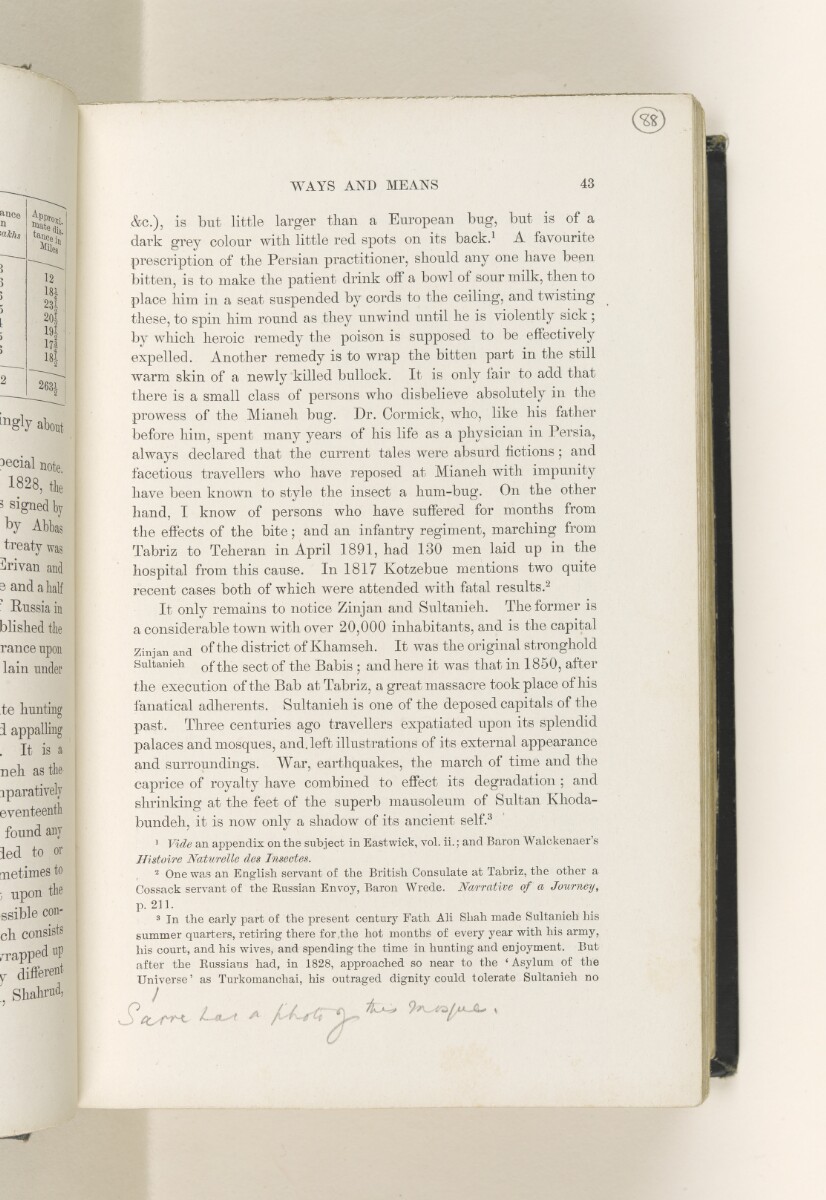
WAYS AND MEANS
43
&c.), is but little larger than a European bug, but is of a
dark grey colour with little red spots on its back . 1 A favourite
prescription of the Persian practitioner, should any one have been
bitten, is to make the patient drink off a bowl of sour milk, then to
place him in a seat suspended by cords to the ceiling, and twisting
these, to spin him round as they unwind until he is violently sick;
by which heroic remedy the poison is supposed to be effectively
expelled. Another remedy is to wrap the bitten part in the still
warm skin of a newly killed bullock. It is only fair to add that
there is a small class of persons who disbelieve absolutely in the
prowess of the Mianeh bug. Dr. Cormick, who, like his father
before him, spent many years of his life as a physician in Persia,
always declared that the current tales were absurd fictions ; and
facetious travellers who have reposed at Mianeh with impunity
have been known to style the insect a hum-bug. On the other
hand, I know of persons who have suffered for months from
the effects of the bite; and an infantry regiment, marching from
Tabriz to Teheran in April 1891, had 130 men laid up in the
hospital from this cause. In 1817 Kotzebue mentions two quite
recent cases both of which were attended with fatal results . 2
It only remains to notice Zinjan and Sultanieh. The former is
a considerable town with over 20,000 inhabitants, and is the capital
Zinjan and of tlie district of Khamseh. It was the original stronghold
Sultanieh 0 f the sect of the Babis ; and here it was that in 1850, after
the execution of the Bab at Tabriz, a great massacre took place of his
fanatical adherents. Sultanieh is one of the deposed capitals of the
past. Three centuries ago travellers expatiated upon its splendid
palaces and mosques, and, left illustrations of its external appearance
and surroundings. War, earthquakes, the march of time and the
caprice of royalty have combined to effect its degradation ; and
shrinking at the feet of the superb mausoleum of Sultan Khoda-
bundeh, it is now only a shadow of its ancient self . 3
1 Vide an appendix on the subject in Eastwick, vol. ii.; and Baron Walckenaer’s
Hi stair e Naturelle des Insect es.
2 One was an English servant of the British Consulate at Tabriz, the other a
Cossack servant of the Russian Envoy, Baron Wrede. Narrative of a Journey,
p. 211.
3 In the early part of the present century Fath Ali Shah made Sultanieh his
summer quarters, retiring there for the hot months of every year with his army,
bis court, and his wives, and spending the time in hunting and enjoyment. But
after the Russians had, in 1828, approached so near to the ‘ Asylum of the
Universe’ as Turkomanchai, his outraged dignity could tolerate Sultanieh no
About this item
- Content
These two volumes are George Curzon's own personal annotated copies of both volumes of his book Persia and the Persian Question , which was published in 1892. Alongside the volumes are various loose papers relating to Persia [Iran], consisting of the following: received correspondence; newspaper cuttings; publishers' press releases; cuttings from various booksellers' catalogues; various journal and magazine articles; two items of printed official British correspondence; several prints of photographs and sketches; and a few handwritten notes by Curzon.
In most cases these papers, which range in date from 1892 to 1924, relate to the chapters in the book where they were originally inserted, suggesting that they were kept by Curzon with the intention of using them to inform a revised edition of the book.
Of particular note among the small amount of correspondence are two letters received by Curzon in 1914 and 1915 from retired schoolmaster and Islamic scholar Sayyid Mazhar Hasan Musawi of Saharanpur, Uttar Pradesh, India (ff 5-9 and ff 44-53). These letters, which are written in Urdu and are accompanied by English translations, discuss in detail several inaccuracies found in the Urdu version of Persia and the Persian Question .
The various prints of photographs and sketches, which were originally inserted into volume two, are of different locations in the Gulf region. Several of these appear to have been produced in preparation for the publication of the second volume of John Gordon Lorimer's Gazetteer of the Persian Gulf The historical term used to describe the body of water between the Arabian Peninsula and Iran. , Oman and Central Arabia (i.e. the 'Geographical and Statistical' section) in 1908, as they are identical to the versions found in that volume.
Also of note among the loose papers are an illustrated article from Country Life dated 5 June 1920, entitled 'The People of Persia' (ff 36-37), and a printed family tree of the Shah of Persia [Aḥmad Shah Qājār], produced in preparation of his visit to Britain in 1919 (f 233).
Volume one of Persia and the Persian Question contains a map of Persia, Afghanistan and Beluchistan [Balochistan], which is folded inside the front cover (f 1).
The German language material consists of a publisher's press release for two books authored by German archaeologist Ernst Emil Herzfeld (ff 29-30).
- Extent and format
- 2 volumes with inserts (898 folios)
- Physical characteristics
Foliation: this shelfmark consists of two physical volumes. The foliation sequence commences at the first folio of volume one (1-463), and terminates at the last folio of volume two (ff 464-898); these numbers are written in pencil, are circled, and are located in the top right corner of the recto The front of a sheet of paper or leaf, often abbreviated to 'r'. side of each folio. Each volume contains a large number of loose leaves, which have been foliated in the order that they were inserted into the volume; for conservation reasons, these loose folios have been removed from the volume and stored separately. The foliation sequence does not include the front and back covers of the two volumes.
Pagination: the file also contains an original printed pagination sequence.
- Written in
- English, Urdu and German in Latin and Arabic script View the complete information for this record
Use and share this item
- Share this item
Annotated Copy of Persia and the Persian Question by George Curzon, with Inserted Papers [88r] (182/1814), British Library: India Office Records and Private Papers, Mss Eur F111/33, in Qatar Digital Library <https://www.qdl.qa/archive/81055/vdc_100157213842.0x0000bd> [accessed 30 August 2026]
https://www.qdl.qa/en/archive/81055/vdc_100157213842.0x0000bd
Copy and paste the code below into your web page where you would like to embed the image.
<meta charset="utf-8"><a href="https://www.qdl.qa/en/archive/81055/vdc_100157213842.0x0000bd">Annotated Copy of <em>Persia and the Persian Question</em> by George Curzon, with Inserted Papers [‎88r] (182/1814)</a> <a href="https://www.qdl.qa/en/archive/81055/vdc_100157213842.0x0000bd"> <img src="https://iiif.qdl.qa/iiif/images/81055/vdc_100000001491.0x00033b/Mss Eur F111_33_0193.jp2/full/!280,240/0/default.jpg" alt="" /> </a>
This record has a IIIF manifest available as follows. If you have a compatible viewer you can drag the icon to load it.https://www.qdl.qa/en/iiif/81055/vdc_100000001491.0x00033b/manifestOpen in Universal viewerOpen in Mirador viewerMore options for embedding images
Copyright: How to use this content
- Reference
- Mss Eur F111/33
- Title
- Annotated Copy of Persia and the Persian Questionby George Curzon, with Inserted Papers
- Pages
- 54r:135v, 147r:149v, 158r:180v, 183r:221v, 224r:224v, 227r:246v, 248r:257v, 259r:260v, 268r:362v, 364r:364v, 367r:388v, 390r:400v, 402r:416v, 419r:432v, 434r:444v, 448r:462v, 464r:471v, 475r:481v, 483r:513v, 516r:525v, 527r:544v, 546r:563v, 566r:598v, 600r:622v, 624r:656v, 658r:665v, 667r:675v, 678r:684v, 687r:688v, 691r:691v, 693r:693v, 695r:708v, 711r:721v, 724r:726v, 728r:729v, 731r:736v, 742r:742v, 746r:757v, 759r:761v, 763r:763v, 765r:765v, 772r:777v, 780r:789v, 793r:794v, 797r:809v, 811r:821v, 825r:840v, 843r:898v
- Author
- Curzon, George Nathaniel, 1st Marquess Curzon of Kedleston
- Usage terms
- Public Domain