
![Annotated Copy of <em>Persia and the Persian Question</em> by George Curzon, with Inserted Papers [‎69v] (145/1814)](https://iiif.qdl.qa/iiif/images/81055/vdc_100000001491.0x00033b/Mss Eur F111_33_0156.jp2/full/!1200,1200/0/default.jpg "Annotated Copy of <em>Persia and the Persian Question</em> by George Curzon, with Inserted Papers [‎69v] (145/1814)")
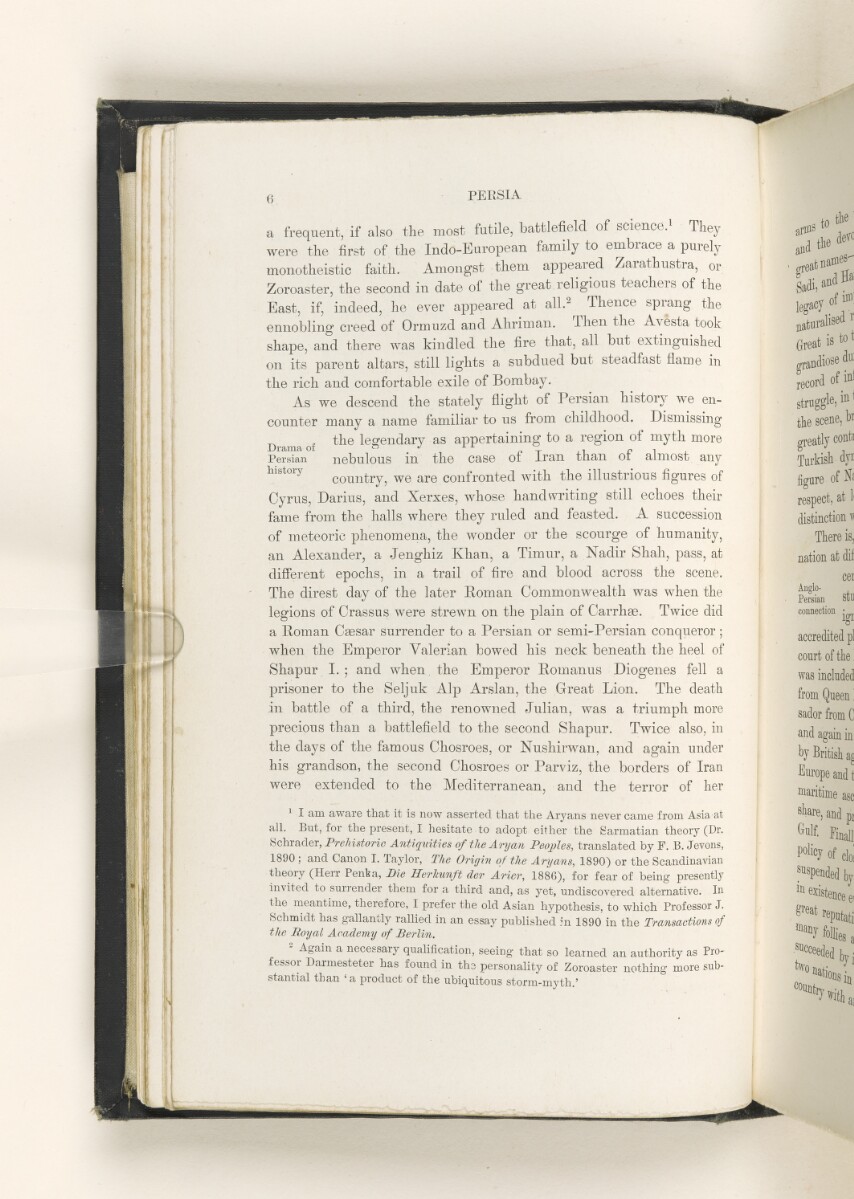
Annotated Copy of Persia and the Persian Question by George Curzon, with Inserted Papers [69v] (145/1814)
The record is made up of 2 volumes with inserts (898 folios). It was created in 1892-1924. It was written in English, Urdu and German. The original is part of the British Library: India Office The department of the British Government to which the Government of India reported between 1858 and 1947. The successor to the Court of Directors. Records and Private Papers Documents collected in a private capacity. .
Transcription
This transcription is created automatically. It may contain errors.
6
PERSIA
a frequent, if also the most futile, battlefield of science. They
were the first of the Indo-European family to embrace a purely
monotheistic faith. Amongst them appealed Zarathustra, or
Zoroaster, the second in date of the great religious teachers of the
East, if, indeed, he ever appeared at all. 2 Thence sprang the
ennobling creed of Ormuzd and Ahriman. Then the A\esta took
shape, and there was kindled the fire that, all but extinguished
on its parent altars, still lights a subdued but steadfast flame in
the rich and comfortable exile of Bombay.
As we descend the stately flight of Persian history we en
counter many a name familiar to us from childhood. Dismissing
Drama of l e R en d ai y as appertaining to a region of myth more
Persian nebulous in the case of Iran than of almost any
instory countl y ? we are confronted with the illustrious figures of
Cyrus, Darius, and Xerxes, whose handwriting still echoes their
fame from the halls where they ruled and feasted. A succession
of meteoric phenomena, the wonder or the scourge of humanity,
an Alexander, a Jenghiz Khan, a Timur, a Nadir Shah, pass, at
different epochs, in a trail of fire and blood across the scene.
The direst day of the later Roman Commonwealth was when the
legions of Crassus were strewn on the plain of Carrhae. Twice did
a Roman Caesar surrender to a Persian or semi-Persian conqueror;
when the Emperor Valerian bowed his neck beneath the heel of
Shapur I. ; and when the Emperor Romanus Diogenes fell a
prisoner to the Seljuk Alp Arslan, the Great Lion. The death
in battle of a third, the renowned Julian, was a triumph more
precious than a battlefield to the second Shapur. Twice also, in
the days of the famous Chosroes, or Nushirwan, and again under
his grandson, the second Chosroes or Parviz, the borders of Iran
were extended to the Mediterranean, and the terror of her
1 I am aware that it is now asserted that the Aryans never came from Asia at
all. Bat, for the present, I hesitate to adopt either the Sarmatian theory (Dr.
Schrader, Prehistoric Antiquities of the Aryan Peoples, translated by F. B. Jevons,
1890 ; and Canon I. Taylor, The Origin of the Aryans, 1890) or the Scandinavian
theory (Herr Penka, Pie Herltunft der Arier, 1886), for fear of being presently
invited to surrender them for a third and, as yet, undiscovered alternative. In
the meantime, therefore, I prefer the old Asian hypothesis, to which Professor J.
Schmidt has gallamly rallied in an essay published in 1890 in the Transactions of
the Royal Academy of Berlin.
Again a necessary qualification, seeing’ that so learned an authority as Pro
fessor Darmesteter has found in the personality of Zoroaster nothing more sub
stantial than a product of the ubiquitous storm-myth.’
About this item
- Content
These two volumes are George Curzon's own personal annotated copies of both volumes of his book Persia and the Persian Question , which was published in 1892. Alongside the volumes are various loose papers relating to Persia [Iran], consisting of the following: received correspondence; newspaper cuttings; publishers' press releases; cuttings from various booksellers' catalogues; various journal and magazine articles; two items of printed official British correspondence; several prints of photographs and sketches; and a few handwritten notes by Curzon.
In most cases these papers, which range in date from 1892 to 1924, relate to the chapters in the book where they were originally inserted, suggesting that they were kept by Curzon with the intention of using them to inform a revised edition of the book.
Of particular note among the small amount of correspondence are two letters received by Curzon in 1914 and 1915 from retired schoolmaster and Islamic scholar Sayyid Mazhar Hasan Musawi of Saharanpur, Uttar Pradesh, India (ff 5-9 and ff 44-53). These letters, which are written in Urdu and are accompanied by English translations, discuss in detail several inaccuracies found in the Urdu version of Persia and the Persian Question .
The various prints of photographs and sketches, which were originally inserted into volume two, are of different locations in the Gulf region. Several of these appear to have been produced in preparation for the publication of the second volume of John Gordon Lorimer's Gazetteer of the Persian Gulf The historical term used to describe the body of water between the Arabian Peninsula and Iran. , Oman and Central Arabia (i.e. the 'Geographical and Statistical' section) in 1908, as they are identical to the versions found in that volume.
Also of note among the loose papers are an illustrated article from Country Life dated 5 June 1920, entitled 'The People of Persia' (ff 36-37), and a printed family tree of the Shah of Persia [Aḥmad Shah Qājār], produced in preparation of his visit to Britain in 1919 (f 233).
Volume one of Persia and the Persian Question contains a map of Persia, Afghanistan and Beluchistan [Balochistan], which is folded inside the front cover (f 1).
The German language material consists of a publisher's press release for two books authored by German archaeologist Ernst Emil Herzfeld (ff 29-30).
- Extent and format
- 2 volumes with inserts (898 folios)
- Physical characteristics
Foliation: this shelfmark consists of two physical volumes. The foliation sequence commences at the first folio of volume one (1-463), and terminates at the last folio of volume two (ff 464-898); these numbers are written in pencil, are circled, and are located in the top right corner of the recto The front of a sheet of paper or leaf, often abbreviated to 'r'. side of each folio. Each volume contains a large number of loose leaves, which have been foliated in the order that they were inserted into the volume; for conservation reasons, these loose folios have been removed from the volume and stored separately. The foliation sequence does not include the front and back covers of the two volumes.
Pagination: the file also contains an original printed pagination sequence.
- Written in
- English, Urdu and German in Latin and Arabic script View the complete information for this record
Use and share this item
- Share this item
Annotated Copy of Persia and the Persian Question by George Curzon, with Inserted Papers [69v] (145/1814), British Library: India Office Records and Private Papers, Mss Eur F111/33, in Qatar Digital Library <https://www.qdl.qa/archive/81055/vdc_100157213842.0x000098> [accessed 21 August 2026]
https://www.qdl.qa/en/archive/81055/vdc_100157213842.0x000098
Copy and paste the code below into your web page where you would like to embed the image.
<meta charset="utf-8"><a href="https://www.qdl.qa/en/archive/81055/vdc_100157213842.0x000098">Annotated Copy of <em>Persia and the Persian Question</em> by George Curzon, with Inserted Papers [‎69v] (145/1814)</a> <a href="https://www.qdl.qa/en/archive/81055/vdc_100157213842.0x000098"> <img src="https://iiif.qdl.qa/iiif/images/81055/vdc_100000001491.0x00033b/Mss Eur F111_33_0156.jp2/full/!280,240/0/default.jpg" alt="" /> </a>
This record has a IIIF manifest available as follows. If you have a compatible viewer you can drag the icon to load it.https://www.qdl.qa/en/iiif/81055/vdc_100000001491.0x00033b/manifestOpen in Universal viewerOpen in Mirador viewerMore options for embedding images
Copyright: How to use this content
- Reference
- Mss Eur F111/33
- Title
- Annotated Copy of Persia and the Persian Questionby George Curzon, with Inserted Papers
- Pages
- 54r:135v, 147r:149v, 158r:180v, 183r:221v, 224r:224v, 227r:246v, 248r:257v, 259r:260v, 268r:362v, 364r:364v, 367r:388v, 390r:400v, 402r:416v, 419r:432v, 434r:444v, 448r:462v, 464r:471v, 475r:481v, 483r:513v, 516r:525v, 527r:544v, 546r:563v, 566r:598v, 600r:622v, 624r:656v, 658r:665v, 667r:675v, 678r:684v, 687r:688v, 691r:691v, 693r:693v, 695r:708v, 711r:721v, 724r:726v, 728r:729v, 731r:736v, 742r:742v, 746r:757v, 759r:761v, 763r:763v, 765r:765v, 772r:777v, 780r:789v, 793r:794v, 797r:809v, 811r:821v, 825r:840v, 843r:898v
- Author
- Curzon, George Nathaniel, 1st Marquess Curzon of Kedleston
- Usage terms
- Public Domain