
!['Volume II. MEMORANDA REGARDING OTHER EXTERNAL AFFAIRS. 1905.' [‎103r] (210/228)](https://iiif.qdl.qa/iiif/images/81055/vdc_100000001491.0x000087/Mss Eur F112_450_0210.jp2/full/!1200,1200/0/default.jpg "'Volume II. MEMORANDA REGARDING OTHER EXTERNAL AFFAIRS. 1905.' [‎103r] (210/228)")
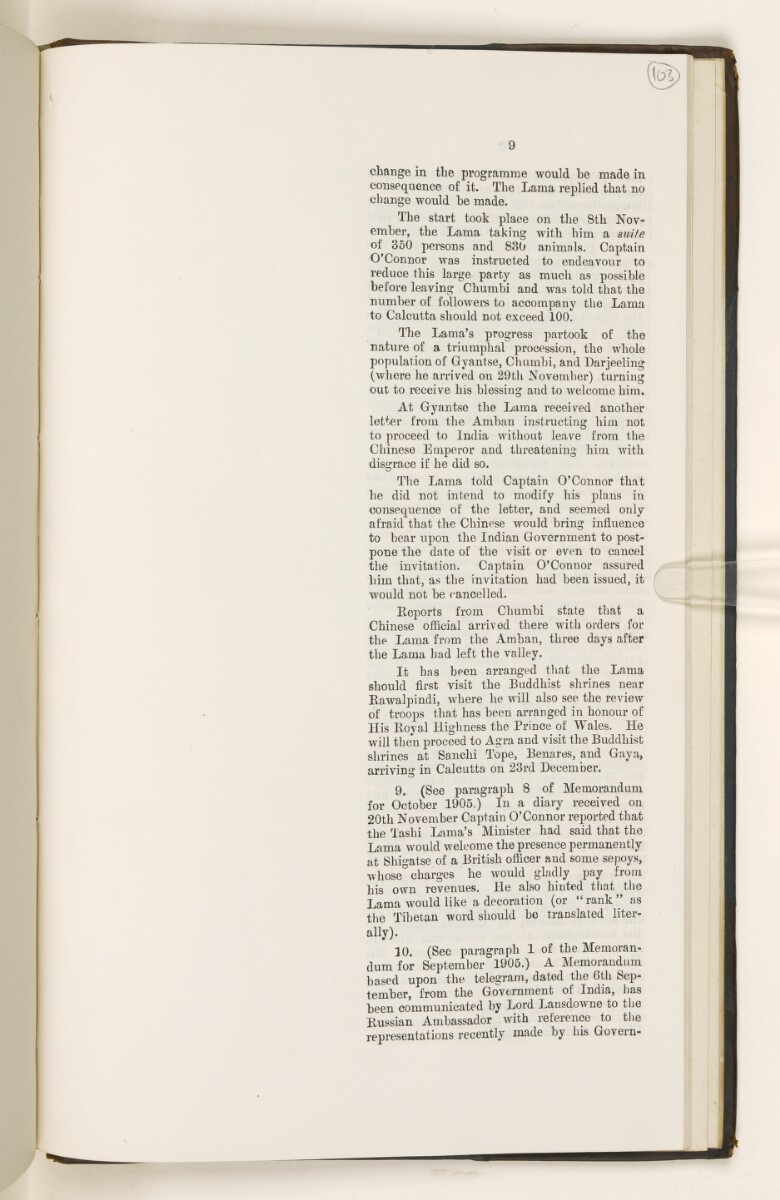
'Volume II. MEMORANDA REGARDING OTHER EXTERNAL AFFAIRS. 1905.' [103r] (210/228)
The record is made up of 1 volume (110 folios). It was created in 1905. It was written in English. The original is part of the British Library: India Office The department of the British Government to which the Government of India reported between 1858 and 1947. The successor to the Court of Directors. Records and Private Papers Documents collected in a private capacity. .
Transcription
This transcription is created automatically. It may contain errors.
9
change in the programme would he made in
consequence of it. The Lama replied that no
change would he made.
The start took place on the 8th Nov
ember, the Lama taking with him a suite
of 350 persons and 830 animals. Captain
O’Connor was instructed to endeavour to
reduce this large party as much as possible
before leaving Chumbi and was told that the
number of followers to accompany the Lama
to Calcutta should not exceed 100.
The Lama’s progress partook of the
nature of a triumphal procession, the whole
population of Gyantse, Chumbi, and Darjeeling
(where he arrived on 29th November) turning
out to receive his blessing and to welcome him.
At Gyantse the Lama received another
letter from the Amban instructing him not
to proceed to India without leave from the
Chinese Emperor and threatening him with
disgrace if he did so.
The Lama told Captain O’Connor that
he did not intend to modify his plans in
consequence of the letter, and seemed only
afraid that the Chinese would bring influence
to bear upon the Indian Government to post
pone the date of the visit or even to cancel
the invitation. Captain O’Connor assured
him that, as the invitation had been issued, it
would not be cancelled.
Deports from Chumbi state that a
Chinese oflicial arrived there with orders for
the Lama from the Amban, three days after
the Lama had left the valley.
It has been arranged that the Lama
should first visit the Buddhist shrines near
Rawalpindi, where he will also see the review
of troops that has been arranged in honour of
His Royal Highness the Prince of Wales. He
will then proceed to Agra and visit the Buddhist
shrines at Sanchi Tope, Benares, and Gaya,
arriving in Calcutta on 23rd December.
9. (See paragraph 8 of Memorandum
for October 1905.) In a diary received on
20th November Captain O’Connor reported that
the Tashi Lama’s Minister had said that the
Lama would welcome the presence permanently
at Shigatse of a British officer and some
sepoys
Term used in English to refer to an Indian infantryman. Carries some derogatory connotations as sometimes used as a means of othering and emphasising race, colour, origins, or rank.
,
whose charges he would gladly pay from
his own revenues. He also hinted that the
Lama would like a decoration (or “rank” as
the Tibetan word should be translated liter-
ally).
10. (See paragraph 1 of the Memoran
dum for September 1905.) A Memorandum
based upon the telegram, dated the 6th Sep
tember, from the Government of India, lias
been communicated by Lord Lansdowne to the
Russian Ambassador with reference to the
representations recently made by ins Govern-
I
About this item
- Content
The volume contains printed monthly memoranda of information received by the Government of India 'regarding external affairs other than those relating to the North-West Frontier Region of British India bordering Afghanistan. , Afghanistan, and Persia' for the months of January to March 1905 inclusive (folios 4-17); memoranda of information received 'regarding external affairs relating to Arabia' for the months of April to December 1905 inclusive (folios 18-54); and memoranda of information received 'regarding external affairs relating to the North-East Frontier, Burma, Siam, and China', for the months of April to December 1905 inclusive (folios 55-108). A note accompanying each memorandum states that they are 'based upon reports, the accuracy of which it is not always possible to guarantee'.
The combined 'other external affairs' reports (folios 4-17) relate to Arabia (Aden), Turkish Arabia A term used by the British officials to describe the territory roughly corresponding to, but not coextensive with, modern-day Iraq under the control of the Ottoman Empire. , the Persian Gulf The historical term used to describe the body of water between the Arabian Peninsula and Iran. , China, Tibet, and Bhutan; the Arabia memoranda (folios 18-54) relate to Aden, Turkish Arabia A term used by the British officials to describe the territory roughly corresponding to, but not coextensive with, modern-day Iraq under the control of the Ottoman Empire. , and the Persian Gulf The historical term used to describe the body of water between the Arabian Peninsula and Iran. ; and the North-East Frontier etc. memoranda (folios 55-108) relate to Tibet, Bhutan, China, Siam [Thailand], Nepal, Burma, and Assam.
Memoranda covering the Persian Gulf The historical term used to describe the body of water between the Arabian Peninsula and Iran. include intelligence reports concerning Maskat [Muscat], Koweit [Kuwait], Nejd [Najd], Bahrein [Bahrain], Katif [Al-Qatif], El Katr/Katar [Qatar], the Arab Coast, Musandim [Musandam], and the Pirate Coast.
The memoranda relating to Arabia include references to the following subjects: political intelligence, tribal affairs, relations with the Ottoman Government, frontier settlement, pearl fisheries, quarantine, and slavery.
The memoranda regarding affairs on and beyond the North-East Frontier of India cover a similar broad range of political and economic intelligence.
- Extent and format
- 1 volume (110 folios)
- Arrangement
The memoranda are arranged in chronological order within in each grouping from the front to the back of the volume.
- Physical characteristics
Foliation: the foliation sequence (used for referencing) commences at the inside front cover with 1 and terminates at the inside back cover with 112; these numbers are written in pencil, are circled, and are located in the top right corner of the recto The front of a sheet of paper or leaf, often abbreviated to 'r'. side of each folio.
- Written in
- English in Latin script View the complete information for this record
Use and share this item
- Share this item
'Volume II. MEMORANDA REGARDING OTHER EXTERNAL AFFAIRS. 1905.' [103r] (210/228), British Library: India Office Records and Private Papers, Mss Eur F112/450, in Qatar Digital Library <https://www.qdl.qa/archive/81055/vdc_100087951862.0x00000b> [accessed 22 August 2026]
https://www.qdl.qa/en/archive/81055/vdc_100087951862.0x00000b
Copy and paste the code below into your web page where you would like to embed the image.
<meta charset="utf-8"><a href="https://www.qdl.qa/en/archive/81055/vdc_100087951862.0x00000b">'Volume II. MEMORANDA REGARDING OTHER EXTERNAL AFFAIRS. 1905.' [‎103r] (210/228)</a> <a href="https://www.qdl.qa/en/archive/81055/vdc_100087951862.0x00000b"> <img src="https://iiif.qdl.qa/iiif/images/81055/vdc_100000001491.0x000087/Mss Eur F112_450_0210.jp2/full/!280,240/0/default.jpg" alt="" /> </a>
This record has a IIIF manifest available as follows. If you have a compatible viewer you can drag the icon to load it.https://www.qdl.qa/en/iiif/81055/vdc_100000001491.0x000087/manifestOpen in Universal viewerOpen in Mirador viewerMore options for embedding images
Copyright: How to use this content
- Reference
- Mss Eur F112/450
- Title
- 'Volume II. MEMORANDA REGARDING OTHER EXTERNAL AFFAIRS. 1905.'
- Pages
- front, back, spine, edge, head, tail, front-i, 2r:111v, back-i
- Author
- Curzon, George Nathaniel, 1st Marquess Curzon of Kedleston
- Copyright
- ©The British Library Board
- Usage terms
- Creative Commons Attribution Licence