
!['Volume II. MEMORANDA REGARDING OTHER EXTERNAL AFFAIRS. 1905.' [‎83v] (171/228)](https://iiif.qdl.qa/iiif/images/81055/vdc_100000001491.0x000087/Mss Eur F112_450_0171.jp2/full/!1200,1200/0/default.jpg "'Volume II. MEMORANDA REGARDING OTHER EXTERNAL AFFAIRS. 1905.' [‎83v] (171/228)")
'Volume II. MEMORANDA REGARDING OTHER EXTERNAL AFFAIRS. 1905.' [83v] (171/228)
The record is made up of 1 volume (110 folios). It was created in 1905. It was written in English. The original is part of the British Library: India Office The department of the British Government to which the Government of India reported between 1858 and 1947. The successor to the Court of Directors. Records and Private Papers Documents collected in a private capacity. .
Transcription
This transcription is created automatically. It may contain errors.
t
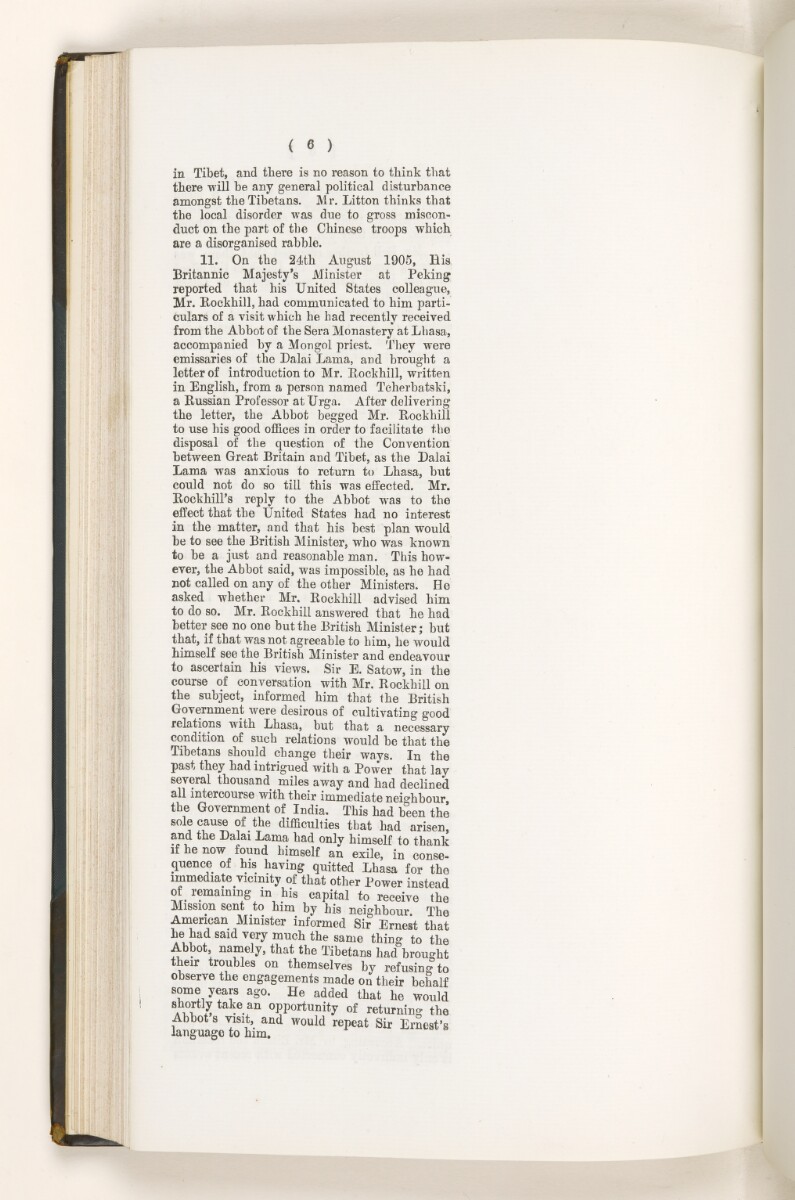
( 6 )
in Tibet, and there is no reason to think that
there will be any general political disturbance
amongst the Tibetans. Mr. Litton thinks that
the local disorder was due to gross miscon
duct on the part of the Chinese troops which
are a disorganised rabble.
11. On the 24th August 1905, His
Britannic Majesty’s Minister at Peking
reported that his United States colleague,
Mr. Boekhill, had communicated to him parti
culars of a visit which he had recently received
from the Abbot of the Sera Monastery at Lhasa,
accompanied by a Mongol priest. They were
emissaries of the Dalai Lama, and brought a
letter of introduction to Mr. Itockhill, written
in English, from a person named Tcherbatski,
a Russian Professor at Urga. After delivering
the letter, the Abbot begged Mr. Itockhill
to use his good offices in order to facilitate the
disposal of the question of the Convention
between Great Britain and Tibet, as the Dalai
Lama was anxious to return to Lhasa, but
could not do so till this was effected. Mr.
Rockhill’s reply to the Abbot was to the
effect that the United States had no interest
in the matter, and that his best plan would
be to see the British Minister, who was known
to be a just and reasonable man. This how
ever, the Abbot said, w 7 as impossible, as he had
not called on any of the other Ministers. He
asked whether Mr. Rockhill advised him
to do so. Mr. Rockhill answered that he had
better see no one but the British Minister; but
that, if that was not agreeable to him, he would
himself see the British Minister and endeavour
to ascertain his views. Sir E. Satow, in the
course of conversation with Mr. Rockhill on
the subject, informed him that the British
Government were desirous of cultivating good
relations with Lhasa, but that a necessary
condition of such relations would be that the
Tibetans should change their ways. In the
past they had intrigued with a Power that lay
several thousand miles away and had declined
all intercourse with their immediate neighbour,
the Government of. India. This had been the
USG °^.^ e difficulties that had arisen,
and the Dalai Lama had only himself to thank
if he now found himself an exile, in conse
quence of his having quitted Lhasa for the
immediate vicimty of that other Power instead
of remaining m his capital to receive the
Mission sent to him by his neighbour. The
American Minister informed Sir Ernest that
he had said very much the same thing to the
Abbot namely, that the Tibetans had brought
heir troubles on themselves by refusing to
observe the engagements made on their behalf
some years ago. He added that he would
s A h ° rt] y take an opportunity of returning the
Abbot s visit, and would repeat Sir Ernest’s
language to him.
About this item
- Content
The volume contains printed monthly memoranda of information received by the Government of India 'regarding external affairs other than those relating to the North-West Frontier Region of British India bordering Afghanistan. , Afghanistan, and Persia' for the months of January to March 1905 inclusive (folios 4-17); memoranda of information received 'regarding external affairs relating to Arabia' for the months of April to December 1905 inclusive (folios 18-54); and memoranda of information received 'regarding external affairs relating to the North-East Frontier, Burma, Siam, and China', for the months of April to December 1905 inclusive (folios 55-108). A note accompanying each memorandum states that they are 'based upon reports, the accuracy of which it is not always possible to guarantee'.
The combined 'other external affairs' reports (folios 4-17) relate to Arabia (Aden), Turkish Arabia A term used by the British officials to describe the territory roughly corresponding to, but not coextensive with, modern-day Iraq under the control of the Ottoman Empire. , the Persian Gulf The historical term used to describe the body of water between the Arabian Peninsula and Iran. , China, Tibet, and Bhutan; the Arabia memoranda (folios 18-54) relate to Aden, Turkish Arabia A term used by the British officials to describe the territory roughly corresponding to, but not coextensive with, modern-day Iraq under the control of the Ottoman Empire. , and the Persian Gulf The historical term used to describe the body of water between the Arabian Peninsula and Iran. ; and the North-East Frontier etc. memoranda (folios 55-108) relate to Tibet, Bhutan, China, Siam [Thailand], Nepal, Burma, and Assam.
Memoranda covering the Persian Gulf The historical term used to describe the body of water between the Arabian Peninsula and Iran. include intelligence reports concerning Maskat [Muscat], Koweit [Kuwait], Nejd [Najd], Bahrein [Bahrain], Katif [Al-Qatif], El Katr/Katar [Qatar], the Arab Coast, Musandim [Musandam], and the Pirate Coast.
The memoranda relating to Arabia include references to the following subjects: political intelligence, tribal affairs, relations with the Ottoman Government, frontier settlement, pearl fisheries, quarantine, and slavery.
The memoranda regarding affairs on and beyond the North-East Frontier of India cover a similar broad range of political and economic intelligence.
- Extent and format
- 1 volume (110 folios)
- Arrangement
The memoranda are arranged in chronological order within in each grouping from the front to the back of the volume.
- Physical characteristics
Foliation: the foliation sequence (used for referencing) commences at the inside front cover with 1 and terminates at the inside back cover with 112; these numbers are written in pencil, are circled, and are located in the top right corner of the recto The front of a sheet of paper or leaf, often abbreviated to 'r'. side of each folio.
- Written in
- English in Latin script View the complete information for this record
Use and share this item
- Share this item
'Volume II. MEMORANDA REGARDING OTHER EXTERNAL AFFAIRS. 1905.' [83v] (171/228), British Library: India Office Records and Private Papers, Mss Eur F112/450, in Qatar Digital Library <https://www.qdl.qa/archive/81055/vdc_100087951861.0x0000ac> [accessed 25 August 2026]
https://www.qdl.qa/en/archive/81055/vdc_100087951861.0x0000ac
Copy and paste the code below into your web page where you would like to embed the image.
<meta charset="utf-8"><a href="https://www.qdl.qa/en/archive/81055/vdc_100087951861.0x0000ac">'Volume II. MEMORANDA REGARDING OTHER EXTERNAL AFFAIRS. 1905.' [‎83v] (171/228)</a> <a href="https://www.qdl.qa/en/archive/81055/vdc_100087951861.0x0000ac"> <img src="https://iiif.qdl.qa/iiif/images/81055/vdc_100000001491.0x000087/Mss Eur F112_450_0171.jp2/full/!280,240/0/default.jpg" alt="" /> </a>
This record has a IIIF manifest available as follows. If you have a compatible viewer you can drag the icon to load it.https://www.qdl.qa/en/iiif/81055/vdc_100000001491.0x000087/manifestOpen in Universal viewerOpen in Mirador viewerMore options for embedding images
Copyright: How to use this content
- Reference
- Mss Eur F112/450
- Title
- 'Volume II. MEMORANDA REGARDING OTHER EXTERNAL AFFAIRS. 1905.'
- Pages
- front, back, spine, edge, head, tail, front-i, 2r:111v, back-i
- Author
- Curzon, George Nathaniel, 1st Marquess Curzon of Kedleston
- Copyright
- ©The British Library Board
- Usage terms
- Creative Commons Attribution Licence