
!['Volume II. MEMORANDA REGARDING OTHER EXTERNAL AFFAIRS. 1905.' [‎81v] (167/228)](https://iiif.qdl.qa/iiif/images/81055/vdc_100000001491.0x000087/Mss Eur F112_450_0167.jp2/full/!1200,1200/0/default.jpg "'Volume II. MEMORANDA REGARDING OTHER EXTERNAL AFFAIRS. 1905.' [‎81v] (167/228)")
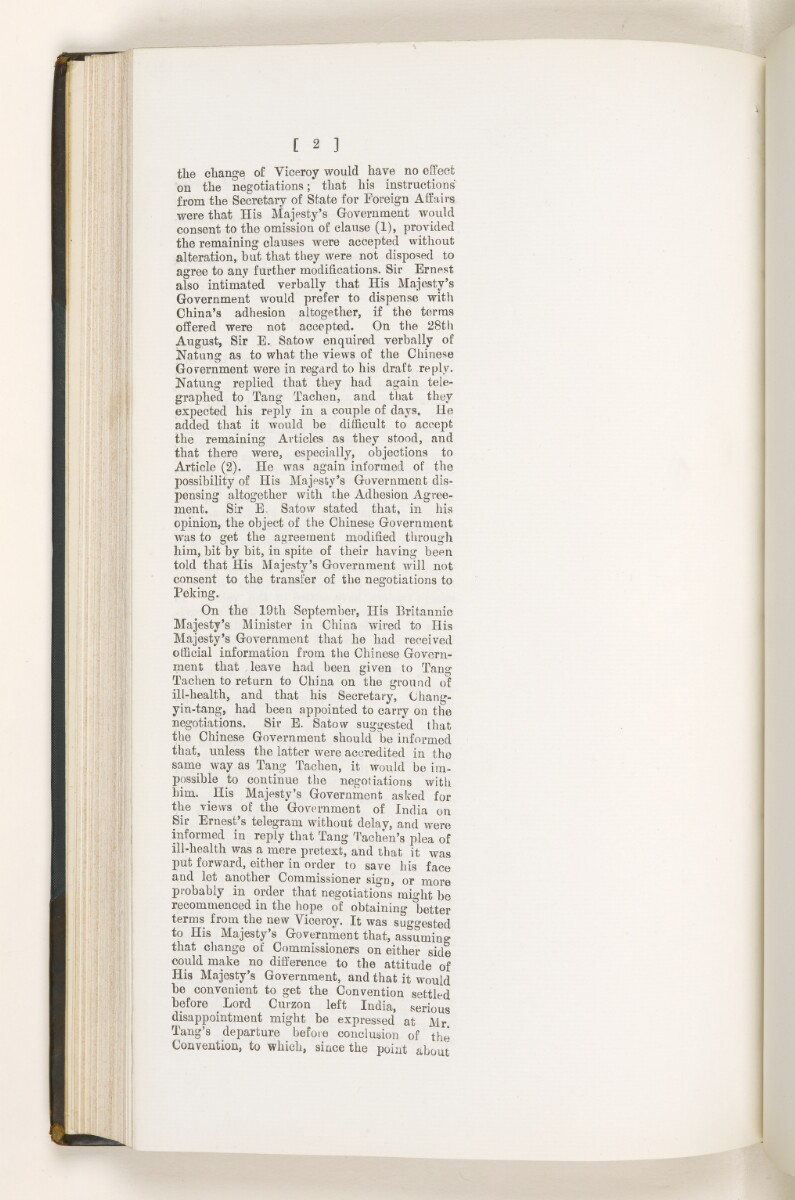
'Volume II. MEMORANDA REGARDING OTHER EXTERNAL AFFAIRS. 1905.' [81v] (167/228)
The record is made up of 1 volume (110 folios). It was created in 1905. It was written in English. The original is part of the British Library: India Office The department of the British Government to which the Government of India reported between 1858 and 1947. The successor to the Court of Directors. Records and Private Papers Documents collected in a private capacity. .
Transcription
This transcription is created automatically. It may contain errors.
; ; : : Ifi' 1
il ikii
[ 2 ]
tlie change of Viceroy would have no effect
on the negotiations; that his instructions
from the Secretary of State for Foreign Affairs
were that His Majesty’s Government would
consent to the omission of clause (1), provided
the remaining clauses were accepted without
alteration, hut that they were not disposed to
agree to any further modifications. Sir Ernest
also intimated verbally that His Majesty’s
Government would prefer to dispense with
China’s adhesion altogether, if the terms
offered were not accepted. On the 28th
August, Sir E. Satow enquired verbally of
Natung as to what the views of the Chinese
Government were in regard to his draft reply.
Natung replied that they had again tele
graphed to Tang Tachen, and that they
expected his reply in a couple of days. He
added that it would be difficult to accept
the remaining Articles as they stood, and
that there were, especially, objections to
Article (2). He was again informed of the
possibility of His Majesty’s Government dis
pensing altogether with the Adhesion Agree
ment. Sir E. Satow stated that, in his
opinion, the object of the Chinese Government
was to get the agreement modified through
him, bit by bit, in spite of their having been
told that His Majesty’s Government will not
consent to the transfer of the negotiations to
Peking.
On the 19th September, His Britannic
Majesty’s Minister in China wired to His
Majesty’s Government that he had received
official information from the Chinese Govern
ment that leave had been given to Tang
Tachen to return to China on the ground of
ill-health, and that his Secretary, Chang-
yin-tang, had been appointed to carry on the
negotiations. Sir E. Satow suggested that
the Chinese Government should be informed
that, unless the latter were accredited in the
same way as Tang Tachen, it would be im
possible .to continue the negotiations with
him. .His Majesty’s Government asked for
the views of the Government of India on
Sir Ernest’s telegram without delav, and were
informed in reply that Tang Tachen’s plea of
ill-health was a mere pretext, and that it was
put forward, either in order to save his face
and let another Commissioner sign, or more
probably in order that negotiations might be
recommenced in the hope of obtaining better
terms, from the new Viceroy. It was suggested
to His Majesty’s Government that, assumino*
that change of Commissioners on either side
could make no difference to the attitude of
His Majesty’s Government, and that it would
be convenient to get the Convention settled
before Lord Curzon left India, serious
disappointment might be expressed at Mr
Tang’s departure before conclusion of the
Convention, to which, since the point about
About this item
- Content
The volume contains printed monthly memoranda of information received by the Government of India 'regarding external affairs other than those relating to the North-West Frontier Region of British India bordering Afghanistan. , Afghanistan, and Persia' for the months of January to March 1905 inclusive (folios 4-17); memoranda of information received 'regarding external affairs relating to Arabia' for the months of April to December 1905 inclusive (folios 18-54); and memoranda of information received 'regarding external affairs relating to the North-East Frontier, Burma, Siam, and China', for the months of April to December 1905 inclusive (folios 55-108). A note accompanying each memorandum states that they are 'based upon reports, the accuracy of which it is not always possible to guarantee'.
The combined 'other external affairs' reports (folios 4-17) relate to Arabia (Aden), Turkish Arabia A term used by the British officials to describe the territory roughly corresponding to, but not coextensive with, modern-day Iraq under the control of the Ottoman Empire. , the Persian Gulf The historical term used to describe the body of water between the Arabian Peninsula and Iran. , China, Tibet, and Bhutan; the Arabia memoranda (folios 18-54) relate to Aden, Turkish Arabia A term used by the British officials to describe the territory roughly corresponding to, but not coextensive with, modern-day Iraq under the control of the Ottoman Empire. , and the Persian Gulf The historical term used to describe the body of water between the Arabian Peninsula and Iran. ; and the North-East Frontier etc. memoranda (folios 55-108) relate to Tibet, Bhutan, China, Siam [Thailand], Nepal, Burma, and Assam.
Memoranda covering the Persian Gulf The historical term used to describe the body of water between the Arabian Peninsula and Iran. include intelligence reports concerning Maskat [Muscat], Koweit [Kuwait], Nejd [Najd], Bahrein [Bahrain], Katif [Al-Qatif], El Katr/Katar [Qatar], the Arab Coast, Musandim [Musandam], and the Pirate Coast.
The memoranda relating to Arabia include references to the following subjects: political intelligence, tribal affairs, relations with the Ottoman Government, frontier settlement, pearl fisheries, quarantine, and slavery.
The memoranda regarding affairs on and beyond the North-East Frontier of India cover a similar broad range of political and economic intelligence.
- Extent and format
- 1 volume (110 folios)
- Arrangement
The memoranda are arranged in chronological order within in each grouping from the front to the back of the volume.
- Physical characteristics
Foliation: the foliation sequence (used for referencing) commences at the inside front cover with 1 and terminates at the inside back cover with 112; these numbers are written in pencil, are circled, and are located in the top right corner of the recto The front of a sheet of paper or leaf, often abbreviated to 'r'. side of each folio.
- Written in
- English in Latin script View the complete information for this record
Use and share this item
- Share this item
'Volume II. MEMORANDA REGARDING OTHER EXTERNAL AFFAIRS. 1905.' [81v] (167/228), British Library: India Office Records and Private Papers, Mss Eur F112/450, in Qatar Digital Library <https://www.qdl.qa/archive/81055/vdc_100087951861.0x0000a8> [accessed 22 June 2026]
https://www.qdl.qa/en/archive/81055/vdc_100087951861.0x0000a8
Copy and paste the code below into your web page where you would like to embed the image.
<meta charset="utf-8"><a href="https://www.qdl.qa/en/archive/81055/vdc_100087951861.0x0000a8">'Volume II. MEMORANDA REGARDING OTHER EXTERNAL AFFAIRS. 1905.' [‎81v] (167/228)</a> <a href="https://www.qdl.qa/en/archive/81055/vdc_100087951861.0x0000a8"> <img src="https://iiif.qdl.qa/iiif/images/81055/vdc_100000001491.0x000087/Mss Eur F112_450_0167.jp2/full/!280,240/0/default.jpg" alt="" /> </a>
This record has a IIIF manifest available as follows. If you have a compatible viewer you can drag the icon to load it.https://www.qdl.qa/en/iiif/81055/vdc_100000001491.0x000087/manifestOpen in Universal viewerOpen in Mirador viewerMore options for embedding images
Copyright: How to use this content
- Reference
- Mss Eur F112/450
- Title
- 'Volume II. MEMORANDA REGARDING OTHER EXTERNAL AFFAIRS. 1905.'
- Pages
- front, back, spine, edge, head, tail, front-i, 2r:111v, back-i
- Author
- Curzon, George Nathaniel, 1st Marquess Curzon of Kedleston
- Copyright
- ©The British Library Board
- Usage terms
- Creative Commons Attribution Licence