
!['Volume II. MEMORANDA REGARDING OTHER EXTERNAL AFFAIRS. 1905.' [‎23v] (51/228)](https://iiif.qdl.qa/iiif/images/81055/vdc_100000001491.0x000087/Mss Eur F112_450_0051.jp2/full/!1200,1200/0/default.jpg "'Volume II. MEMORANDA REGARDING OTHER EXTERNAL AFFAIRS. 1905.' [‎23v] (51/228)")
'Volume II. MEMORANDA REGARDING OTHER EXTERNAL AFFAIRS. 1905.' [23v] (51/228)
The record is made up of 1 volume (110 folios). It was created in 1905. It was written in English. The original is part of the British Library: India Office The department of the British Government to which the Government of India reported between 1858 and 1947. The successor to the Court of Directors. Records and Private Papers Documents collected in a private capacity. .
Transcription
This transcription is created automatically. It may contain errors.
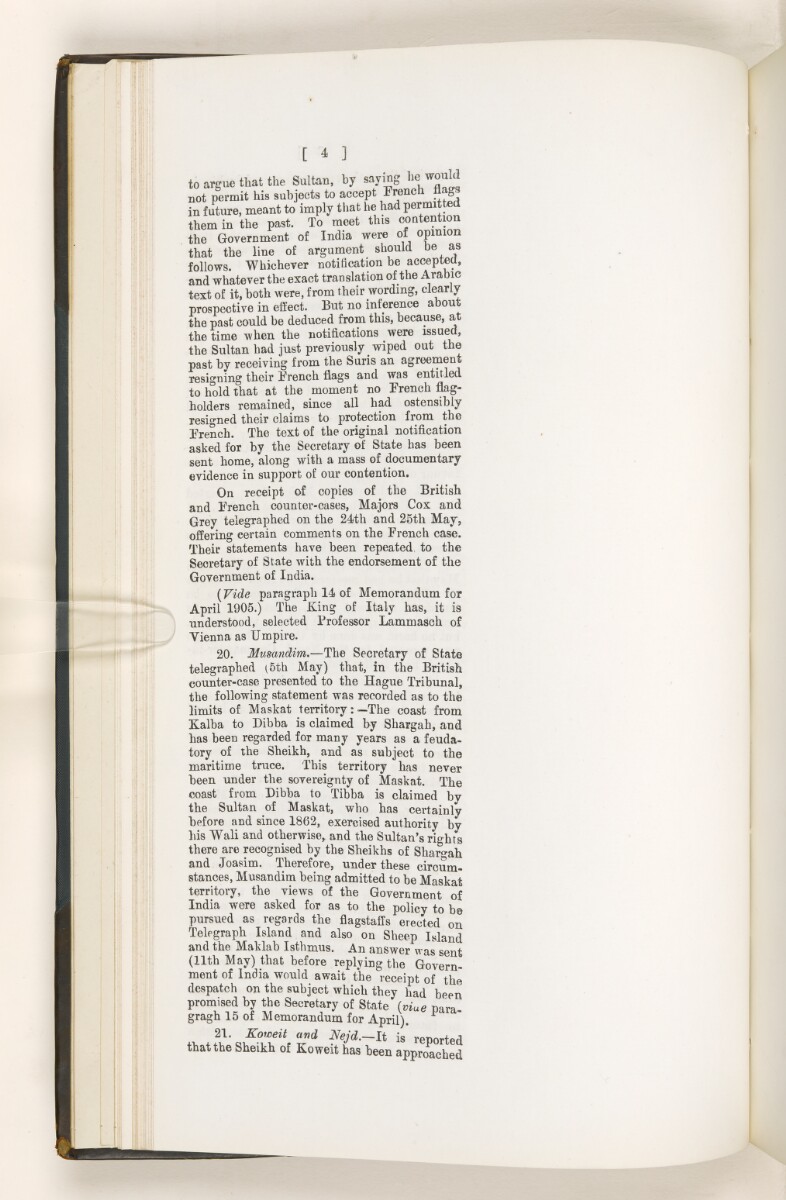
to argue that the Sultan, by saj ing he
not permit his subjects to accept French flags
in future, meant to imply that he had permitte
them in the past. To meet this contention
the Government of India were of opinion
that the line of argument should be as
follows. Whichever notification be accepted,
and whatever the exact translation of the Arabic
text of it, both were, from their wording, clearly
prospective in effect. But no inference about
the past could be deduced from this, because, at
the time when the notifications were issued,
the Sultan had just previously wiped out the
past by receiving from the Suris an agreement
resigning their French flags and was entitled
to hold that at the moment no French flag-
holders remained, since all had ostensibly
resigned their claims to protection from the
French. The text of the original notification
asked for by the Secretary of State has been
sent home, along with a mass of documentary
evidence in support of our contention.
On receipt of copies of the British
and French counter-cases, Majors Cox and
Grey telegraphed on the 24th and 25th May,
offering certain comments on the French case.
Their statements have been repeated to the
Secretary of State with the endorsement of the
Government of India.
(Vide paragraph 14 of Memorandum for
April 1905.) The King of Italy has, it is
understood, selected Professor Lammasch of
Vienna as Umpire.
20. Musandim. —The Secretary of State
telegraphed i5th May) that, in the British
counter-case presented to the Hague Tribunal,
the following statement was recorded as to the
limits of Maskat territory: —The coast from
Kalba to Dibba is claimed by Shargah, and
has been regarded for many years as a feuda
tory of the Sheikh, and as subject to the
maritime truce. This territory has never
been under the sovereignty of Maskat. The
coast from Dibba to Tibba is claimed by
the Sultan of Maskat, who has certainly
before and since 1862, exercised authority by
his Wali and otherwise, and the Sultan’s rights
there are recognised by the Sheikhs of Shargah
and Joasim. Therefore, under these circum
stances, Musandim being admitted to be Maskat
territory, the views of the Government of
India were asked for as to the policy to be
pursued as regards the flagstaffs erected on
Telegraph Island and also on Sheep Island
and the Maklab Isthmus. An answer was sent
(11th May) that before replying the Govern
ment of India would await the receipt of the
despatch on the subject which they had been
promised by the Secretary of State (viue para-
gragh 15 of Memorandum for April). 1
21. Koweit and Nejd.—lt is reported
that the Sheikh of Koweit has been approached
About this item
- Content
The volume contains printed monthly memoranda of information received by the Government of India 'regarding external affairs other than those relating to the North-West Frontier Region of British India bordering Afghanistan. , Afghanistan, and Persia' for the months of January to March 1905 inclusive (folios 4-17); memoranda of information received 'regarding external affairs relating to Arabia' for the months of April to December 1905 inclusive (folios 18-54); and memoranda of information received 'regarding external affairs relating to the North-East Frontier, Burma, Siam, and China', for the months of April to December 1905 inclusive (folios 55-108). A note accompanying each memorandum states that they are 'based upon reports, the accuracy of which it is not always possible to guarantee'.
The combined 'other external affairs' reports (folios 4-17) relate to Arabia (Aden), Turkish Arabia A term used by the British officials to describe the territory roughly corresponding to, but not coextensive with, modern-day Iraq under the control of the Ottoman Empire. , the Persian Gulf The historical term used to describe the body of water between the Arabian Peninsula and Iran. , China, Tibet, and Bhutan; the Arabia memoranda (folios 18-54) relate to Aden, Turkish Arabia A term used by the British officials to describe the territory roughly corresponding to, but not coextensive with, modern-day Iraq under the control of the Ottoman Empire. , and the Persian Gulf The historical term used to describe the body of water between the Arabian Peninsula and Iran. ; and the North-East Frontier etc. memoranda (folios 55-108) relate to Tibet, Bhutan, China, Siam [Thailand], Nepal, Burma, and Assam.
Memoranda covering the Persian Gulf The historical term used to describe the body of water between the Arabian Peninsula and Iran. include intelligence reports concerning Maskat [Muscat], Koweit [Kuwait], Nejd [Najd], Bahrein [Bahrain], Katif [Al-Qatif], El Katr/Katar [Qatar], the Arab Coast, Musandim [Musandam], and the Pirate Coast.
The memoranda relating to Arabia include references to the following subjects: political intelligence, tribal affairs, relations with the Ottoman Government, frontier settlement, pearl fisheries, quarantine, and slavery.
The memoranda regarding affairs on and beyond the North-East Frontier of India cover a similar broad range of political and economic intelligence.
- Extent and format
- 1 volume (110 folios)
- Arrangement
The memoranda are arranged in chronological order within in each grouping from the front to the back of the volume.
- Physical characteristics
Foliation: the foliation sequence (used for referencing) commences at the inside front cover with 1 and terminates at the inside back cover with 112; these numbers are written in pencil, are circled, and are located in the top right corner of the recto The front of a sheet of paper or leaf, often abbreviated to 'r'. side of each folio.
- Written in
- English in Latin script View the complete information for this record
Use and share this item
- Share this item
'Volume II. MEMORANDA REGARDING OTHER EXTERNAL AFFAIRS. 1905.' [23v] (51/228), British Library: India Office Records and Private Papers, Mss Eur F112/450, in Qatar Digital Library <https://www.qdl.qa/archive/81055/vdc_100087951861.0x000034> [accessed 4 June 2026]
https://www.qdl.qa/en/archive/81055/vdc_100087951861.0x000034
Copy and paste the code below into your web page where you would like to embed the image.
<meta charset="utf-8"><a href="https://www.qdl.qa/en/archive/81055/vdc_100087951861.0x000034">'Volume II. MEMORANDA REGARDING OTHER EXTERNAL AFFAIRS. 1905.' [‎23v] (51/228)</a> <a href="https://www.qdl.qa/en/archive/81055/vdc_100087951861.0x000034"> <img src="https://iiif.qdl.qa/iiif/images/81055/vdc_100000001491.0x000087/Mss Eur F112_450_0051.jp2/full/!280,240/0/default.jpg" alt="" /> </a>
This record has a IIIF manifest available as follows. If you have a compatible viewer you can drag the icon to load it.https://www.qdl.qa/en/iiif/81055/vdc_100000001491.0x000087/manifestOpen in Universal viewerOpen in Mirador viewerMore options for embedding images
Copyright: How to use this content
- Reference
- Mss Eur F112/450
- Title
- 'Volume II. MEMORANDA REGARDING OTHER EXTERNAL AFFAIRS. 1905.'
- Pages
- front, back, spine, edge, head, tail, front-i, 2r:111v, back-i
- Author
- Curzon, George Nathaniel, 1st Marquess Curzon of Kedleston
- Copyright
- ©The British Library Board
- Usage terms
- Creative Commons Attribution Licence