
![Report of the Special Mission to Egypt under Lord Milner, and related papers [‎231v] (465/473)](https://iiif.qdl.qa/iiif/images/81055/vdc_100000001491.0x000295/Mss Eur F112_260_0465.jp2/full/!1200,1200/0/default.jpg "Report of the Special Mission to Egypt under Lord Milner, and related papers [‎231v] (465/473)")
Report of the Special Mission to Egypt under Lord Milner, and related papers [231v] (465/473)
The record is made up of 1 file (237 folios). It was created in 15 May 1920-14 Oct 1921. It was written in English. The original is part of the British Library: India Office The department of the British Government to which the Government of India reported between 1858 and 1947. The successor to the Court of Directors. Records and Private Papers Documents collected in a private capacity. .
Transcription
This transcription is created automatically. It may contain errors.
V
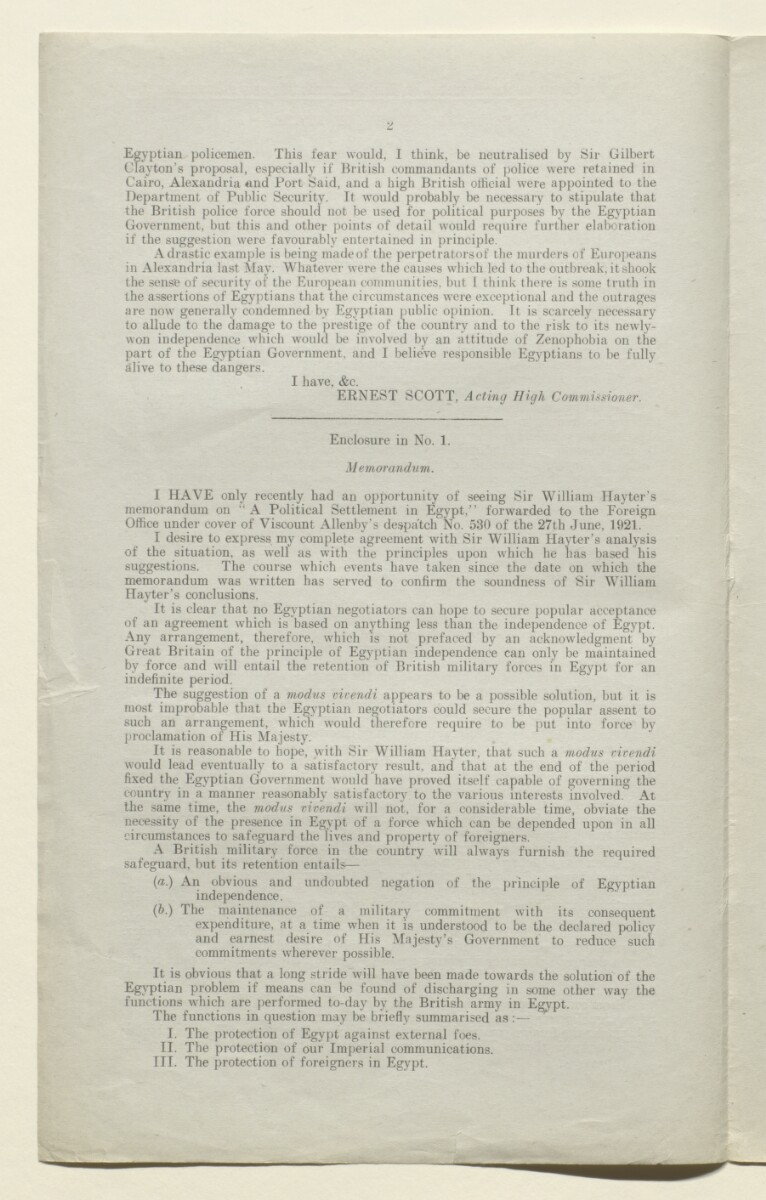
Egyptian policemen. This fear would, I think, be neutralised by Sir Gilbert
Clayton's proposal, especially if British commandants of police were retained in
Cairo, Alexandria «md Port Said, and a high British otficial were appointed to the
Department of Public Security. It would probably be necessary to stipulate that
the British police force should not be used for political purposes by the Egyptian
Government, but this and other points of detail would require further elaboration
if the suggestion were favourably entertained in principle.
A drastic example is being madeof the perpetrators of the murders of Europeans
in Alexandria last May. Whatever were the causes which led to the outbreak, it shook
the sense of security of the European communities, but 1 think there is some truth in
the assertions of Egyptians that the circumstances were exceptional and the outrages
are now generally condemned by Egyptian public opinion. It is scarcely necessary
to allude to the damage to the prestige of the country and to the risk to its newly-
won independence which would be involved by an attitude of Zenophobia on the
part of the Egyptian Government, and I believe responsible Egyptians to be fully
alive to these dangers.
T have &c
ERNEST SCOTT, Acting High Commissioner.
Enclosure in No. 1.
Memorandum.
I HAVE only recently had an opportunity of seeing Sir William Hay ter’s
memorandum on “A Political Settlement in Egypt,” forwarded to the Foreign
Office under cover of Viscount Allenby's despatch No. 530 of the 27th June, 1921.
I desire to express my complete agreement with Sir William Hayter’s analysis
of the situation, as well as with the principles upon which he has based his
suggestions. The course which events have taken since the date on which the
memorandum was written has served to confirm the soundness of Sir William
Hayter’s conclusions.
It is clear that no Egyptian negotiators can hope to secure popular acceptance
of an agreement which is based on anything less than the independence of Egypt.
Any arrangement, therefore, which is not prefaced by an acknowledgment by
Great Britain of the principle of Egyptian independence can only be maintained
by force and will entail the retention of British military forces in Egypt for an
indefinite period.
The suggestion of a modus vivendi appears to be a possible solution, but it is
most improbable that the Egyptian negotiators could secure the popular assent to
such an arrangement, which would therefore require to be put into force by
proclamation of His Majesty.
It is reasonable to hope, with Sir William Hayter, that such a modus vivendi
would lead eventually to a satisfactory result, and that at the end of the period
fixed the Egyptian Government would have proved itself capable of governing the
country in a manner reasonably satisfactory to the various interests involved. At
the same time, the modus vivendi will not, for a considerable time, obviate the
necessity of the presence in Egypt of a force which can be depended upon in all
circumstances to safeguard the lives and property of foreigners.
A British military force in the country will always furnish the required
safeguard, but its retention entails—
(a.) An obvious and undoubted negation of the principle of Egyptian
independence.
(5.) The maintenance of a military commitment with its consequent
expenditure, at a time when it is understood to be the declared policy
and earnest desire of His Majesty’s Government to reduce such
commitments wherever possible.
It is obvious that a long stride will have been made towards the solution of the
Egyptian problem if means can be found of discharging in some other way the
functions which are performed to-day by the British army in Egypt.
The functions in question may be briefly summarised as :—
I. The protection of Egypt against external foes.
II. The protection of our Imperial communications.
III. The protection of foreigners in Egypt.
About this item
- Content
The file contains official correspondence, memoranda, and reports relating to political affairs in Egypt. The correspondents and authors are officials at the Foreign Office (Lord Curzon was Secretary of State for Foreign Affairs at the time), War Office, Air Ministry, Admiralty, Colonial Office, Board of Trade, Board of Education, as well as those within the Egyptian civil service.
The file contains copies of reports of the Special Mission to Egypt (folios 1-7, 75-93, and 175-194), led by Lord Alfred Milner, whose purpose was to investigate and advise following the Egyptian Revolution of 1919. Much of the content of the file is in response to the findings and recommendations of the Mission and discusses the possibilities of a political settlement with Egypt.
- Extent and format
- 1 file (237 folios)
- Arrangement
The file is arranged in chronological order, from the front to the rear.
- Physical characteristics
Foliation: the foliation sequence (used for referencing) commences at the front cover with 1, and terminates at the inside back cover with 235; these numbers are written in pencil, are circled, and are located in the top right corner of the recto The front of a sheet of paper or leaf, often abbreviated to 'r'. side of each folio. The file has one foliation anomaly, f 76a.
- Written in
- English in Latin script View the complete information for this record
Use and share this item
- Share this item
Report of the Special Mission to Egypt under Lord Milner, and related papers [231v] (465/473), British Library: India Office Records and Private Papers, Mss Eur F112/260, in Qatar Digital Library <https://www.qdl.qa/archive/81055/vdc_100080131821.0x000042> [accessed 12 August 2026]
https://www.qdl.qa/en/archive/81055/vdc_100080131821.0x000042
Copy and paste the code below into your web page where you would like to embed the image.
<meta charset="utf-8"><a href="https://www.qdl.qa/en/archive/81055/vdc_100080131821.0x000042">Report of the Special Mission to Egypt under Lord Milner, and related papers [‎231v] (465/473)</a> <a href="https://www.qdl.qa/en/archive/81055/vdc_100080131821.0x000042"> <img src="https://iiif.qdl.qa/iiif/images/81055/vdc_100000001491.0x000295/Mss Eur F112_260_0465.jp2/full/!280,240/0/default.jpg" alt="" /> </a>
This record has a IIIF manifest available as follows. If you have a compatible viewer you can drag the icon to load it.https://www.qdl.qa/en/iiif/81055/vdc_100000001491.0x000295/manifestOpen in Universal viewerOpen in Mirador viewerMore options for embedding images
Copyright: How to use this content
- Reference
- Mss Eur F112/260
- Title
- Report of the Special Mission to Egypt under Lord Milner, and related papers
- Pages
- front, front-i, 2r:39v, 42r:50v, 53r:76v, 76ar:76av, 77r:140v, 143r:143v, 144ar, 144r:235v
- Author
- East India Company, the Board of Control, the India Office, or other British Government Department
- Usage terms
- Open Government Licence